The difference between single-stage and 2-stage PET stretch blow molding is one of the most frequently misunderstood specifications in PET packaging equipment. Buyers who select the wrong configuration encounter one of two outcomes: a single-stage machine that cannot scale beyond 1,500 BPH per cavity, or a 2-stage machine installed for a product that genuinely benefits from single-stage’s heat-retention economics. This guide explains the process difference, the technical specifications that determine output and quality, and the production scenarios where each configuration is the correct choice.
| Specification | Single-Stage (ISBM) | 2-Stage (RSBM) |
| Preform Source | Injection-molded in same machine | External preform supplier |
| Max Output (BPH/cavity) | 800–1,500 | 1,500–2,500+ |
| Preform Inventory Required | None | Yes (days to weeks) |
| Hot-Fill Capability | ✓ Superior (residual heat) | Limited (requires special preform) |
| Format Changeover | Longer (injection + blow mold change) | Faster (blow mold only) |
| Best Application | Wide-mouth jars, hot-fill, small batch | High-volume standard bottles (water, CSD, edible oil) |
Single-Stage vs 2-Stage: The Process Difference That Changes Everything
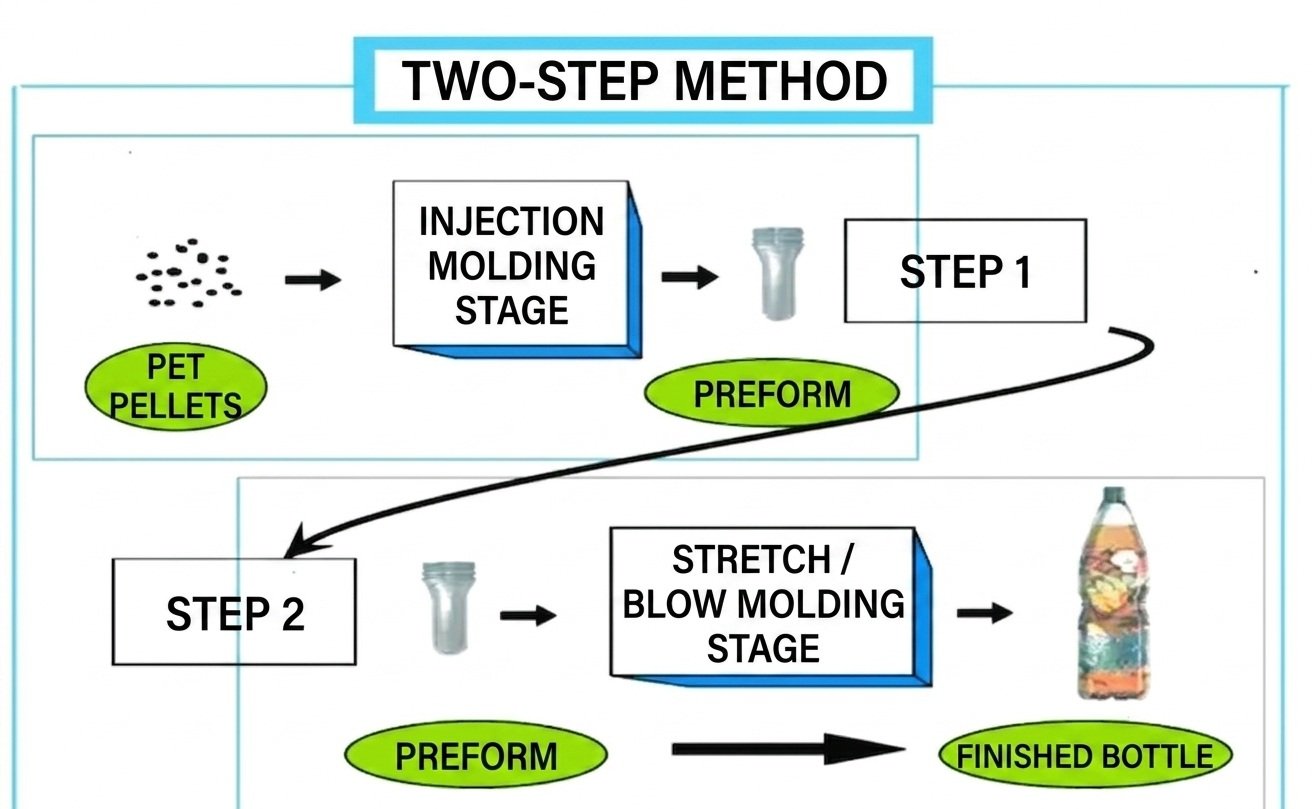
Most buyers encounter these two configurations when they realize that “PET blow molding machine” is not a single specification — it describes two fundamentally different production architectures that share only the final blowing step.
Single-Stage (Injection Stretch Blow Molding — ISBM)
In single-stage ISBM, preform injection and bottle blowing occur in the same machine in a continuous sequence. PET resin is injected into a preform cavity, cooled to the stretch temperature range (not fully cooled), transferred to the blow station while still retaining internal heat, and blown into the bottle mold. The preform never reaches ambient temperature between injection and blowing — it retains a controlled residual heat profile from injection.
This residual heat is the key characteristic of single-stage processing. It enables two capabilities that 2-stage machines cannot replicate:
- Hot-fill performance: The residual heat profile produces a bottle with higher crystallinity, improving resistance to thermal deformation at fill temperatures above 85°C — critical for hot-fill juice, tea, and isotonic beverage applications.
- Wide-mouth and non-standard neck geometry: The preform geometry is defined by the injection mold, not sourced from an external preform supplier — enabling custom neck diameters, wide-mouth jars (38mm–120mm), and complex preform geometries that are unavailable as standard external preforms.
The constraint: cycle time is governed by the injection step, which is slower than reheating a pre-manufactured preform. Maximum output is approximately 800–1,500 BPH per cavity — sufficient for small-to-medium production, but not for large-scale beverage lines.
2-Stage (Reheat Stretch Blow Molding — RSBM)
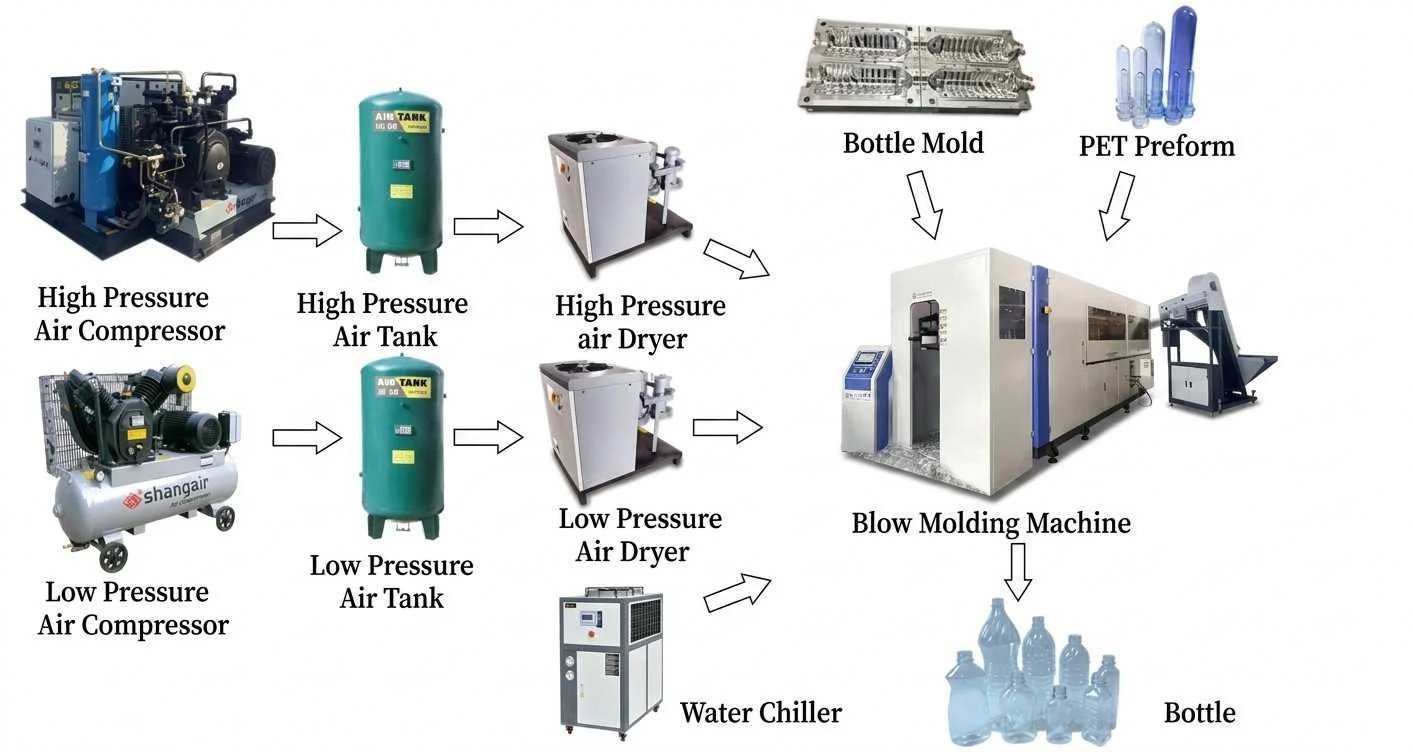
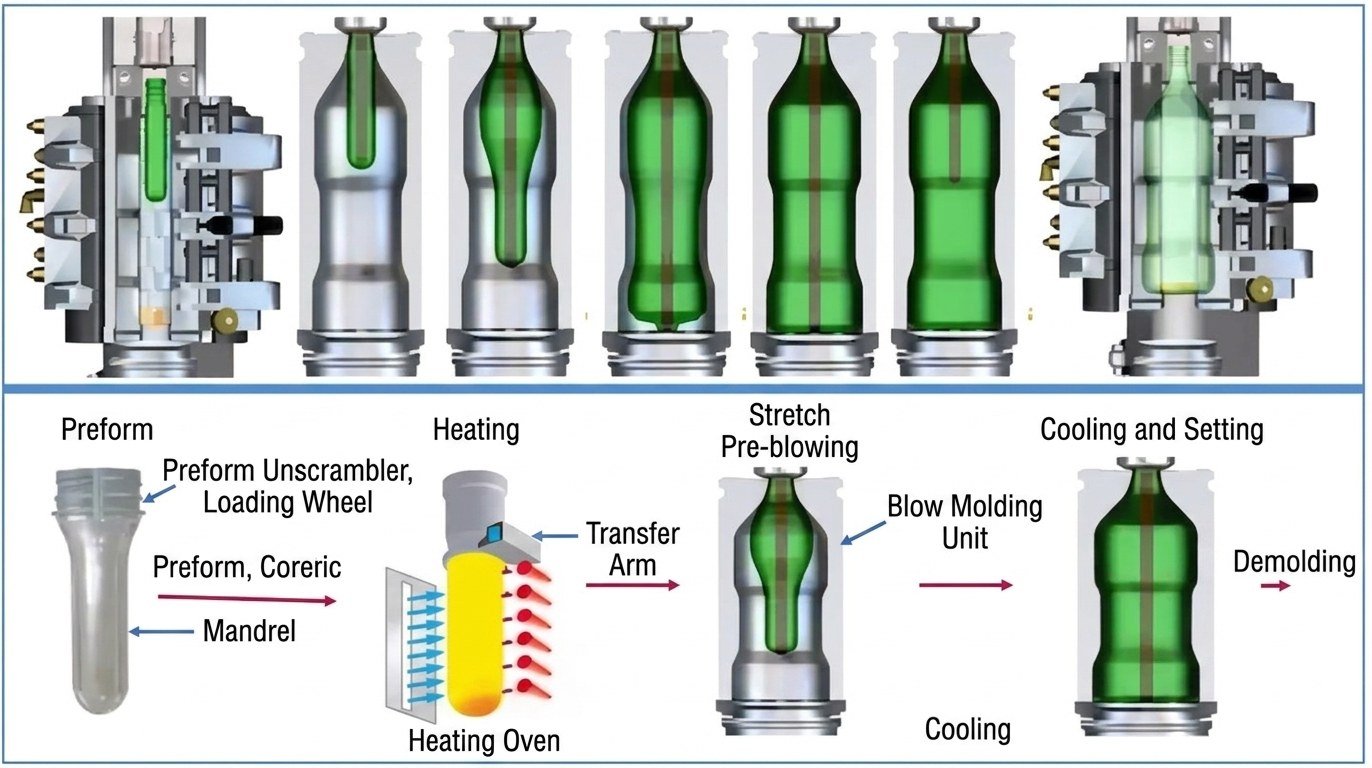
In 2-stage RSBM, preform manufacturing and bottle blowing are fully separated operations. Preforms are produced by a dedicated injection molding machine (or purchased from an external supplier), stored at ambient temperature, then fed into the reheat blow molding machine where they pass through an infrared oven, are reheated to stretch temperature, and blown into bottles.
The separation of injection and blowing eliminates the injection cycle time from the blow station’s output calculation. The blow station runs at its mechanical speed limit — typically 1,500–2,500+ BPH per cavity — with the preform inventory acting as a buffer.
This is why 2-stage machines dominate high-volume beverage production globally: a 6-cavity 2-stage machine can exceed 15,000 BPH on standard 500ml water bottles, a throughput that single-stage cannot approach at any commercially viable cavity count.
The trade-off: preform inventory must be managed, preform sourcing is a separate supply chain dependency, and the residual heat advantages of single-stage processing are lost — making 2-stage less suitable for hot-fill and non-standard preform geometries.
Not sure which stage configuration your application requires? Sailwin’s engineers will assess your bottle specification, fill temperature, and monthly volume to confirm the right configuration.
Get a Configuration Recommendation →
Process Flow Comparison: Where the Two Architectures Diverge
| Process Step | Single-Stage (ISBM) | 2-Stage (RSBM) |
| Step 1 | PET resin → injection molded preform (in-machine) | Pre-manufactured preform fed from hopper / inventory |
| Step 2 | Preform retains residual heat → transferred to blow station | Preform enters IR oven → reheated to stretch temperature |
| Step 3 | Stretch rod extends axially + blow air inflates radially | Stretch rod extends axially + blow air inflates radially |
| Step 4 | Bottle ejected → next injection cycle begins | Bottle ejected → next preform enters oven |
| Cycle Bottleneck | Injection cycle time (~12–20 sec) | Blow cycle time (~3–6 sec) |
| Output Ceiling | ~1,500 BPH/cavity | 2,500+ BPH/cavity |
Cavity Count and BPH: What the Numbers Mean for Your Production Plan
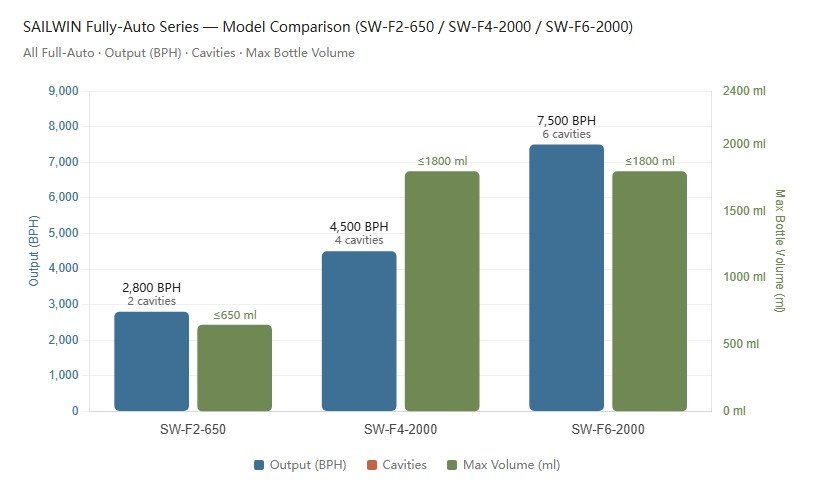
For 2-stage machines, output is determined by cavity count multiplied by BPH per cavity. The following figures are based on standard 500ml water bottle production at typical IR oven and blow station cycle times:
| Cavity Count | BPH Range (500ml) | Monthly Output (2 shifts) | Best For |
| 2-cavity | 3,000 – 5,000 | ~1,500,000 bottles | Market entry, multi-format operations |
| 4-cavity | 6,000 – 10,000 | ~3,000,000 – 4,000,000 bottles | Growth phase, established beverage producers |
| 6-cavity | 10,000 – 15,000+ | ~5,000,000 – 6,000,000 bottles | High-volume, stable format beverage lines |
Important: BPH ratings in supplier specifications are typically tested at optimal conditions — standard preform, room temperature, single bottle format, no changeover downtime. Real production efficiency is typically 80–90% of rated BPH. Plan your capacity requirement against 85% of rated output, not 100%.
How to Calculate Your Required Cavity Count
- Monthly bottle target ÷ 25 production days = daily target
- Daily target ÷ 16 operating hours (2 shifts) = required BPH
- Required BPH ÷ 0.85 (efficiency factor) = rated BPH needed
- Rated BPH ÷ BPH per cavity = minimum cavity count
Example: 3,000,000 bottles/month target:
3,000,000 ÷ 25 ÷ 16 = 7,500 BPH required → ÷ 0.85 = 8,824 rated BPH needed → ÷ 2,200 BPH/cavity = 4 cavities minimum → 4-cavity machine.
Want Sailwin to run this calculation for your production plan? Share your monthly target, bottle format, and shift pattern — we’ll specify the exact cavity count and machine model.
Key Technical Specifications to Verify on Any 2-Stage PET Stretch Blow Molding Machine
Beyond cavity count, these five specifications determine whether the machine will consistently meet your quality and output requirements over a 10-year operating life.
1. IR Heating Zone Count and Independent Control
The IR oven heats the preform to the correct stretch temperature profile before the blow station. More independently controlled heating zones give finer temperature distribution across the preform length — critical for consistent wall thickness in the finished bottle. Minimum acceptable: 5 independently controlled zones. Better machines offer 8–12 zones with individual power adjustment. Fewer zones produce inconsistent heating profiles, especially for non-standard preform geometries.
2. Stretch Rod Speed and Stroke Control
The stretch rod extends into the preform axially before radial blow begins. Stretch rod speed and the timing of blow pressure introduction relative to rod extension determine the biaxial orientation ratio — which governs wall thickness distribution, clarity, and CO₂ barrier performance. Servo-controlled stretch rod systems give more precise and repeatable control than hydraulic systems, particularly at high BPH.
3. Blow Pressure Range (High and Low Pressure)
Two-stage blow is standard: low pressure (8–12 bar) for initial pre-blow, high pressure (25–40 bar) for final forming. The high-pressure specification determines the minimum wall thickness achievable — critical for lightweight bottle designs below 10 grams for 500ml. Confirm both stages are independently programmable.
4. Mold Cooling System
Water-cooled molds are standard. Confirm the cooling water flow rate specification per mold cavity and the mold material (P20 steel standard; hardened steel for longer tooling life at high volumes). Inadequate cooling limits BPH — the machine cannot cycle faster than the bottle can solidify in the mold.
5. PLC and Servo System Brand
Siemens or Mitsubishi PLC for the control system; servo motors from reputable brands (Yaskawa, Panasonic, or equivalent) for stretch rod and mold movement. Generic control systems are the most common cause of unresolvable field failures in machines operating far from the manufacturing country. Always confirm component brands before purchase.
When to Choose Single-Stage vs 2-Stage: The Decision Matrix
| Choose Single-Stage (ISBM) When | Choose 2-Stage (RSBM) When |
| Hot-fill product (above 85°C fill temperature) | Still water, CSD, cold-fill juice, edible oil |
| Wide-mouth jar (38mm+ neck diameter) | Standard neck finish (PCO 1881, 3025, etc.) |
| Custom preform geometry unavailable from suppliers | Standard preform available from multiple suppliers |
| Monthly volume under 1,000,000 bottles | Monthly volume above 1,000,000 bottles |
| Multiple small-batch formats with frequent changeover | Stable high-volume format with minimal changeover |
| Cosmetic / premium packaging requiring complex geometry | Standard round beverage bottle at maximum output |
Sailwin’s 2-stage PET stretch blow molding machines are available in 2-cavity, 4-cavity, and 6-cavity configurations for standard round bottle production, plus high-speed PET blow molding machines for maximum-output beverage lines. For wide-mouth and specialty formats, see the wide-neck PET blow molding machine range. All models are part of the fully automatic PET blow molding machine line.
Your application doesn’t fit cleanly into one column? Describe your product — bottle format, fill temperature, monthly volume — and Sailwin will confirm which configuration is correct with engineering justification.
Get a Configuration Recommendation →
Case Study: Juice Producer Selects Correct Stage Configuration and Avoids $60,000 Error
The Situation
A juice producer in North Africa needed a PET blow molding machine for hot-fill juice at 88°C fill temperature, producing a proprietary bottle with a 45mm wide-mouth neck for easy-pour dispensing. Initial RFQ went to three suppliers, all of whom quoted 2-stage machines as the standard recommendation.
The Engineering Review
Sailwin’s application team identified two specification conflicts with 2-stage:
- 88°C hot-fill requires higher bottle crystallinity than standard 2-stage cold-blow can reliably achieve without a dedicated heat-set mold system — adding significant cost and complexity
- 45mm wide-mouth neck is a non-standard preform geometry unavailable from regional preform suppliers — requiring custom preform injection tooling regardless of machine type
Correct specification: single-stage ISBM — the residual heat from injection produces natural crystallinity suitable for 88°C hot-fill, and the preform injection mold produces the custom 45mm geometry in-machine, eliminating the external preform supply chain dependency entirely.
The Outcome
Customer received a single-stage machine 22% lower in price than the 2-stage heat-set alternative. Preform supply chain simplified to in-house production. Hot-fill validation passed at 90°C without additional treatment. The correct configuration saved approximately $60,000 vs. the most expensive 2-stage alternative — and delivered better hot-fill performance.
Frequently Asked Questions
What is a 2-stage PET stretch blow molding machine?
A 2-stage PET stretch blow molding machine (also called reheat stretch blow molding or RSBM) is a machine that produces PET bottles from pre-manufactured preforms in two separate operations. Stage 1: preform manufacturing (injection molding, done separately or externally). Stage 2: preform reheating in an IR oven and blowing into a bottle mold. The separation of stages allows the blow station to run at its mechanical speed limit, achieving 1,500–2,500+ BPH per cavity — significantly higher than single-stage configurations.
What is the difference between single-stage and 2-stage PET blow molding?
Single-stage (ISBM) combines preform injection and bottle blowing in one machine. The preform is blown while still retaining heat from injection — enabling hot-fill performance and custom preform geometries. 2-stage (RSBM) separates preform manufacturing from blowing. Preforms are stored and fed into the blow machine from inventory, then reheated and blown. 2-stage achieves higher BPH but loses the residual heat advantages of single-stage.
Which is better for water and CSD bottles — single-stage or 2-stage?
2-stage. Still water, carbonated soft drinks, juice (cold-fill), and edible oil are all cold-fill applications that do not require the hot-fill capability of single-stage. 2-stage machines produce these bottles at significantly higher BPH and lower per-bottle cost at volume above 1,000,000 bottles/month. Single-stage is the correct choice only when hot-fill or non-standard preform geometry is required.
How many bottles per hour can a 2-stage PET blow molding machine produce?
Output depends on cavity count and bottle format. For 500ml standard round bottles: 2-cavity produces approximately 3,000–5,000 BPH; 4-cavity 6,000–10,000 BPH; 6-cavity 10,000–15,000+ BPH. Real production efficiency is typically 80–90% of rated output. Always plan capacity against 85% of the manufacturer’s rated BPH, not the headline specification.
Do I need to buy preforms separately for a 2-stage machine?
Yes. A 2-stage machine requires pre-manufactured PET preforms as input. These can be purchased from external preform suppliers (common for standard neck finishes like PCO 1881) or produced in-house with a separate injection molding machine. Preform inventory management becomes part of your production planning — factor 3–7 days of preform buffer stock into your logistics model.
Can a 2-stage PET machine produce wide-mouth jars?
It depends on preform availability. Standard wide-mouth preforms (up to 38mm) are available from some suppliers. For larger neck diameters (45mm+), external preform supply is typically unavailable — making single-stage the practical choice. For wide-mouth applications, see Sailwin’s wide-neck PET blow molding machine.
What preform IV (intrinsic viscosity) should I use for a 2-stage PET machine?
Standard PET preforms for beverage bottles: IV 0.72–0.82 dL/g. Higher IV (0.80–0.84 dL/g) for CSD bottles requiring higher CO₂ barrier. Lower IV (0.70–0.76 dL/g) for still water where lightweight and clarity are the primary requirements. Always confirm preform IV specification with your preform supplier and verify against the machine manufacturer’s recommended processing range.
What is the PET stretch blow molding machine price range?
2-stage PET stretch blow molding machine pricing varies by cavity count, automation level, and component specification. Entry-level 2-cavity machines start from a lower price point; 6-cavity high-speed machines with Siemens PLC and servo systems are at the upper end. For an accurate price against your specific bottle format and output requirement, contact Sailwin for a factory-direct quote — pricing without a specification is not meaningful for capital equipment of this type.
Summary
The choice between single-stage and 2-stage PET stretch blow molding is determined by three questions: Does your product require hot-fill? Does your bottle require a custom or wide-mouth preform geometry? Is your monthly volume above 1,000,000 bottles? If the answer to any of the first two is yes, single-stage warrants serious evaluation. If your volume is high and your product is cold-fill with a standard neck, 2-stage is the correct configuration.
Sailwin’s 2-stage PET stretch blow molding machines — from 2-cavity to 6-cavity — are engineered for continuous high-volume production with Siemens PLC control, independent IR heating zones, and servo stretch rod systems. All machines are CE and ISO 9001 certified, with full technical documentation available before any payment commitment. For a complete view of the PET range, see the Sailwin blow molding machine overview.
Get a Technical Specification and Factory-Direct Quote →