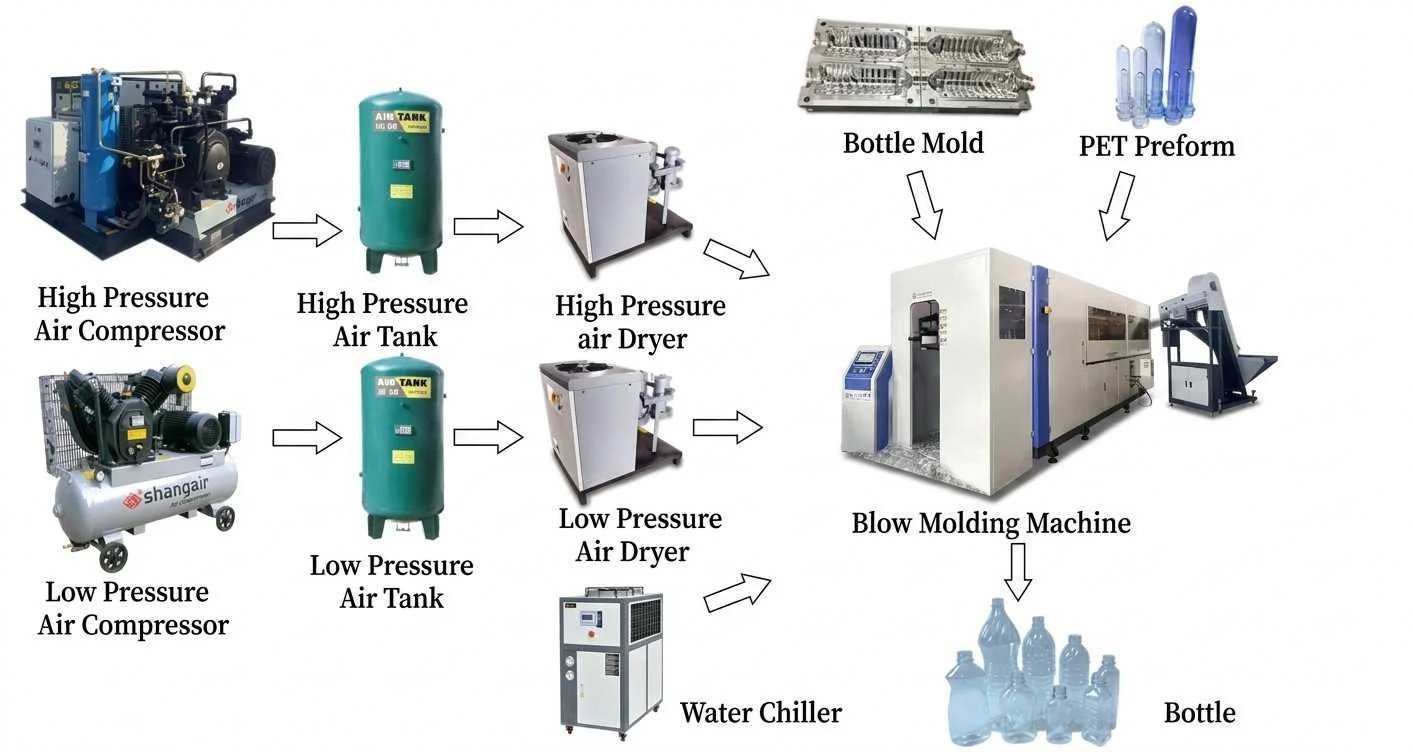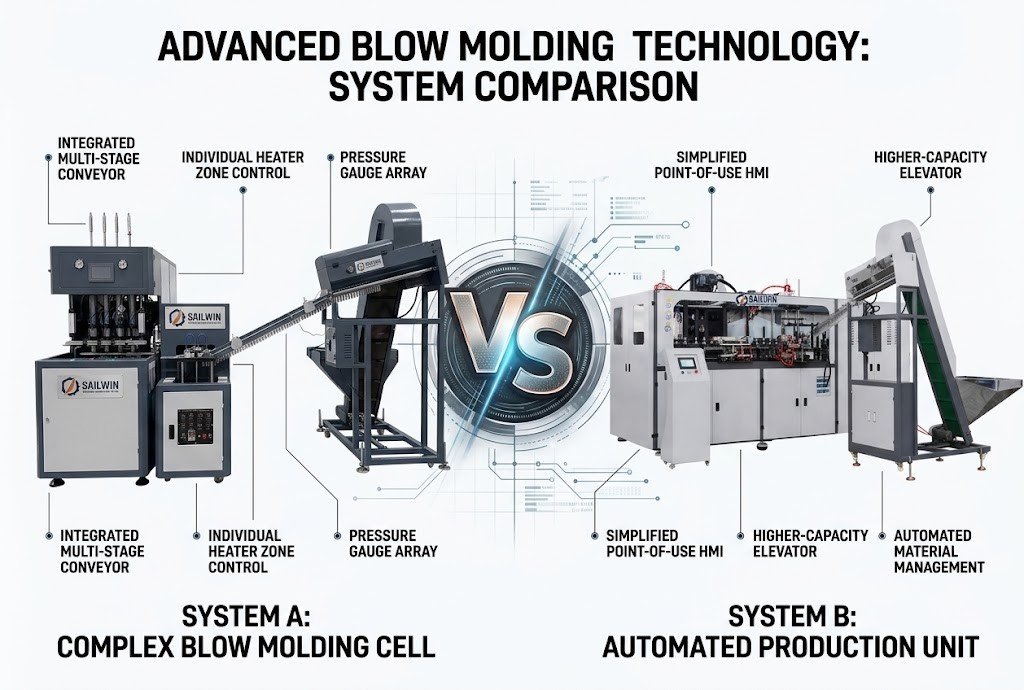
Choosing the right PET blow molding machine is one of the most capital-intensive decisions a packaging manufacturer faces. The wrong machine choice leads to production bottlenecks, excessive scrap rates, and costly equipment swaps within 18 months. This guide covers machine types, key specs, preform selection, supplier evaluation, and pricing factors — so you can make a confident, data-backed purchase decision the first time.
| Factor | What to Know |
| Machine Type | Semi-auto / Fully auto / Linear / Rotary |
| Key Material | PET preform heated and stretch-blown into finished bottle |
| Cavity Count | 2 / 4 / 6 cavities — directly determines output per hour |
| Certifications | CE & ISO 9001 required for most export markets |
| Typical Lead Time | 30–60 days ex-factory (standard models) |
What Is a PET Blow Molding Machine and How Does It Work?
Most buyers who end up with the wrong machine made the same mistake: they evaluated price and output speed without understanding the underlying process. A mismatch at the process level — for example, trying to run PET bottles on an extrusion blow molding machine — cannot be fixed with settings or operator skill. It requires replacing the machine entirely.
A PET blow molding machine transforms PET preforms into finished plastic bottles through a controlled three-stage stretch blow molding process.
From PET Preform to Finished Bottle — The 3-Step Process
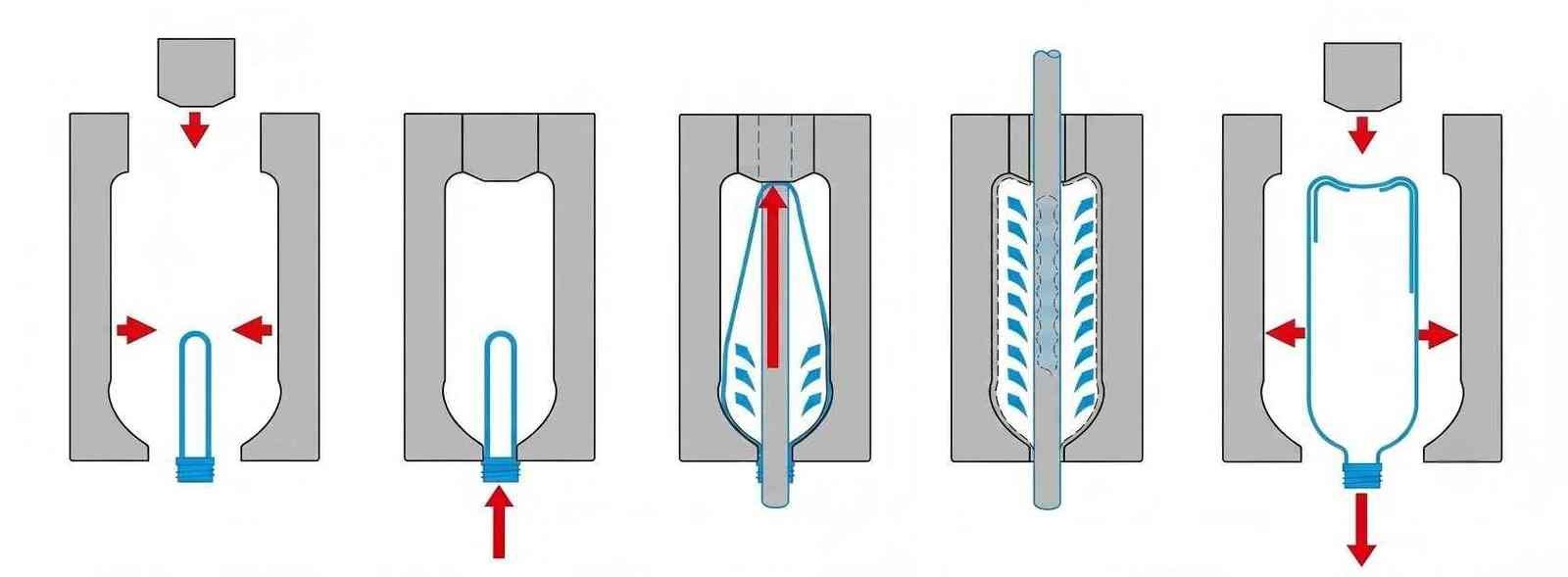
- Heating: PET preforms pass through an infrared (IR) heating oven. Lamp count and independently controlled temperature zones determine how evenly the preform wall is heated. Uneven heating is the root cause of wall-thickness variation and bottle collapse at the filling line.
- Stretching: A mechanical stretch rod extends axially, orienting PET molecules longitudinally. This biaxial orientation is what gives PET bottles their crystal clarity, pressure resistance, and drop-impact strength — none of which extrusion blow molding can replicate in PET.
- Blowing: High-pressure air (25–40 bar) inflates the preform against the mold cavity wall. The bottle takes the exact shape of the mold in under 3 seconds per cycle.
Stretch Blow Molding vs Extrusion Blow Molding — Which Is for PET?
| Process | Material | Typical Application | Wall Clarity |
| Stretch Blow Molding (SBM) | PET, PP | Water, CSD, juice, cosmetic bottles | Crystal clear |
| Extrusion Blow Molding (EBM) | HDPE, PP, PA | Jerrycans, fuel tanks, chemical containers | Translucent / opaque |
Bottom line: PET bottles — from 100ml water bottles to 5-gallon containers — require stretch blow molding. Extrusion blow molding is for HDPE/PP industrial containers. Confirm which process your supplier’s machine uses before any deposit is paid.
Need to confirm the right machine type for your bottle? Sailwin’s engineers provide free technical consultation — including process selection, preform specification, and output planning — before you commit to any purchase.
4 Main Types of PET Blow Molding Machines
Buyers frequently over-specify or under-specify machine type. A rotary high-speed machine quoted at a “competitive” price becomes a liability when your volume doesn’t justify the complexity — operator training, spare parts inventory, and maintenance schedules all scale with machine complexity. Equally, a semi-automatic machine that maxes out at 1,500 BPH will strangle a growing beverage line within two years.
| Type | Best For | Typical Output (BPH) | Automation Level |
| Semi-Automatic | Startups, small batch, wide-mouth jars | 500–1,500 | Manual preform loading |
| Fully Automatic (Linear) | Mid-volume beverage & personal care lines | 2,000–8,000 | Fully automated |
| Rotary | High-speed CSD & water lines | 8,000–24,000+ | Fully automated |
| High-Speed Linear | Versatile bottle shapes at high throughput | 6,000–12,000 | Fully automated |
Semi-Automatic PET Blow Molding Machine — When It Makes Sense
Semi-automatic machines require an operator to load preforms manually. This is the right entry point when monthly volume is under 300,000 bottles, when you run multiple bottle formats with frequent changeovers, or when capital budget is the primary constraint. The lower upfront cost allows faster payback and lower risk during market entry.
Sailwin’s semi-automatic PET blow molding machine series — including the SW-2000-2 model — is engineered for reliable output with minimal operator training requirements.
Fully Automatic PET Blow Molding Machine — The Production Workhorse
Fully automatic machines integrate preform loading, heating, blowing, and ejection without manual intervention. For volumes above 2,000 BPH, labor savings alone typically justify the higher upfront investment within 12–18 months. Sailwin’s automatic PET blow molding machine range covers 2-cavity to 6-cavity configurations, engineered for continuous 24/7 operation.
2-Cavity vs 4-Cavity vs 6-Cavity — How Cavity Count Affects ROI
Cavity count is the single biggest lever on cost-per-bottle. More cavities mean more bottles per cycle — but also higher mold tooling cost and more demanding heating uniformity requirements. Match cavity count to your verified volume forecast, not your aspirational forecast.
- 2-Cavity PET blow molding machine — entry-level fully automatic; ideal for 500ml–2L standard bottles
- 4-Cavity PET blow molding machine — the most popular mid-range configuration for growing beverage lines
- 6-Cavity PET blow molding machine — high-output for established lines with predictable, high-volume demand
Not sure which cavity configuration fits your volume? Send us your monthly bottle target and bottle size — we’ll recommend the right model and provide a factory-direct price within 24 hours.
Get a Configuration Recommendation →
Key Specifications to Check Before You Buy
Price comparison between suppliers is meaningless without a specification-level comparison. Suppliers quoting the same “8,000 BPH / 4-cavity” machine can deliver vastly different real-world performance depending on heating system design, control system quality, and clamping precision. Here are the four spec categories that matter most.
1. Bottle Volume Range & Neck Size Compatibility
Confirm the machine handles your exact bottle volume (330ml, 500ml, 1.5L, 5-gallon) and neck finish (28mm PCO 1881 for CSD; 38mm or 48mm for wide-mouth). A machine optimized for small bottles cannot efficiently produce large-format containers without significant tooling modifications — which suppliers rarely disclose upfront.
2. Heating System — IR Lamp Count & Zone Control
More independently controlled heating zones = more precise temperature distribution = fewer defective bottles. Poor heating uniformity is the root cause of most wall-thickness variation, bottle collapse, and whitening defects. Specify minimum zone count in your purchase contract, not just total wattage.
3. Clamping Force & Mold Change Time
Higher clamping force ensures dimensional accuracy under high blowing pressure (up to 40 bar). Mold change time directly impacts downtime between bottle formats — critical for contract bottlers running 3–5 SKUs on one line. Ask for a timed mold-change demonstration before accepting delivery.
4. Output Speed (BPH) vs Actual Production Efficiency
Published BPH is measured at optimal lab conditions. Demand OEE (Overall Equipment Effectiveness) data from real customer installations. A machine rated at 8,000 BPH running at 85% OEE outperforms a 10,000 BPH machine at 65% OEE — and costs less per bottle produced.
| Spec | Semi-Auto | Fully Auto (4-Cavity) | High-Speed (6-Cavity) |
| Output (BPH) | 500–1,500 | 4,000–6,000 | 8,000–12,000 |
| Heating Zones | 3–5 | 6–8 | 8–12 |
| Blowing Pressure | 25–30 bar | 30–38 bar | 35–40 bar |
| Mold Change Time | 30–60 min | 20–40 min | 15–30 min |
| Certifications | CE, ISO 9001 | CE, ISO 9001 | CE, ISO 9001 |
Want Sailwin’s full specification sheet for your target bottle? Share your bottle volume, neck size, and monthly output target — we’ll send a detailed technical spec within 24 hours.
Request Full Technical Specs →
PET Preform Selection — The Factor Most Buyers Overlook
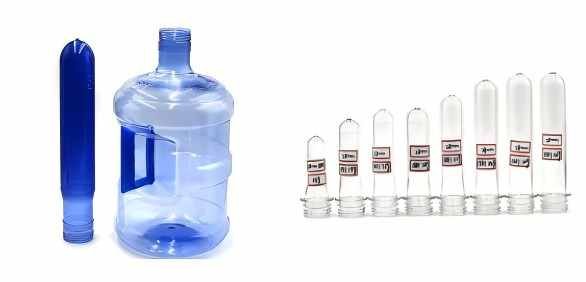
Here is a scenario that repeats itself across factories every year: the machine arrives, installation goes smoothly, operators run the first production batch — and within two days, bottles are deforming at the filling line, walls are uneven, or reject rates exceed 8%. The machine gets blamed. The actual cause is almost always the preform specification.
The machine is only as good as the preform fed into it. Three preform parameters determine bottle quality:
- Gram weight: Determines wall thickness. An undersized preform for a 1.5L bottle produces fragile walls that deform under filling pressure. An oversized preform inflates material cost by 10–15% per bottle. Use the manufacturer’s gram weight table for your exact bottle volume.
- Neck finish: Must match your filling line’s cap specification exactly. 28mm PCO 1881 is the global standard for CSD and water; 38mm and 48mm are standard for wide-mouth food and cosmetic jars.
- IV (Intrinsic Viscosity): Bottle-grade PET requires IV of 0.72–0.84 dL/g. Below this range, bottles lack structural integrity. Above this range, processing temperature and cycle time increase, reducing output efficiency.
Common mistake that costs money: Using identical gram weight preforms for still water bottles and CSD bottles of the same volume. CSD bottles must withstand internal carbonation pressure of 3.5–5 bar — requiring 10–15% heavier preforms than equivalent still water bottles.
Sailwin provides preform specification recommendations with every machine order — including gram weight table, neck finish compatibility, and resin IV guidance for your specific bottle portfolio.
Get Preform Specs With Your Quote →
How to Evaluate a PET Blow Molding Machine Supplier
A blow molding machine purchase is a 10–15 year relationship with your supplier. The machine’s purchase price is typically 30–40% of its total lifetime cost — maintenance, spare parts, downtime, and support make up the rest. Evaluating only upfront price is how buyers end up with an orphaned machine and no support within 3 years.
These seven criteria separate reliable manufacturers from low-cost risks:
- CE & ISO 9001 Certification: Non-negotiable for EU, Middle East, and most emerging-market customs clearance. Ask for the certificate number and verify it independently — counterfeits exist.
- Factory Verification: Request a live video factory tour or an in-person visit before signing. Legitimate manufacturers with real production capacity welcome this. Refusal or excessive delay is a red flag.
- Spare Parts Response Time: Confirm that common wear parts — IR heating lamps, seals, solenoid valves — are either warehoused locally or can be shipped within 48 hours. A line down for one week waiting on parts costs more than the original price difference between suppliers.
- Delivery Timeline in Writing: Standard models: 30–45 days. Custom mold configurations: 45–70 days. Get this in the contract with penalty terms, not just a verbal assurance.
- Pre-Shipment Trial Blow Video: Before the machine ships, request a video showing your exact bottle being blown at rated speed. Reputable suppliers treat this as standard procedure.
- Verifiable Customer References: Ask for 2–3 customer contacts in your region. A supplier claiming 60+ country installations should be able to provide verifiable references without hesitation.
- Mold Customization Capability: Confirm the supplier’s in-house mold manufacturing capability for your specific bottle geometry — oval, square, handled, or asymmetric designs require tooling expertise beyond standard round bottles.
Sailwin offers factory video tours, pre-shipment trial blow reports, and verified customer references for all models. CE and ISO 9001 certificate numbers are available on request.
Request Factory Tour & References →
PET Blow Molding Machine Price — What Drives the Cost?
Two quotes for “the same machine” can differ by 40–60%. Without understanding what drives that gap, buyers either overpay for unnecessary features or underpay for a machine that underperforms. Five factors account for most of the price variation:
- Cavity Count: Each additional cavity increases mold complexity, heating system precision requirements, and clamping mechanism cost. The price curve is non-linear — a 6-cavity machine costs significantly more than 3× a 2-cavity machine.
- Automation Level: Fully automatic systems with integrated preform feeders, bottle conveyors, and PLC-controlled sorting cost significantly more than semi-automatic base configurations. Calculate the 2-year labor cost differential before deciding automation is “too expensive.”
- Control System Brand: Mitsubishi or Siemens PLCs and servo drives deliver measurably lower downtime and longer service life versus generic Chinese-brand equivalents. The premium is real but so is the ROI over a 10-year machine lifespan.
- Mold Material: Aluminum molds cost less and ship faster; steel molds last 3–5× longer for high-volume production runs. Confirm exactly which material is included in the quoted price — some suppliers default to aluminum and charge a premium for steel as an “upgrade.”
- After-Sales Package: On-site installation, operator training, and a 12-month spare parts warranty protect your investment. A machine purchased without this support structure costs more in the long run than one purchased with it.
Sailwin provides itemized, line-by-line quotations within 24 hours — machine spec, mold configuration, control system brand, and Incoterms breakdown. No hidden costs, no package bundling you didn’t ask for.
Case Study: How a Beverage Startup Scaled from 800 to 5,200 BPH
Customer Challenge
A Southeast Asian still water startup needed to begin production within 60 days on a constrained capital budget. Demand projections were uncertain — committing to a high-capacity fully automatic line carried too much financial risk for a brand with no proven sales volume.
Sailwin’s Solution
Phase 1: A 2-cavity semi-automatic PET blow molding machine — lower upfront investment, 35-day delivery, and operator training completed within 3 days of installation. Monthly output: approximately 480,000 bottles at one shift.
Phase 2 (14 months later): As monthly volume crossed 800,000 bottles and a second retail chain listing was secured, the customer upgraded to Sailwin’s 4-cavity fully automatic machine. Critically, the same mold tooling from Phase 1 was compatible with the new machine — eliminating retooling cost entirely.
Results
- Output increased from 800 BPH to 5,200 BPH — a 6.5× throughput gain
- Per-bottle production cost reduced by 38% through labor elimination and higher throughput
- Full ROI on the Phase 2 machine achieved within 11 months of installation
- Zero production downtime during the machine transition — mold compatibility was preserved across both phases
Planning a phased scale-up? Sailwin engineers your mold tooling for cross-model compatibility from Day 1 — so your Phase 1 investment carries forward when you scale.
Frequently Asked Questions
What is a PET blow molding machine?
A PET blow molding machine uses stretch blow molding technology to transform PET preforms into finished plastic bottles. The process heats the preform, stretches it mechanically with a rod, then inflates it with high-pressure air inside a mold cavity — producing clear, strong, lightweight bottles in a single automated cycle.
How is PET blow molding different from injection molding?
Injection molding produces solid plastic parts or preforms by injecting molten plastic into a closed mold. PET blow molding takes those preforms and uses heat and air pressure to expand them into hollow bottles. The two processes are complementary — injection molding makes the preform; the PET blow molding machine makes the bottle.
How many bottles per hour can a PET blow molding machine produce?
Output depends on cavity count and machine type. Semi-automatic 2-cavity machines produce 500–1,500 BPH. Fully automatic 4-cavity machines produce 4,000–6,000 BPH. High-speed 6-cavity configurations reach 8,000–12,000 BPH for 500ml bottles under optimal conditions.
What bottle sizes can PET blow molding machines make?
Sailwin’s machines cover bottle volumes from 100ml to 20L, including standard water and beverage bottles (330ml, 500ml, 1L, 1.5L, 2L), 5-gallon PET containers, and wide-neck PET jars for food and cosmetic applications. Each bottle size requires a dedicated mold.
Do I need CE certification for a PET blow molding machine?
CE certification is mandatory for machinery imported into the European Union and is increasingly required by customs authorities in the Middle East, Southeast Asia, and Latin America. Sailwin machines carry CE and ISO 9001 certification. Always request the certificate number and verify its validity before signing any purchase contract.
What is the minimum order quantity (MOQ) for a PET blow molding machine?
There is no MOQ — machines are purchased individually. However, ordering molds for multiple bottle formats simultaneously typically reduces per-format tooling cost by 15–25%.
How long does it take to receive a PET blow molding machine from China?
Standard models: 30–45 days production lead time. Custom mold configurations: 45–70 days. Ocean freight from China adds 20–35 days depending on destination. Plan for 60–90 days total from order confirmation to machine ready for production.
Can the machine be customized for special bottle shapes?
Yes. Sailwin’s in-house mold engineering team designs tooling for oval, square, asymmetric, handled, and other non-standard bottle geometries. Provide a 3D drawing or a physical sample bottle for a mold feasibility and cost assessment.
Summary
Selecting the right PET blow molding machine comes down to four decisions: matching machine type and cavity count to your verified volume requirements, specifying correct preform parameters before production begins, evaluating suppliers on total cost of ownership rather than purchase price alone, and securing CE/ISO certification documentation before any payment is made.
Key decisions to resolve before requesting quotes:
- Monthly bottle volume target → determines semi-auto vs. fully auto and cavity count
- Bottle volume range and neck finish → determines mold configuration
- Preform gram weight and resin IV → prevents wall defects and reject rate spikes
- Supplier CE/ISO certification and verifiable customer references → protects your capital
Sailwin has delivered PET blow molding machines to customers in 60+ countries, covering the full range from entry-level semi-automatic to high-speed 6-cavity fully automatic systems. All machines are CE and ISO 9001 certified, with factory-direct pricing, pre-shipment trial blow reports, and on-site installation support included as standard.
Get a Free Quote for Your PET Blow Molding Machine →