Choosing between a fully automatic and semi-automatic PET blow molding machine — or more broadly, a PET bottle blowing machine of either type — is one of the highest-stakes decisions in setting up a bottle production line. Get it right and your capital works efficiently from Day 1. Get it wrong and you either hit a production ceiling in 14 months or carry a machine running at 40% capacity for years. This guide gives you the exact framework — including a 3-year Total Cost of Ownership comparison built on real production economics — to make the right call for your operation.
| Factor | Semi-Automatic | Fully Automatic |
| Output (BPH, 500ml) | 800–1,500 | 2,000–12,000+ |
| Operator Requirement | 1 per machine per shift | 0–1 per line |
| Upfront Investment | Lower | Higher |
| 3-Year TCO (2-cavity baseline) | ~$98,000 | Lower at scale |
| Best For | Startup / <500K bottles/month | >800K bottles/month |
| Mold Upgrade Path | ✓ Compatible with Sailwin auto line | ✓ Cross-model compatible |
What Actually Separates These Two Machine Types — Beyond the Name
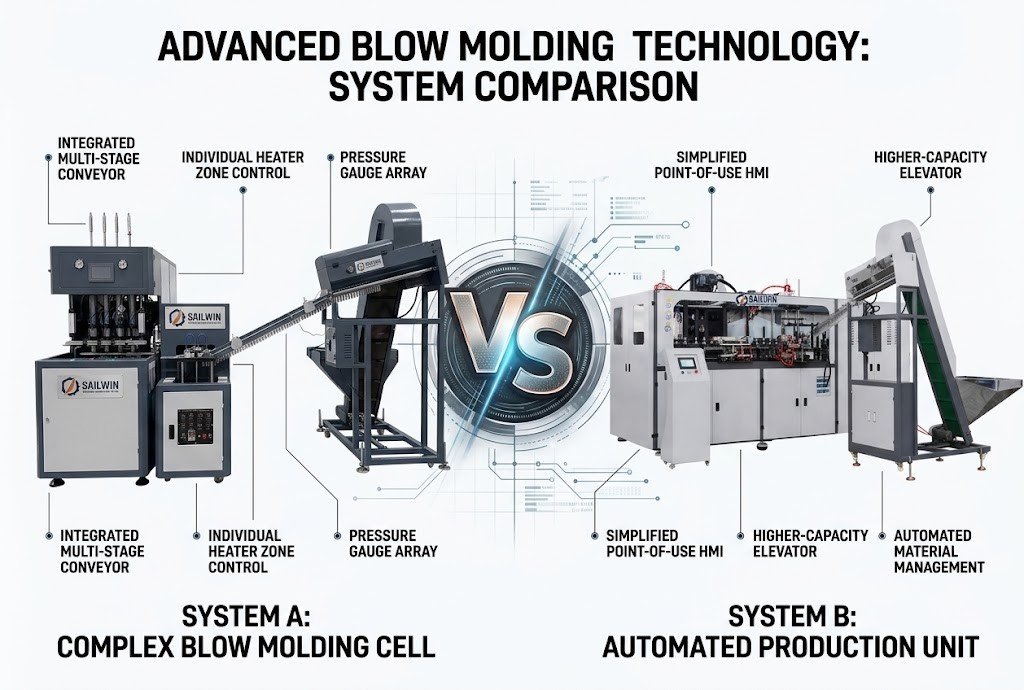
Most buyers assume the only difference is a preform loading conveyor. The reality is more significant: fully automatic machines integrate the entire production cycle — preform feeding, orientation, heating, blowing, and bottle ejection — into a single uninterrupted closed loop. Semi-automatic machines require a human operator to load preforms into the heating mandrels at each cycle.
Whether you are evaluating a semi-automatic PET stretch blow molding machine for market entry or a fully automatic PET bottle blowing machine for scaling production, this single operational difference drives nearly every downstream consequence:
- Labor dependency: A semi-automatic machine running 2 shifts requires at least 2 operators per machine, per day — often 3 when accounting for breaks and shift overlaps. A fully automatic machine requires 1 operator to monitor the entire line.
- Output ceiling: A semi-automatic machine is physically limited by operator loading speed. Fully automatic machines run at mechanical cycle speed — consistently, 24 hours a day, without fatigue.
- Format flexibility: Semi-automatic machines handle a wider range of bottle neck diameters and unusual shapes with less retooling friction — an advantage for wide-mouth jars and cosmetic bottles that fully automatic high-speed lines cannot always accommodate efficiently.
Not sure which category of blow molding machine fits your product line? Our full range covers both PET and EBM configurations.
When Semi-Automatic Is the Right Choice
Semi-automatic is not the inferior choice — it is the correct choice in specific, well-defined circumstances. Buying a fully automatic machine when your volume does not justify it is as costly a mistake as the reverse.
Choose semi-automatic when:
- Your monthly bottle volume is under 500,000 bottles on a single shift
- You produce multiple bottle formats with frequent changeovers (wide-mouth jars, cosmetic bottles, non-standard neck sizes)
- Initial capital budget is the binding constraint and payback period is a primary concern
- You need production running within 35 days of order confirmation
- You are entering a new market and volume certainty is low in Year 1
Sailwin’s semi-automatic PET blow molding machine range — including the SW-2000-2 model — is engineered with the same mold tooling dimensions as the fully automatic line, so your Phase 1 investment carries forward to a fully automatic upgrade with zero retooling cost.
Not sure if your volume justifies the jump to fully automatic? Sailwin engineers provide free pre-purchase output planning — send us your monthly target and bottle format.
Get a Free Output Planning Consultation →
When Fully Automatic Pays for Itself
The financial case for fully automatic is built on one equation: at what monthly volume do the labor savings recover the price premium?
For a standard 2-shift operation with operators earning $12,000/year (mid-cost region baseline), a semi-automatic machine requires 4 operators per machine per day. A fully automatic machine of equivalent output requires 1. At 800,000 bottles/month, the labor cost differential alone recovers the fully automatic machine’s premium within 12–18 months.
Choose fully automatic when:
- Monthly volume is consistently above 800,000 bottles
- You run 2 shifts or plan to scale to 2 shifts
- Your product mix is stable — fewer format changeovers, higher volume per SKU
- Labor cost is a significant fraction of your production economics
- You need 24/7 continuous production capability
Sailwin’s automatic PET blow molding machine range covers 2-cavity, 4-cavity, and 6-cavity configurations — all engineered for continuous 24/7 operation.
Ready to calculate your labor savings? Tell us your monthly volume and operating shifts — we’ll show you the exact payback period for a fully automatic configuration.
3-Year Total Cost of Ownership: The Number That Changes the Decision
When buyers search for the best semi automatic blow moulding machine price or automatic PET blowing machine price, the sticker price is the wrong comparison point. The dominant cost driver is labor — and it only appears in the TCO model, not the purchase invoice.
The following analysis is based on a 2-cavity PET blow molding machine operated in a mid-cost region (operator annual salary: $12,000 USD), running 2 shifts per day, 25 production days/month.
Semi-Automatic Machine: 3-Year TCO Breakdown
| Cost Item | Year 1 (USD) | Year 2 (USD) | Year 3 (USD) | 3-Year Total (USD) | % of TCO |
| Equipment Investment | $12,000 | $0 | $0 | $12,000 | ~15% |
| Labor Cost | $24,000 | $24,000 | $24,000 | $72,000 | ~65% |
| Maintenance & Upkeep | $2,000 | $4,000 | $8,000 | $14,000 | ~20% |
| Annual Total | $38,000 | $28,000 | $32,000 | $98,000 | 100% |
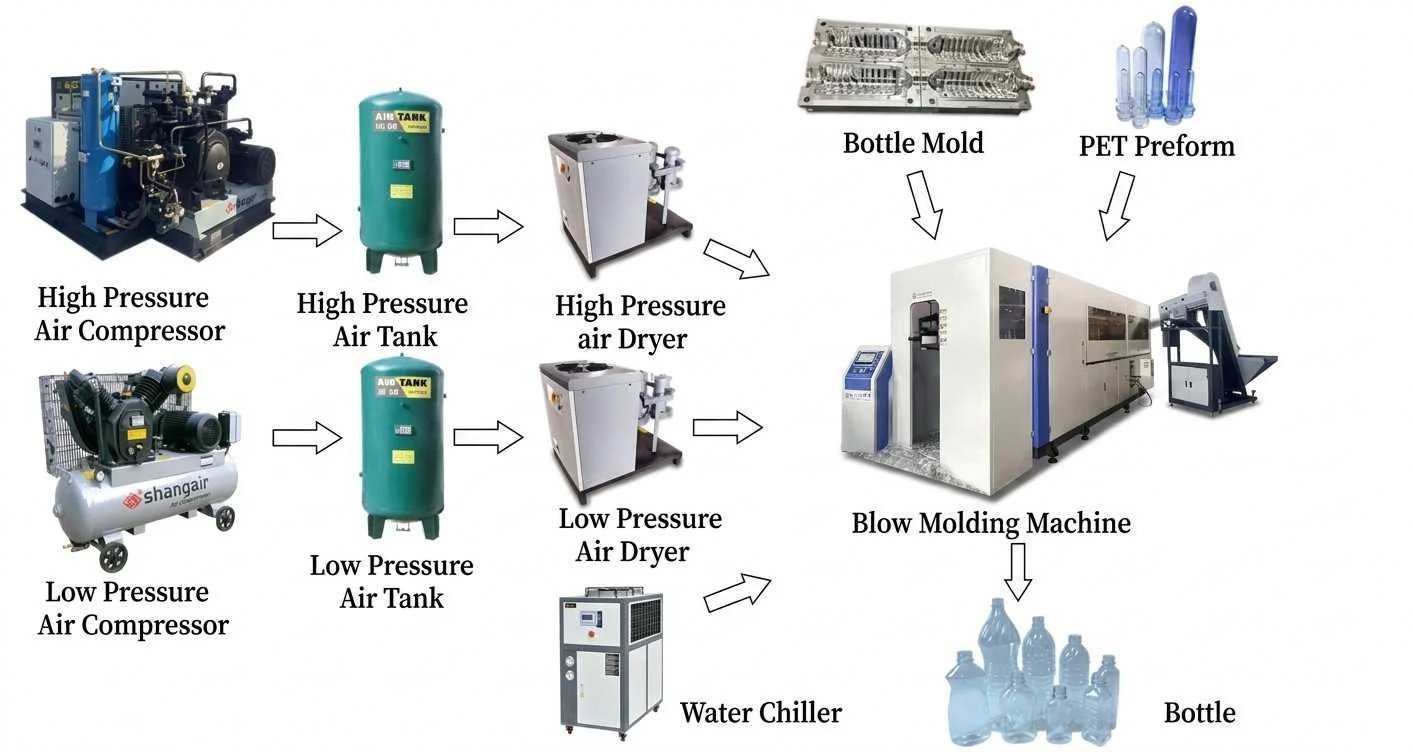
Equipment cost includes blow molding machine, auxiliary equipment (compressor, chiller, air tank), and basic mold set. Maintenance increases year-on-year as equipment ages. Labor: 2-shift operation, 2 operators per shift per machine at $12,000/year per operator.
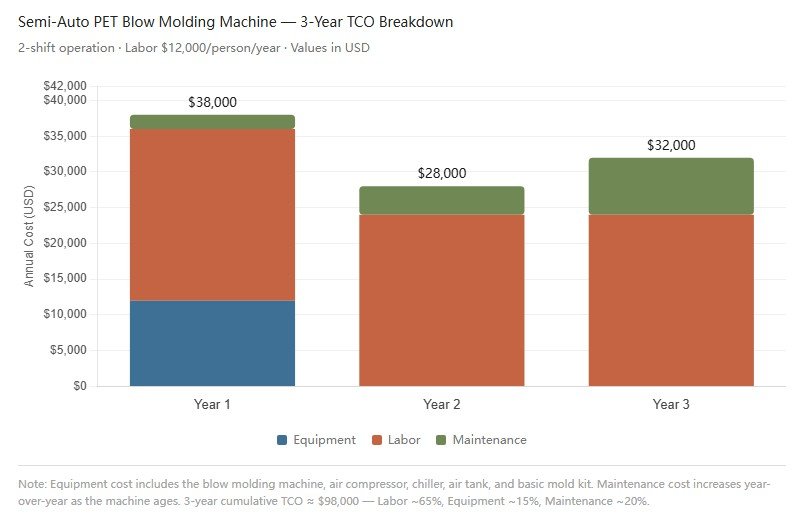
The critical insight: Equipment investment is only ~15% of 3-year TCO. Labor at ~65% is the dominant cost — which means any purchase decision focused on machine price alone is optimizing the wrong number. A fully automatic machine eliminates the labor cost entirely; at sufficient volume, this difference recovers the price premium within 12–18 months.
Want a TCO model for your specific operation? Share your volume, shift pattern, and local operator cost — Sailwin will build a custom 3-year analysis for your scenario.
How to Upgrade from Semi-Automatic to Fully Automatic Without Scrapping Your Mold Investment
One of the most expensive mistakes in PET blow molding is buying a semi-automatic machine from a supplier whose mold tooling dimensions are incompatible with their fully automatic line. When you outgrow the semi-automatic machine — and most growing operations do — you are forced to scrap existing tooling and retool from scratch.
Sailwin designs all mold tooling to be dimensionally compatible across the semi-automatic and fully automatic machine range:
- Phase 1 mold investment transfers to Phase 2 with zero additional tooling cost
- Same mold, same bottle geometry, different machine — no format consistency risk
- Upgrade lead time is reduced because no new mold development cycle is required
Before purchasing from any supplier, ask directly: “Are your semi-automatic and fully automatic machines mold-compatible? Can the same mold tooling run on both?” A supplier who cannot confirm this with engineering documentation is telling you something important.
Case Study: Beverage Startup Scales from Semi-Auto to Fully Automatic in 14 Months
Customer Challenge
A Southeast Asian still water startup needed production running within 60 days on a constrained capital budget. Demand in Year 1 was uncertain — committing to a fully automatic machine before validating market volume carried unacceptable financial risk.
Sailwin’s Solution
Phase 1: A 2-cavity semi-automatic PET blow molding machine — delivered in 35 days, operational within 5 days of arrival. Monthly output: approximately 480,000 x 500ml bottles on one shift.
Phase 2 (14 months later): Monthly volume crossed 800,000 bottles. The customer upgraded to Sailwin’s 4-cavity fully automatic machine. Mold tooling from Phase 1 transferred directly — zero retooling cost.
Results
- Output increased from 800 BPH to 5,200 BPH — a 6.5x throughput gain
- Per-bottle production cost reduced by 38% through labor elimination and higher throughput
- Full ROI on Phase 2 machine achieved within 11 months of installation
- Zero production downtime during the machine transition
Planning a phased investment like this? Sailwin engineers mold tooling for cross-model compatibility from Day 1 — your Phase 1 investment is fully protected when you scale.
Frequently Asked Questions
What is the main difference between a fully automatic and semi-automatic PET blow molding machine?
The core difference is preform loading. Semi-automatic machines require an operator to manually load preforms at each cycle. Fully automatic machines integrate preform feeding, heating, blowing, and bottle ejection in a continuous closed loop with no manual intervention. This difference drives all labor cost, output ceiling, and format flexibility distinctions between the two types.
At what monthly volume should I switch from semi-automatic to fully automatic?
At the mid-cost region baseline ($12,000/year per operator, 2-shift operation), the crossover point is typically around 800,000 bottles/month — where labor savings recover the fully automatic machine’s price premium within 12–18 months. At lower local labor costs, the crossover moves higher; at higher labor costs, it moves lower.
Can I use the same molds when upgrading from semi-automatic to fully automatic?
With Sailwin machines, yes. All Sailwin mold tooling is dimensionally compatible across the semi-automatic and fully automatic range. Always verify mold cross-compatibility before purchasing from any supplier — this is the most common hidden cost in a machine upgrade.
How many operators does a semi-automatic PET blow molding machine need?
One operator per machine per shift for preform loading. Running 2 shifts on 1 machine requires a minimum of 2 operators per day — often 3 accounting for breaks. A fully automatic machine of equivalent output requires 1 operator to monitor the entire line.
How long does delivery take for semi-automatic vs fully automatic Sailwin machines?
Standard semi-automatic models: 30–35 days production lead time. Fully automatic machines with standard mold configurations: 35–45 days. Custom mold configurations: add 15–25 days. Ocean freight adds 20–35 days depending on destination. All machines are ISO 9001 and CE certified — certificates available on request before any payment is made.
What bottle formats work better on semi-automatic machines?
Semi-automatic machines are better suited for wide-mouth jars (38mm–120mm neck), handled bottles, asymmetric shapes, and small-batch custom formats where changeover frequency is high. Fully automatic high-speed lines are optimized for standard round bottle formats at high, stable volume.
Looking for HDPE containers or industrial drums instead of PET bottles?
If your product requires HDPE jerrycans, chemical drums, or large industrial containers rather than PET bottles, a different process applies entirely. See our extrusion blow molding machine guide for HDPE and multilayer barrier container production.
Summary
The choice between fully automatic and semi-automatic is not about which machine is better — it is about which machine matches your current volume, labor economics, and scale-up trajectory.
Key conclusions:
- Under 500,000 bottles/month: semi-automatic is the correct starting point — lower risk, faster payback, better format flexibility
- Above 800,000 bottles/month on 2 shifts: fully automatic typically recovers its premium within 12–18 months through labor savings alone
- Equipment purchase price is only ~15% of 3-year TCO — labor at ~65% is the number that determines the right machine
- Mold tooling cross-compatibility is non-negotiable if you plan to scale — verify this before any purchase
Sailwin manufactures both semi-automatic and fully automatic PET blow molding machines with guaranteed mold cross-compatibility — so your investment is protected at every stage of growth.
Get a Free Quote and TCO Analysis →