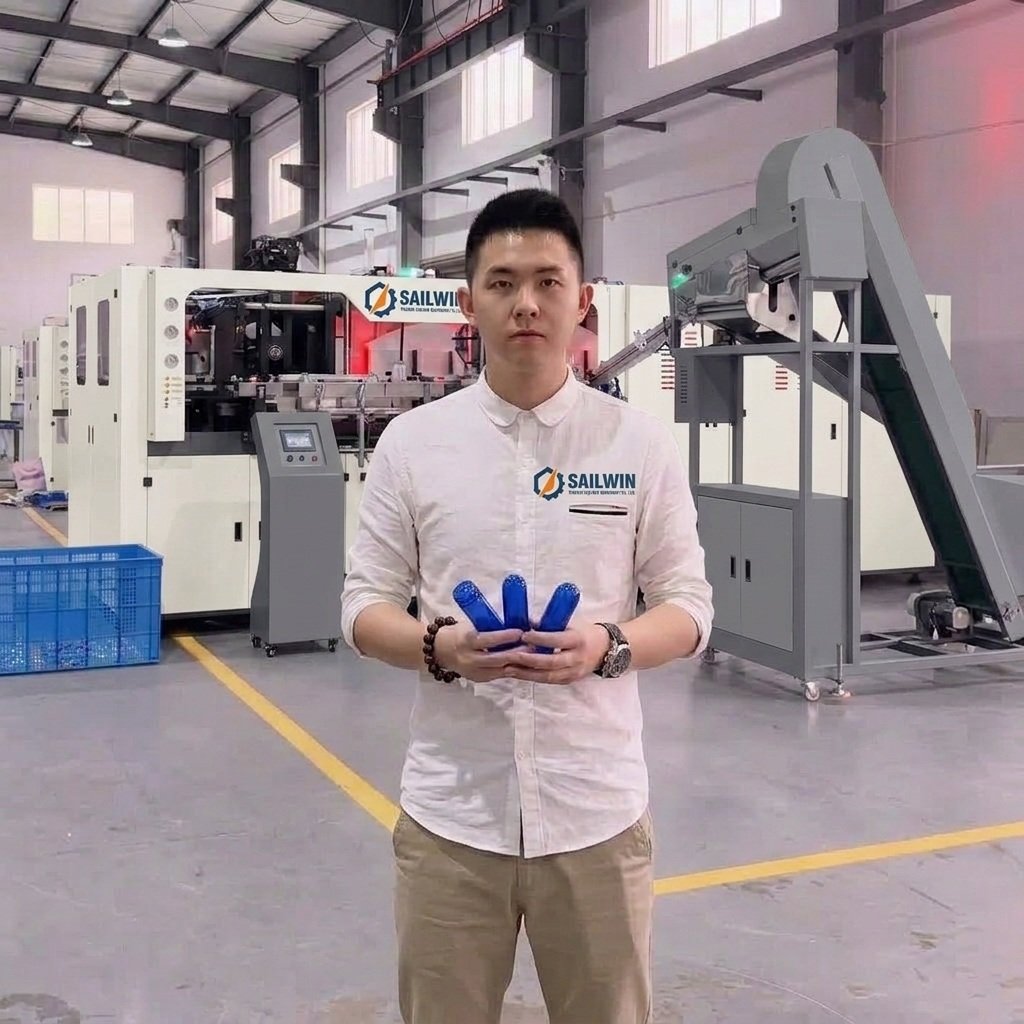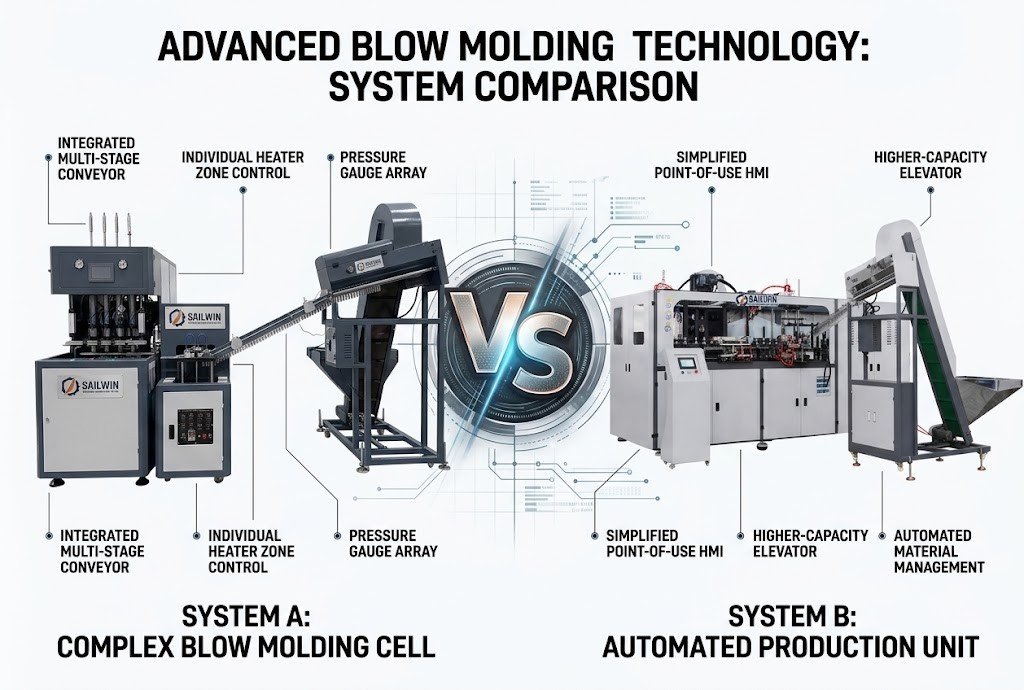
Most packaging manufacturers who end up with the wrong PET blow molding machine made the same mistake: they evaluated price and output speed without a structured selection framework. The result is a machine that hits its physical limits within 18 months, or one so over-specified that it runs at 40% capacity for years. This guide gives you a five-step decision framework — covering output planning, machine type, technical specifications, supplier verification, and price negotiation — so you get the right machine the first time.
| Decision Factor | What to Determine | Why It Matters |
| Output Requirement | Monthly bottle volume target | Determines cavity count and automation level |
| Machine Type | Semi-auto vs Fully auto vs Rotary | Drives 60% of the purchase price and all labor costs |
| Technical Specs | Heating zones, clamping force, OEE | Determines real-world efficiency vs. spec-sheet claims |
| Supplier Credentials | CE/ISO, references, after-sales | Protects your 10–15 year investment |
| Total Cost of Ownership | Machine + mold + labor + maintenance | Purchase price is only 30–40% of lifetime cost |
Why Machine Selection Mistakes Are So Costly — And So Common
The blow molding machine market is filled with suppliers quoting identical output figures on machines with fundamentally different engineering. A “6,000 BPH / 4-cavity” machine from Supplier A and the same specification from Supplier B can deliver an 18-month production gap in real-world operation — because heating zone count, control system quality, and clamping precision are rarely disclosed upfront.
Three mistakes account for the majority of wrong purchases:
- Over-relying on BPH figures: Published BPH is measured under optimal lab conditions, not on your production floor with your preform spec and your operators. A machine rated at 8,000 BPH running at 65% OEE delivers fewer bottles than a 6,000 BPH machine at 88% OEE — and costs more per bottle produced.
- Under-specifying for growth: Buying the smallest machine that covers today’s volume is rational. Buying one with no upgrade path is not. A machine that reaches its ceiling in 14 months forces an unplanned capital expenditure at the worst possible time.
- Ignoring after-sales capability: A production line down for one week waiting on spare parts costs more than the price difference between a reputable supplier and a low-cost alternative. This calculation is almost never made at the point of purchase.
| Mistake | Consequence | How to Avoid It |
| Buying on BPH alone | Real output 30–40% below spec | Request OEE data from real installations |
| Under-specifying for growth | Forced replacement in 12–18 months | Plan for 3-year volume, not today’s volume |
| Ignoring after-sales | 1-week downtime = production loss > price gap | Verify spare parts lead time before signing |
| Skipping supplier verification | Machine arrives without CE cert or support | Use the 7-point supplier checklist (Step 4) |
Not sure where your requirements fall? Sailwin’s engineers provide free pre-purchase consultations — including output planning, machine type recommendation, and preform specification guidance — before any commitment.
Talk to a Sailwin Engineer Free →
Step 1 — Define Your Output Requirements Before Looking at Any Machine
Every other decision in this guide flows from one number: your monthly bottle volume target. Get this wrong and every subsequent step is built on a false foundation.
How to Calculate the BPH You Actually Need
The formula is straightforward, but most buyers skip it:
Required BPH = Monthly Volume ÷ (Production Days × Shifts per Day × Hours per Shift × Target OEE)
Example: A plant targeting 1,200,000 bottles/month, running 25 days, 1 shift of 8 hours, at 80% OEE:
Required BPH = 1,200,000 ÷ (25 × 1 × 8 × 0.80) = 7,500 BPH
This plant needs a machine capable of at least 7,500 BPH — which means a 4-cavity or 6-cavity fully automatic configuration, not the 4,000 BPH machine a sales rep might propose based on the headline monthly volume.
Cavity Count to Monthly Volume: Quick Reference
| Machine Configuration | Typical BPH (500ml) | Monthly Volume (1 Shift) | Monthly Volume (2 Shifts) |
| Semi-Auto 2-Cavity | 800–1,200 | ~400,000 | ~800,000 |
| Fully Auto 2-Cavity | 2,000–3,000 | ~960,000 | ~1,920,000 |
| Fully Auto 4-Cavity | 4,000–6,000 | ~1,920,000 | ~3,840,000 |
| Fully Auto 6-Cavity | 7,000–10,000 | ~3,360,000 | ~6,720,000 |
| High-Speed 6-Cavity | 10,000–12,000 | ~4,800,000 | ~9,600,000 |
Figures calculated at 25 production days/month, 8-hour shift, 80% OEE. Actual output varies by bottle size, wall thickness, and preform spec.
Tell us your monthly target and bottle size — Sailwin will confirm the exact cavity configuration and model that meets your requirement, with a factory-direct quote within 24 hours.
Get a Configuration Recommendation →
Step 2 — Choose the Right Machine Type
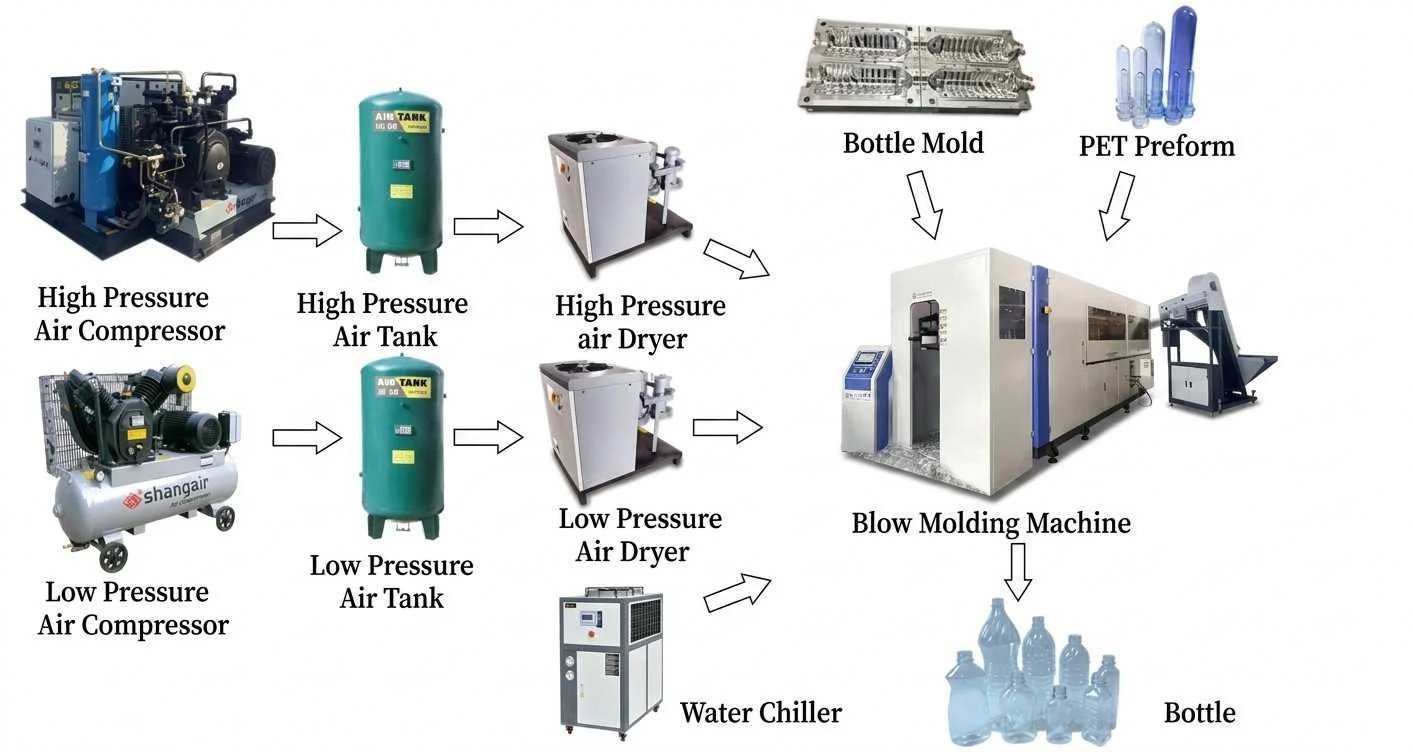
Machine type is the single decision with the largest downstream consequences. It determines your labor requirements, your mold tooling investment, your energy costs, and your upgrade path.
Semi-Automatic PET Blow Molding Machine — The Right Entry Point
Semi-automatic machines require one operator per machine to load preforms manually into the heating section. This is not a weakness — it is the correct choice when:
- Monthly volume is under 500,000 bottles (one shift)
- You produce multiple bottle formats with weekly changeovers
- Initial capital budget is the binding constraint
- You need production running within 35 days of order
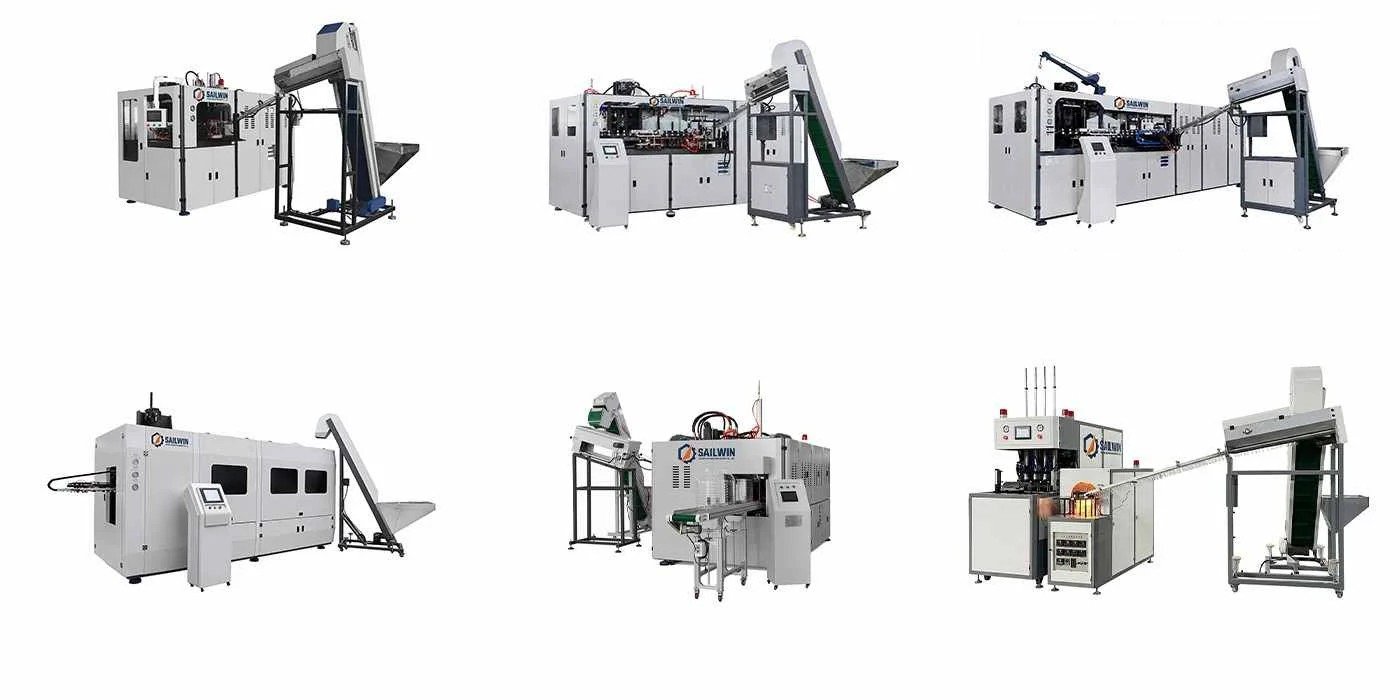
Sailwin’s semi-automatic PET blow molding machine range — including the SW-2000-2 model — is engineered to deliver consistent quality with minimal operator training, and uses the same mold tooling dimensions as Sailwin’s fully automatic line for a seamless upgrade path.
Fully Automatic PET Blow Molding Machine — When to Make the Jump
Fully automatic machines integrate preform loading, IR heating, stretch-blowing, and bottle ejection with no manual intervention. The financial case for going fully automatic is straightforward: at volumes above 800,000 bottles/month on a single shift, the labor cost savings typically recover the price premium within 12–18 months.
Sailwin’s automatic PET blow molding machine range is available in 2, 4, and 6-cavity configurations — all engineered for 24/7 continuous operation with centralized PLC control.
Linear vs Rotary: When Does a Rotary Machine Make Sense?
| Configuration | BPH Range | Best For | Key Consideration |
| Linear (2–6 cavity) | 800–12,000 | Most beverage & personal care lines | Lower complexity, easier mold changes, wider bottle range |
| Rotary (12+ cavity) | 12,000–30,000+ | Dedicated high-volume CSD / water lines | Higher upfront cost, more complex maintenance, bottle size less flexible |
For most buyers in the 2,000–10,000 BPH range, a linear fully automatic machine is the correct choice. Rotary machines are only justified when you have a dedicated, high-certainty production volume above 12,000 BPH on a single bottle format.
Step 3 — Evaluate Technical Specifications That Actually Predict Performance
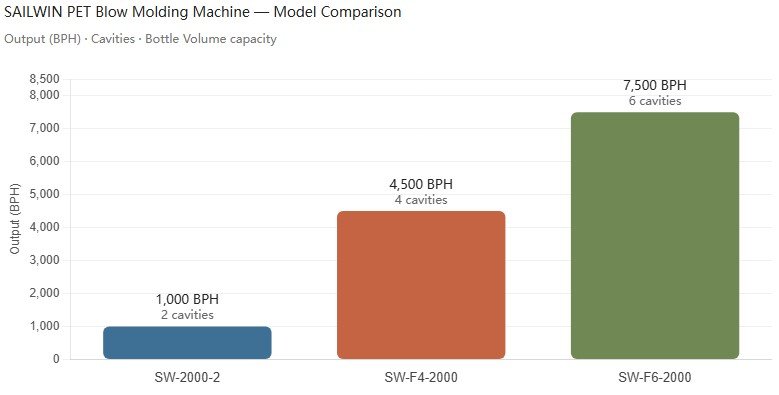
Specification sheets from different suppliers use the same terms to describe fundamentally different engineering. These four categories are where the real differences hide.
1. Heating System — IR Lamp Count and Zone Independence
The heating oven is where most quality problems originate. A preform heated unevenly — hotter on one side, cooler on another — produces bottles with uneven wall thickness, which shows up as:
- Bottles that collapse or deform at the filling line
- High reject rates at the inspector station
- Premature failure under carbonation pressure (for CSD applications)
The critical specification is not total wattage — it is the number of independently controlled heating zones. More zones mean finer temperature gradient control. For a 4-cavity fully automatic machine, look for a minimum of 6 independently controlled zones; for a 6-cavity high-speed machine, 8–12 zones.
2. Clamping Force and Mold Change Time
Clamping force (measured in kN) determines how precisely the machine holds the mold halves together under high blowing pressure (25–40 bar). Insufficient clamping force leads to flash lines on the bottle seam — a cosmetic defect that fails retail packaging standards.
Mold change time is the production-floor metric that separates a machine specification from a business tool. For contract bottlers running 3–5 SKUs:
- Semi-automatic machines: 30–60 minutes per mold change
- Fully automatic linear machines: 20–40 minutes
- High-speed configurations with quick-release systems: 15–25 minutes
Request a timed, live mold-change demonstration before accepting delivery — not a video.
3. OEE vs. Published BPH — The Number That Matters
Overall Equipment Effectiveness (OEE) is the product of Availability × Performance × Quality. A machine with 95% availability, 90% performance, and 98% quality rate delivers an OEE of 84% — meaning your actual output is 84% of the nameplate BPH.
Always ask suppliers for OEE data from verified customer installations, not from their own factory floor demonstrations. A reputable supplier with machines running in 60+ countries can produce this data without hesitation.
4. Control System Brand: The 10-Year Cost You Are Not Calculating
Machines fitted with Mitsubishi or Siemens PLCs and servo drives cost more upfront. Over a 10-year machine lifespan, the difference is reversed:
- Generic PLC systems: higher unplanned downtime frequency, proprietary fault codes requiring supplier intervention, limited local technician support globally
- Mitsubishi / Siemens systems: global support network, standard fault documentation, faster local diagnosis, measurably lower mean time to repair (MTTR)
| Specification | Semi-Auto (2-Cavity) | Fully Auto (4-Cavity) | High-Speed (6-Cavity) |
| Output BPH (500ml) | 800–1,500 | 4,000–6,000 | 8,000–12,000 |
| Heating Zones (independent) | 3–5 | 6–8 | 8–12 |
| Blowing Pressure | 25–30 bar | 30–38 bar | 35–40 bar |
| Mold Change Time | 30–60 min | 20–40 min | 15–25 min |
| Recommended Control System | Standard PLC | Mitsubishi / Siemens | Mitsubishi / Siemens |
| CE + ISO 9001 | Required | Required | Required |
Want Sailwin’s full technical specification sheet for any model — including heating zone layout, clamping force curve, and OEE data from customer installations? Send us your bottle volume and format.
Request Full Technical Specs →
Step 4 — Verify Supplier Credentials With This 7-Point Checklist
The machine purchase price is 30–40% of your total lifetime cost. Maintenance, spare parts, downtime, and support make up the rest. A supplier you cannot reach after delivery is a liability that compounds every year.
- CE & ISO 9001 Certification — Verify, Don’t Just Ask: Request the certificate number and verify it independently against the issuing body’s database. Counterfeit CE certificates exist in the market. Both the machine model and serial number should appear on the certificate.
- Factory Video Tour or In-Person Visit: A manufacturer with real production capacity welcomes this request. A supplier who delays for more than two weeks or offers excuses is almost certainly a trading company without manufacturing capability.
- Spare Parts Stocking and Lead Time: Ask specifically: “If my IR heating lamp fails at 2am on a Tuesday, how quickly can you ship a replacement?” Common wear parts — heating lamps, solenoid valves, blow-off seals, stretch rods — should be available within 24–48 hours. Anything longer means production risk.
- Delivery Timeline in Writing with Penalty Terms: Standard models: 30–45 days. Custom mold configurations: 45–70 days. A supplier confident in their production capacity will commit to this in the contract. “Approximately 60 days” without a penalty clause is a red flag.
- Pre-Shipment Trial Blow Report and Video: Before the machine ships, your exact bottle should be blown at rated speed on your machine, documented on video. This is standard practice at Sailwin and at any reputable manufacturer. If a supplier resists this, ask why.
- Verifiable Customer References in Your Region: Request 2–3 customer contacts — ideally in your country or a neighboring market. Call them. A supplier claiming installations in 60+ countries has no legitimate reason to decline this request.
- Mold Customization and Cross-Model Compatibility: Confirm the supplier manufactures molds in-house and that tooling will be compatible with any future machine upgrades. This single factor protects your tooling investment when you scale.
Sailwin passes all seven criteria — CE and ISO 9001 certificate numbers available on request, factory video tours arranged within 3 business days, and verified customer references in 60+ countries.
Request Factory Tour & References →
Step 5 — Negotiate Price and After-Sales Terms Correctly
Two quotes for “the same machine” routinely differ by 40–60%. Without knowing what drives that gap, you either overpay or unknowingly accept a machine with hidden compromises.
What Drives Price Variation — And What to Do About It
- Cavity Count: The price curve is non-linear. A 6-cavity machine is not 3× the price of a 2-cavity — mold engineering complexity and heating precision requirements create a steeper premium. Get itemized quotes that separate machine cost from mold cost.
- Automation Level: Preform feeders, conveyors, and integrated sorting systems add significant cost. Calculate the 24-month labor cost savings before deciding automation is unaffordable.
- Control System: Always ask which PLC brand is quoted. A supplier who swaps Mitsubishi for a no-name PLC to hit a price target will never disclose this proactively.
- Mold Material: Aluminum molds are faster to produce and cheaper; steel molds last 3–5× longer in high-volume runs. Ask explicitly: “What material is the mold in this quote?”
- After-Sales Package: On-site installation, operator training (2–5 days on your floor), and a 12-month spare parts warranty are worth more than the cost difference between a stripped quote and a fully supported purchase.
Hidden Costs to Request Upfront
| Cost Item | Often Not in Base Quote? | What to Confirm |
| Mold tooling per bottle format | Frequently excluded | Price per mold set; aluminum vs steel |
| On-site installation & training | Sometimes excluded | Days on site; engineer travel cost |
| Spare parts kit (Year 1) | Rarely included | Which parts included; lead time for reorders |
| Sea freight & insurance | Depends on Incoterms | Confirm EXW vs CIF vs DDP terms |
| Import duties & customs clearance | Always buyer’s account | HS code; confirm local import duty rate |
Sailwin provides fully itemized quotations within 24 hours — machine spec, mold material, control system brand, Incoterms, and after-sales package broken out line by line. No bundled surprises.
Get a Factory-Direct Itemized Quote →
Case Study: Beverage Startup Scales From 800 to 5,200 BPH in 14 Months
Customer Challenge
A Southeast Asian still water startup needed to begin production within 60 days on a constrained capital budget. Demand forecasts for the first year were uncertain — committing to a high-capacity fully automatic line carried unacceptable financial risk for a brand with no proven sales volume.
Sailwin’s Solution
Phase 1: A 2-cavity semi-automatic PET blow molding machine — delivered in 35 days, installed in 2 days, operators trained in 3 days. Monthly output at one shift: approximately 480,000 × 500ml bottles.
Phase 2 (14 months later): Monthly volume crossed 800,000 bottles as a second retail chain listing was secured. The customer upgraded to Sailwin’s 4-cavity fully automatic machine. Because Sailwin engineered mold tooling compatibility between both models from the outset, zero retooling cost was incurred.
Results
- Output increased from 800 BPH to 5,200 BPH — a 6.5× throughput gain
- Per-bottle production cost reduced by 38% through labor elimination and higher throughput
- Full ROI on the Phase 2 machine achieved within 11 months of installation
- Zero production downtime during the machine transition — mold compatibility preserved across both phases
Planning a phased scale-up like this customer? Sailwin designs mold tooling for cross-model compatibility from Day 1 — protecting your Phase 1 investment as you grow.
Frequently Asked Questions
What is the most important factor when choosing a PET blow molding machine?
Your monthly bottle volume target is the first and most critical factor — it determines cavity count, automation level, and the entire machine configuration. Calculate the BPH you actually need using the formula: Monthly Volume ÷ (Production Days × Shifts × Hours × Target OEE). Every other specification choice follows from this number.
How many cavities do I need for my PET blow molding machine?
For volumes under 500,000 bottles/month: a 2-cavity semi-automatic or fully automatic machine. For 500,000–2,000,000/month: a 2-cavity or 4-cavity fully automatic. For above 2,000,000/month on a single shift: a 4-cavity or 6-cavity fully automatic configuration. Contact Sailwin with your exact volume and we’ll confirm the right model.
What certifications should a PET blow molding machine have?
CE certification is mandatory for EU imports and increasingly required by customs authorities in the Middle East, Southeast Asia, and Latin America. ISO 9001 confirms the manufacturer’s quality management system. Always verify the CE certificate number independently — counterfeit certificates exist in the market.
How long does it take to receive a PET blow molding machine from China?
Standard models from Sailwin: 30–45 days production lead time. Custom mold configurations: 45–70 days. Ocean freight adds 20–35 days depending on destination port. Plan for 60–90 days total from order confirmation to machine commissioned and running.
What is the difference between a linear and rotary PET blow molding machine?
Linear machines (2–6 cavity) are suitable for most operations up to 12,000 BPH and offer flexible bottle format changeovers. Rotary machines (12+ cavities) are for dedicated high-volume single-format lines above 12,000 BPH and require significantly higher maintenance complexity. For most buyers, a linear fully automatic machine is the right choice.
Can I upgrade from a semi-automatic to a fully automatic machine later?
Yes — if your supplier engineers mold tooling compatibility between machine models from the start. Sailwin designs all mold dimensions to be compatible across the semi-automatic and fully automatic range, so your Phase 1 tooling investment carries forward with zero retooling cost on upgrade.
What should I ask a supplier before signing a PET blow molding machine contract?
Seven questions: (1) Can you provide CE and ISO 9001 certificate numbers for independent verification? (2) Can I do a factory video tour within 5 business days? (3) What is your spare parts lead time for heating lamps and solenoid valves? (4) Will you commit to delivery lead time in the contract with penalty terms? (5) Can I get a pre-shipment trial blow video of my exact bottle? (6) Can you provide 2–3 customer references in my region? (7) Is mold tooling compatible with future machine upgrades?
What is OEE and why does it matter more than BPH?
OEE (Overall Equipment Effectiveness) is the product of Availability × Performance × Quality Rate. It measures how much of your machine’s theoretical capacity actually converts to good bottles. A machine rated at 10,000 BPH at 65% OEE delivers fewer good bottles than an 8,000 BPH machine at 88% OEE. Always request OEE data from real customer installations, not factory demonstrations.
Summary
Choosing the right PET blow molding machine comes down to five disciplined decisions made in order: calculate your real BPH requirement before looking at any machine; choose the machine type that matches your volume and labor economics; evaluate the technical specifications that predict real-world performance rather than nameplate figures; verify your supplier against a non-negotiable seven-point checklist; and negotiate a fully itemized contract that accounts for all costs over the machine’s lifetime.
Key actions before you request any quote:
- Calculate required BPH using your actual production days, shifts, and a realistic OEE estimate
- Confirm your 3-year volume forecast — not just today’s requirement — to avoid an unplanned replacement cycle
- Verify CE and ISO 9001 certificate numbers independently before any deposit is paid
- Request OEE data from real customer installations, not factory demos
- Confirm mold cross-model compatibility if you plan a phased scale-up
Sailwin has delivered PET blow molding machines to manufacturers in 60+ countries — from entry-level semi-automatic machines for market entry to high-speed 6-cavity fully automatic systems for established beverage lines. All machines are CE and ISO 9001 certified, with factory-direct pricing, pre-shipment trial blow reports, and on-site installation support included as standard.
Get a Free Quote for Your PET Blow Molding Machine →