In industrial packaging and chemical container manufacturing, selecting an incorrectly sized extrusion blow molding machine is among the costliest mistakes an operations director can make. If a machine’s clamping tonnage is undersized for a 20-liter stacking jerrycan, parting line flash will prevent hermetic cap sealing and cause catastrophic failure during UN chemical drop tests. Conversely, deploying an oversized 200-liter accumulator head machine to produce small 1-liter pesticide bottles creates massive energy inefficiencies: oversized extruder barrels degrade resin through excessive residence times, and prolonged cycle times slash profit margins.
High-density polyethylene (HDPE) remains the unchallenged global polymer for packaging harsh agrochemicals, automotive lubricants, household detergents, and bulk industrial liquids. However, sizing an industrial HDPE blow molding machine across the wide container spectrum — from 100ml personal care bottles up to 1,000-liter intermediate bulk containers (IBCs) — requires balancing extruder screw diameter, continuous versus accumulator die head mechanics, platen daylight, and multi-point parison programming. This technical guide delivers an engineering roadmap for matching container volume to machine specifications, optimizing wall thickness distribution with 100-point parison controllers, and achieving certified UN hazmat packaging compliance.
| Container Volume Range | Extrusion Technology | Required Clamping Force | Target Industrial Applications |
| Small Bottles (100ml – 2L) | Continuous Extrusion (Single / Multi-Head) | 40 – 100 kN (4 – 10 Tons) | Personal care, cosmetics, milk, small motor oil |
| Medium Containers (3L – 10L) | Continuous / Small Accumulator Option | 120 – 220 kN (12 – 22 Tons) | Laundry detergent, edible oil, coolant jugs |
| Stacking Jerrycans (15L – 30L) | Accumulator Head (FIFO 3L – 6L capacity) | 250 – 450 kN (25 – 45 Tons) | UN hazardous chemicals, agrochemicals, lube oil |
| Open/Tight Head Drums (50L – 220L) | Large Accumulator Head (10L – 25L shot) | 600 – 1,500 kN (60 – 150 Tons) | L-ring chemical drums, blue shipping barrels |
| Bulk Tanks / IBCs (500L – 1000L) | Heavy Accumulator Head (40L – 80L shot) | 2,000 – 3,500 kN (200 – 350 Tons) | IBC intermediate bulk containers, septic tanks |
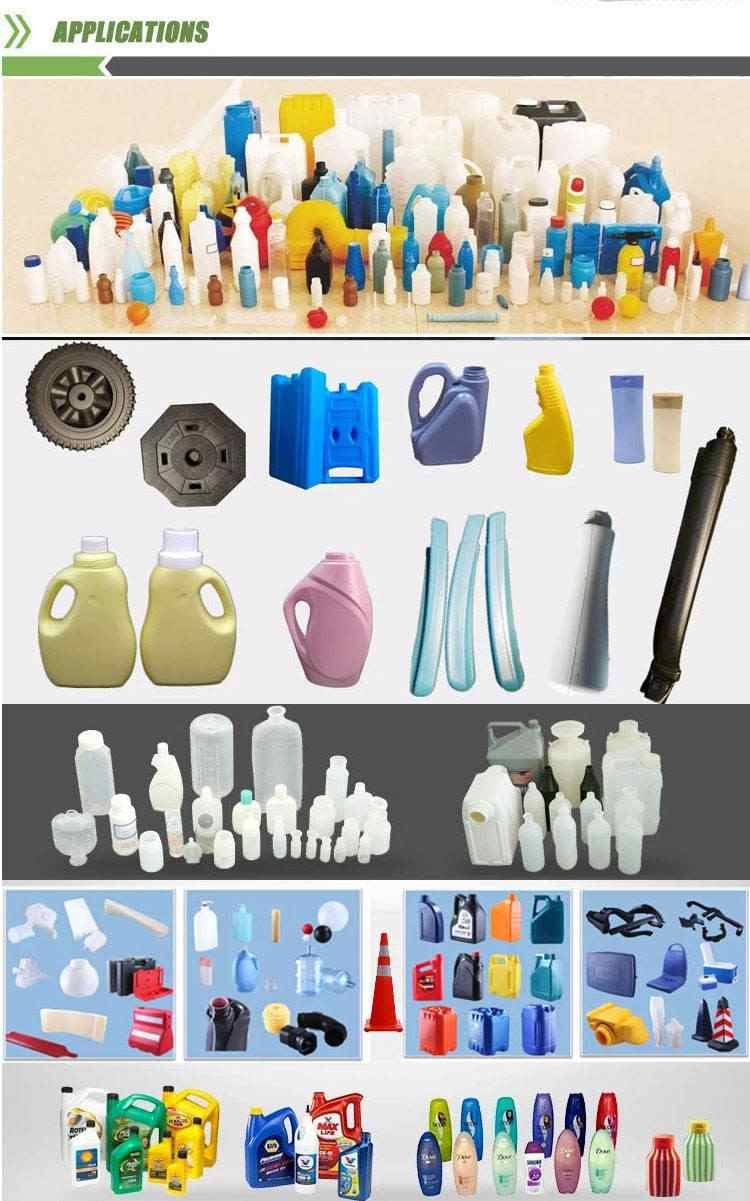
Why HDPE Dominates the Global Industrial Container Market
While PET is the premier polymer for beverage transparency, High-Density Polyethylene (HDPE) remains the undisputed gold standard for industrial packaging. HDPE’s semi-crystalline linear polymer chains provide an unmatched combination of chemical inertia, mechanical toughness, and flexural fatigue resistance:
| Property / Performance Metric | High-Density Polyethylene (HDPE) | Polyethylene Terephthalate (PET) | Engineering Significance |
| Environmental Stress Crack Resistance (ESCR) | Exceptional (> 1,000 hours F50) | Moderate (Prone to chemical crazing) | Resists surfactants, agricultural solvents & active acids |
| Impact Strength at Sub-Zero (-20°C) | High ductility (No shatter) | Brittle transition below 0°C | Withstands winter shipping & cold warehouse drops |
| Chemical Compatibility (pH Range) | pH 1 to pH 14 (Universal) | Narrow (pH 4 to pH 9) | Safe for bleach, caustic soda, hydrochloric acid |
| Multi-Layer Co-Extrusion Capability | Up to 6 layers (HDPE + EVOH barrier) | Monolayer or coating | Blocks oxygen and hydrocarbon solvent permeation |
| Integrated Hollow Handle Molding | Seamless continuous hollow handle | Requires separate welded/inserted handle | Superior structural ergonomics for heavy 20L containers |
For industrial chemical packagers, the ability of an extrusion blow molding machine to mold a continuous hollow handle integrated directly into the bottle geometry is paramount. Liquid flows freely through the hollow handle during filling and decanting, while the solid pinch-off weld provides tensile strength capable of supporting 25kg loads during rough truck transport.
Container Sizing Breakdown: Matching Your Volume to the Machine Class
1. Small Containers (100ml to 2 Liters): High-Output Shuttle Systems
For personal care bottles, pharmaceutical flasks, and motor oil bottles under 2 liters, high output is achieved through continuous extrusion paired with linear shuttle platen movement. Multi-cavity die heads (double, triple, or quadruple parison heads) feed twin stations (left and right clamping platens), allowing one mold to cool and calibrate while the opposite mold captures fresh parisons.
2. Industrial Jerrycans (10L to 30L): The Backbone of Chemical Packaging
The 20-liter stacking jerrycan is the workhorse of global chemical transport. Manufacturing jerrycans requires a specialized jerrycan blow molding machine equipped with a First-In, First-Out (FIFO) Accumulator Head. Unlike continuous extrusion where parisons sag under their own gravitational weight, an accumulator head melts and pools 3kg to 5kg of molten HDPE inside an internal cylindrical chamber. When the mold opens, an electric or hydraulic ram shoots the parison downward in less than 2.0 seconds, completely eliminating parison drawdown and vertical neck thinning.
3. Large Industrial Drums & IBC Tanks (50L to 1000L): Heavy Tonnage Platforms
Manufacturing 220-liter (55-gallon) chemical shipping drums or 1,000-liter IBC containers demands massive structural clamping forces exceeding 1,200 kN. Sailwin’s large extrusion blow molding machine series incorporates high-output barrier screws (120mm to 150mm diameter) capable of plasticizing over 450 kg/h of high-molecular-weight HDPE (HMW-HDPE), paired with multi-axis bottom mold blow pins and robot part-takeout arms.
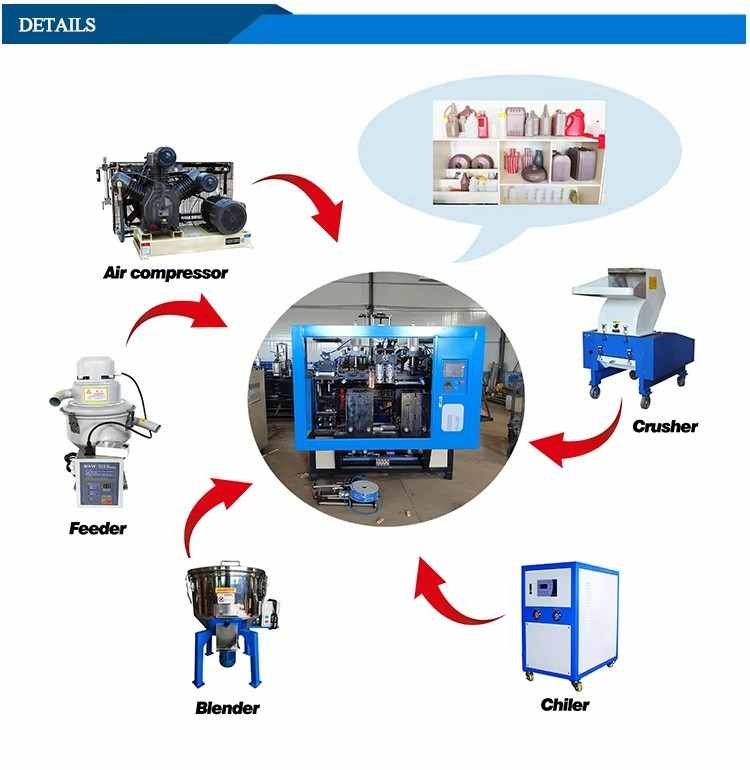
Pneumatic & Auxiliary Line Architecture for HDPE Extrusion
Unlike PET stretch blow molding which requires 30 to 35 bar high-pressure air, extrusion blow molding utilizes medium blow pressures between 6 and 10 bar. However, the pneumatic volume (CFM) required is significantly higher due to large container volumes and internal cavity air purging. A turnkey HDPE manufacturing line incorporates five interconnected auxiliary modules:
- Low/Medium Pressure Screw Compressor (8 – 10 bar): Supplies high-volume compressed air to blow pins and pneumatic de-flashing cylinders.
- High-Efficiency Mold Water Chiller (5°C – 8°C): Circulates chilled water through beryllium-copper mold inserts to solidify thick container corners rapidly.
- Automated Heavy-Duty Regrind Crusher & Granulator: Automatically captures top handle flash and bottom pinch-off tails, grinding scrap into clean regrind pellets mixed back into the feed hopper (up to 30% ratio without structural degradation).
- Vacuum Auto-Loader & Masterbatch Mixer: Continuously feeds virgin resin pellets, masterbatch colorant, and regrind into the extruder feed throat with gravimetric dosing accuracy.
Need an Engineering Sizing Recommendation for Your HDPE Container?
Send us your container drawing, target resin grammage, and daily production quota. Our technical packaging team will size the exact screw diameter, clamping tonnage, and die head configuration required.
Parison Wall Thickness Control (PWDS): Eliminating Flash and Thin Spots
The single greatest operational challenge in large-format HDPE blow molding is gravitational parison sag. As a 1,200g molten tube of plastic hangs suspended from the die head, gravity stretches the upper section, making the top of the container paper-thin while the bottom gathers into an excessively thick, heavy mass.
To guarantee uniform wall distribution, modern industrial blow molders utilize an electro-hydraulic 100-Point Axial Parison Programmer paired with Radial Parison Wall Thickness Control (PWDS). As the parison extrudes downward, a high-speed servo valve dynamically shifts the conical die core pin up and down according to a programmed 100-point curve:
| Container Zone | Parison Tooling Dynamic Action | Resulting Wall Thickness Benefit |
| Handle & Neck Zone | Die opening widens to deposit extra resin mass | Reinforces handle drop resistance and neck thread rigidity |
| Center Sidewall Panel | Die pin closes slightly to throttle resin flow | Eliminates excess overweight resin; saves 10% – 15% material |
| Bottom Pinch-Off Corners | PWDS radial flexible ring expands at container corners | Guarantees minimum 1.8mm wall thickness at high-impact drop corners |
Without 100-point parison control, packagers are forced to increase overall container weight by 20% to 30% simply to ensure container corners meet drop test criteria. Over an annual run of 500,000 jerrycans, parison optimization saves over $75,000 in raw HDPE resin costs.
UN Dangerous Goods Packaging Certification: Drop, Stacking & Pressure Standards
Containers intended for shipping hazardous chemicals, pesticides, or corrosive acids must pass international United Nations (UN) Packagings Certification (UN 3H1 for tight-head jerrycans and UN 1H1 for tight-head plastic drums). Sizing your blow molding machine properly ensures containers pass three rigorous laboratory qualification tests:
- 1.8-Meter Cold Drop Test (-18°C): The container is filled with a low-temperature antifreeze solution chilled to -18°C and dropped from a height of 1.8 meters onto rigid concrete at three angles: diagonal base drop, corner impact, and handle impact. Zero rupture or leakage is permitted.
- 28-Day Stacking Top-Load Test (40°C): Containers are filled and subjected to a top compressive load equivalent to a 3-meter stacking height in a 40°C environmental chamber for 28 days. The container must not buckle or tilt.
- Hydraulic Internal Pressure Leak Test (200 kPa): Containers are pressurized with water to 200 kPa (2.0 bar) for 30 minutes to verify molecular weld strength along the bottom pinch-off seam.
Clamping Force Calculation: Preventing Flash on Large Flat Moldings
Unlike cylindrical bottles which distribute internal pressure uniformly, rectangular jerrycans and chemical drums feature broad, flat sidewalls. During the blowing phase (6 to 10 bar), this flat projected area exerts massive opening forces attempting to push the mold platens apart.
The minimum required clamping force is calculated using the following engineering formula:
For example, a dual-cavity mold producing two 20L jerrycans has a total projected area of 4,200 cm². At 8.0 bar blowing pressure with a 1.4 safety multiplier, the minimum required clamping force is 470 kN (47 Tons). Deploying a 30-ton clamp on this mold will cause parting line flashing, defective neck calibrator sealing, and 100% rejection during hydraulic leak tests.
Case Study: Agrochemical Formulator Achieves UN Approval and 22% Resin Cut
Customer Profile: A major agrochemical formulation manufacturer in the Middle East produced 20L HDPE jerrycans for emulsifiable pesticide concentrates using an outdated continuous extrusion blow molder without parison programming.
Operational Challenges: The client suffered from a 4.2% container reject rate during factory quality control. To pass UN cold drop tests, the plant had increased jerrycan weight to an excessive 1,350 grams. Even at this heavy weight, uneven corner wall distribution caused intermittent drop test failures at the bottom pinch-off.
Sailwin Turnkey Solution:
- Supplied a Sailwin SW-20L accumulator head extrusion blow molding machine rated at 350 kN clamping force.
- Integrated a MOOG 100-point axial parison programmer paired with a high-flow FIFO 5-liter accumulator die head.
- Engineered precision beryllium-copper mold pinch-off inserts with optimized 30-degree relief angles to create high-tensile molecular weld lines along the container base.
- Integrated automated neck deflashing and rotary bottle leak testing stations into the downstream discharge conveyor.
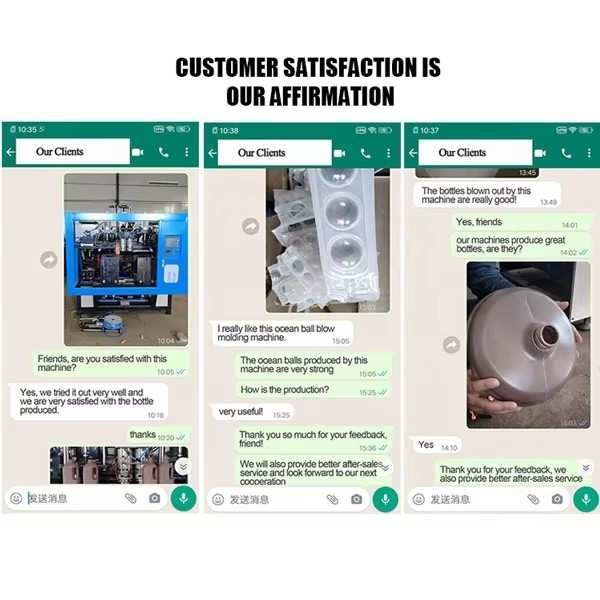
Quantifiable Production Results:
| Performance Metric | Old Continuous Machine | Sailwin SW-20L Accumulator System | Operational Benefit |
| Target Jerrycan Weight | 1,350 Grams | 1,050 Grams | 22.2% direct resin savings (300g per bottle) |
| UN 1.8m Cold Drop Pass Rate | 88.5% (Frequent corner burst) | 100% Certified Pass (0 Failures) | Achieved official UN 3H1 hazmat certification |
| Production Cycle Time | 42 Seconds | 31 Seconds | +35.5% increase in hourly output |
| Annual Raw Material Savings | Baseline | $94,500 Saved Annually | Full machinery payback achieved in 8.2 months |
Facing UN Drop Test Failures or Excessive Container Weight?
Contact Sailwin’s technical extrusion group. We evaluate your current pinch-off design, run parison simulation models, and engineer high-rigidity machines guaranteed to pass certified hazmat standards.
Frequently Asked Questions: HDPE Extrusion Blow Molding
What is the difference between continuous extrusion and accumulator head machines?
In continuous extrusion, the screw rotates constantly, continuously pushing molten parisons downward. This is ideal for smaller containers (under 5L) where parisons are short and lightweight. For containers over 10L (such as 20L jerrycans and 200L drums), accumulator head machines melt plastic into a heated cylinder and shoot the entire heavy parison downward in 1 to 2 seconds, preventing gravitational sagging and wall thinning.
Can an HDPE blow molding machine also process Polypropylene (PP)?
Yes. Extrusion blow molders can process high-melt-strength Polypropylene (PP) resins for hot-fill applications (up to 100°C) or higher stiffness containers. However, PP requires slightly higher barrel temperature profiles (190°C – 220°C compared to 160°C – 190°C for HDPE) and specialized screw flight geometries to maintain homogeneous melt viscosity.
Why are mold pinch-off inserts made from Beryllium Copper?
Beryllium copper (Be-Cu) possesses over three times the thermal conductivity of tool steel while maintaining high surface hardness. Installing Be-Cu inserts along the mold bottom pinch-off and handle perimeter pulls heat out of dense plastic pinch seams four times faster, preventing hot-spot weld degradation and cutting overall cycle times by 15% to 25%.
What percentage of regrind scrap can be recycled back into HDPE production?
In standard non-UN industrial containers (such as detergent or motor oil bottles), up to 25% to 35% regrind can be reintroduced without compromising container structural integrity. For UN-certified hazardous chemical containers, regrind content is typically restricted to 10% to 15% in-plant clean regrind, or incorporated exclusively within the middle core layer of a 3-layer co-extrusion structure.
What is View Stripe (View Line) technology in HDPE bottles?
A view stripe is a transparent vertical window running down the container sidewall that allows end-users to view liquid levels inside opaque colored bottles (essential for motor oil and pesticide bottles). It is produced by a secondary auxiliary micro-extruder feeding clear natural resin into a specialized co-extrusion die head channel.
Does Sailwin test client molds under full production conditions prior to dispatch?
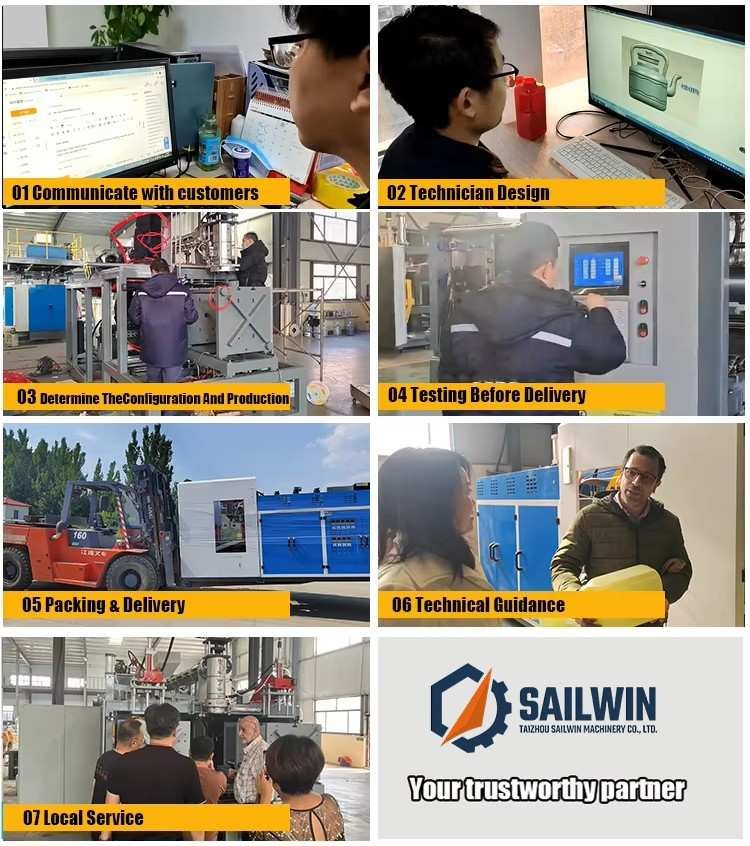
Yes. Every Sailwin HDPE extrusion blow molding system undergoes continuous 72-hour factory acceptance testing (FAT) using the client’s actual HDPE resin and mold tooling. Bottle wall thickness ultrasound profiling, 1.8-meter cold drop tests, and hydraulic pressure decay logs are documented and certified under ISO 9001 certified manufacturing quality protocols prior to international shipping.
Summary & Related Machinery Guides
Selecting the right HDPE blow molding machine requires matching container volume to the appropriate extrusion class: continuous shuttle systems for high-output small bottles, and rigid accumulator head machines with 100-point parison programming for heavy-duty jerrycans and industrial chemical drums. Investing in balanced clamping forces, high-plasticizing barrier screws, and precision parison controllers guarantees uniform wall distribution, low container scrap, and seamless UN certification compliance.
To further explore blow molding technology across industrial packaging formats, review our specialized technical guides:
- Extrusion Blow Molding Machine (EBM) Series Catalog — Browse full technical specifications for all HDPE models.
- Jerrycan Blow Molding Machine Guide — Specialized accumulator systems for 10L to 30L chemical containers.
- Large Extrusion Blow Molding Machine Specifications — Sizing machinery for 200L drums and IBC bulk tanks.
- Blow Molding Machine Knowledge Center — Comprehensive hub covering extrusion and stretch blow molding systems.
Ready to Engineer Your HDPE Extrusion Production Line?
Speak with Sailwin’s technical extrusion engineering group today for comprehensive machinery proposals, parison control specifications, custom mold drawings, and factory layout designs.