The servo hydraulic blow molding machine question arrives the same way in almost every extrusion blow molding project: two quotations sit side by side, the servo-hydraulic version costs noticeably more, and the supplier promises energy savings. What is missing is the number that actually decides the purchase — how much of that premium comes back, and over what period, given the machine’s real duty cycle rather than a round-the-clock ideal.
Getting that wrong is expensive in both directions. Paying the premium on a machine that runs six hours a day at low output produces a saving that never repays the capital. Conversely, refusing the premium on a plant that runs three shifts on high-tonnage parts throws away the largest running-cost reduction available on the machine, every month, for the life of the asset — which is typically far longer than the payback calculation anyone did at the quotation stage.
Sailwin has delivered extrusion blow molding machines into 500+ installations across 60+ countries over 15+ years, manufacturing under ISO 9001:2015 with CE marking, with machines built on Siemens or Mitsubishi PLC control, FESTO blow valves, SMC cylinders, Schneider electrical components and ABB drives. Servo drive configurations are quoted at up to 30% energy saving against a standard hydraulic equivalent. This guide explains where that figure comes from, where it does not apply, and how to run the payback arithmetic on your own duty cycle before you sign.
Key Takeaways
- The saving scales with running hours, not with machine size alone. A high-output machine on single-shift operation can save less in absolute terms than a smaller machine running three shifts.
- Servo drive is quoted at up to 30% saving, and the “up to” matters. The upper figure belongs to duty cycles with long idle or low-flow periods, which is where a fixed-displacement hydraulic system wastes the most.
- Some of the cheapest savings are not in the drive at all. High-pressure exhaust recovery, chilled water temperature control and mould cooling discipline reduce running cost with no capital premium.
Model the Energy Saving on Your Own Duty Cycle
Send your part, cycle time and shift pattern — our engineers return a machine recommendation with an energy and running-cost comparison within 24 hours.
1. Where the Energy Actually Goes on an Extrusion Blow Molding Machine
Energy discussions stall because the machine is treated as a single load. In reality an extrusion blow molding machine is four separate loads with very different behaviour, and only some of them respond to a servo upgrade. Separating them is the first step in any honest comparison.
| Load | Behaviour through the cycle | Responds to servo drive? |
|---|---|---|
| Hydraulic pumps and drives | Carry clamping, carriage and blow-pin movement. A fixed-displacement pump delivers full flow even during the long low-demand portions of the cycle | Directly. This is where the quoted saving is generated |
| Extruder barrel heating | Continuous and largely independent of cycle. Controlled by zone, not by drive architecture | No. Addressed through insulation and heating control instead |
| Mould temperature control | Chillers and pumps running continuously to hold mould temperature; the load depends on heat removed per hour | No. Improved by correct chilled water temperature and flow discipline |
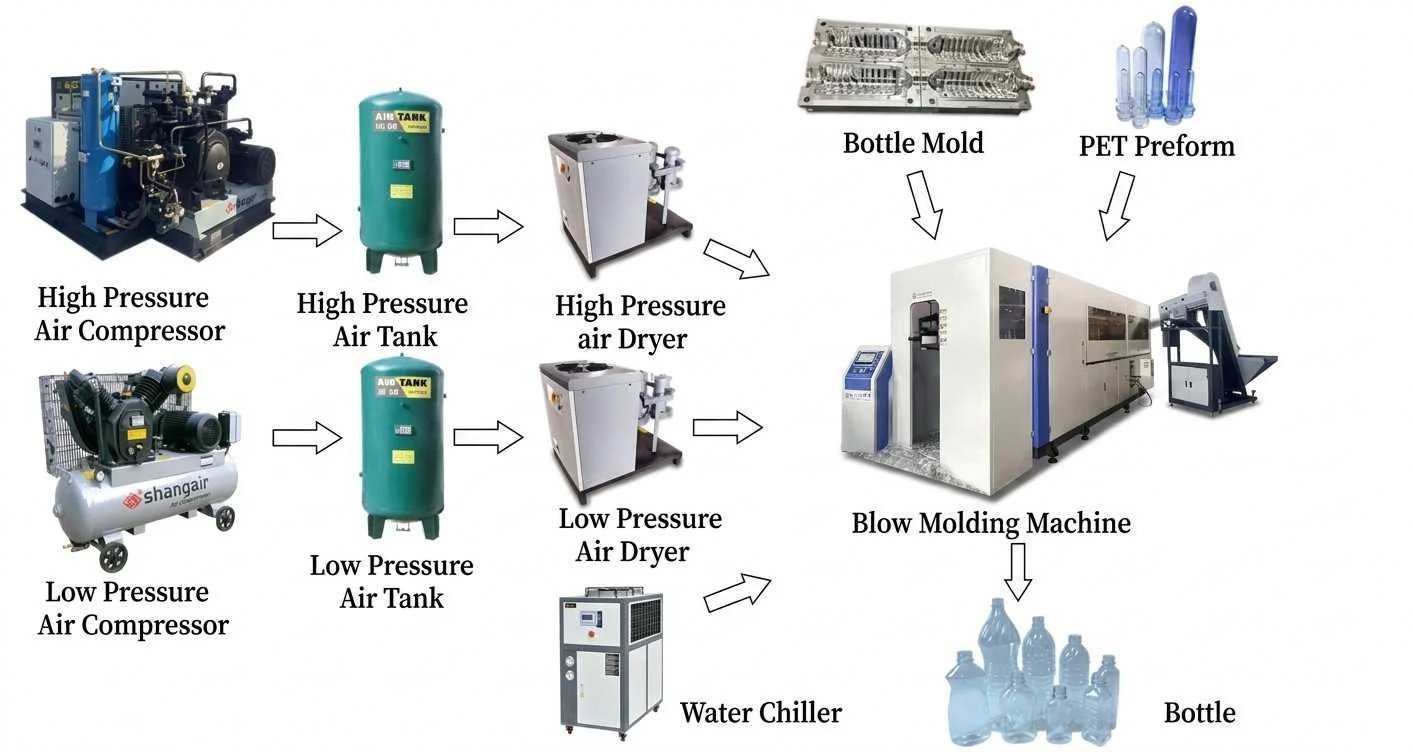
| Compressed air — low and high pressure | Blowing consumes high-pressure air in short bursts. The compressor is often the largest single electrical load attributed to the cell | Indirectly, through cycle timing and blow valve control |
Two observations follow. First, the servo saving applies to one of four loads, which is why a plant that buys a servo machine and changes nothing else rarely sees the headline figure on its electricity bill. Second, the compressed air system is frequently where the largest avoidable cost sits — and it can often be improved on an existing machine.
2. What a Servo-Hydraulic Drive Actually Changes
A conventional hydraulic system on a blow molding machine uses a fixed-displacement pump driven at constant speed. It produces a constant flow of oil, and the flow that is not needed at that moment is pushed over a relief valve and returned to tank as heat. During clamping, carriage movement and blow-pin actuation the machine needs high flow; during the blow dwell and the mould-open portion of the cycle it needs very little. The relief valve does not care. It keeps consuming full motor power and dissipating the surplus as heat, which the oil cooler then has to remove using more electricity.
A servo-hydraulic system replaces the constant-speed drive with a servo motor that varies speed with demand. Flow is produced when it is required and reduced when it is not, so the power drawn follows the cycle rather than ignoring it. Three practical consequences follow, and only the first is usually quoted:
- Electrical saving. Quoted at up to 30% against a standard hydraulic equivalent. The upper end belongs to cycles with long idle or low-flow periods and to machines whose hydraulic load dominates the total.
- Less waste heat. Because less energy is dumped across the relief valve, the oil runs cooler, which reduces the load on the oil cooler and slows hydraulic fluid degradation. Cooler oil also means more stable viscosity, which in turn makes movements more repeatable.
- Better control of motion. Speed and pressure can be profiled rather than switched, so carriage and mould movements can be softened at the ends of travel. On heavy parts — jerricans, drums, IBCs, pallets — that reduces mechanical shock and, over years, wear on the closing unit.
The second and third consequences are real but harder to put on a quotation, and they are the reason a servo machine sometimes pays back faster than the electricity arithmetic alone suggests. Reduced hydraulic heat and gentler movement translate into fewer maintenance interventions, and unscheduled downtime on a blow molding line is usually more expensive than the electricity the line consumes.
The honest test for a servo upgrade is not “does it save energy” — it does. The test is “does it save enough on my cycle, in my shift pattern, at my electricity price, to beat the premium I am being asked to pay”. Those are three inputs only the buyer has.
Compare Servo and Standard Hydraulic Offers Side by Side
Send both quotations and your shift pattern — we will lay out the running-cost difference and where the premium is or is not justified.
3. The Payback Arithmetic: Duty Cycle Decides Everything
A worked example makes the logic visible without pretending to know your plant’s numbers. Suppose a machine with a hydraulic load consuming 30 kW on a standard drive. A servo configuration delivering a 25% saving on that load returns 7.5 kW. Multiply by running hours and by the electricity tariff to get the annual saving; compare that against the premium.
| Duty pattern | Annual running hours (assumed) | Energy saved at 7.5 kW | When the premium is hard to justify |
|---|---|---|---|
| Single shift, 5 days | ~2,000 h | ~15,000 kWh per year | Frequently. Low utilisation makes any capital premium slow to recover on energy alone |
| Two shifts, 5 days | ~4,000 h | ~30,000 kWh per year | Depends on tariff; the case strengthens where high-tariff hours fall inside the shift |
| Three shifts, 6–7 days | ~6,500–7,500 h | ~49,000–56,000 kWh per year | Rarely. At continuous operation the premium is normally recovered well inside the asset’s life |
Illustrative arithmetic with assumed inputs (30 kW hydraulic load, 25% saving, round running hours). Substitute your own metered figures — the structure of the calculation matters more than the numbers shown.
Three refinements change the answer materially, and all three are frequently ignored:
- Part size and weight. A machine making 20 L jerricans or 200 L drums runs a much higher hydraulic load per cycle than a machine making 500 ml bottles, so the absolute saving is larger and the premium is recovered faster. The heaviest part in the Sailwin range is the SW-S1000L at up to 1,000 L, and the lightest is the SW-2S1L at up to 0.5 L running at up to 950 parts per hour on two stations.
- Cycle time. The proportion of the cycle spent at low hydraulic demand determines how much energy a servo drive can avoid wasting. Short, dense cycles with little dwell leave less room for improvement than long cycles with substantial cooling and handling time.
- Electricity tariff structure. If consumption is concentrated in high-tariff hours, the value of each avoided kilowatt-hour rises. Where the plant has on-site generation or a very low industrial tariff, the energy case weakens and the reliability case has to carry more weight.
There is also a capacity option worth considering before choosing servo for its own sake. Because a servo-hydraulic system controls pump output precisely, some configurations achieve the same movement speeds with a smaller installed hydraulic capacity, which reduces the machine’s peak demand as well as its average consumption. Where a factory’s electrical supply is the binding constraint on adding a machine, that can matter more than the running-cost saving.
4. Savings That Do Not Require a Capital Premium
Before comparing servo against standard hydraulics, it is worth fixing the losses that cost nothing to address. In most extrusion blow molding plants these produce a larger total reduction than the drive upgrade, and they apply to existing machines as well as new ones.
- High-pressure exhaust recovery. High-pressure blowing air is normally vented to atmosphere at the end of the blow. Recovering that exhaust for reuse reduces compressor load by approximately 20%. On any line where the compressor is the dominant electrical load of the cell, this is the single most effective measure available.
- Correct pressure levels. Blow air is supplied at 30–40 bar high pressure and 8–10 bar low pressure. Running high-pressure air above the requirement, or using high-pressure air where low-pressure air would do, wastes compressor energy on every cycle without improving the part.
- Chilled water discipline. Mould cooling circuits are typically operated between 8 °C and 12 °C. Chasing a lower temperature than the process needs increases chiller energy disproportionately, because each additional degree of cooling costs progressively more. Set the temperature from the cooling requirement of the part, and insulate pipework and mould manifolds so the chiller is not fighting ambient heat.
- Leak and standby elimination. Compressed air leaks and hydraulic losses are continuous. A plant that shuts down air and hydraulic systems during unplanned stoppages rather than leaving them pressurised recovers the cost of doing so within a short period, at no capital cost at all.
- Mould change discipline. A mould change in under 30 minutes on Sailwin machines keeps utilisation high; the most energy-efficient machine in a plant is always the one that is running rather than idling between jobs.
Combine these with a servo drive and the effect is cumulative rather than overlapping, because they act on different loads. That is the practical argument for treating the drive decision as one line in a wider energy review rather than as a standalone purchase question.
5. Case Study: Choosing Between Two Offers on a Jerrycan Line
An industrial packaging producer, evaluating two offers for a 20 L jerrycan line, could not reconcile the supplier’s quoted energy saving with the premium being asked, because the two figures were expressed on different bases.
- Two offers where the energy saving was quoted against different baselines, making the premium impossible to evaluate
- Compressed air consumption treated as a fixed site cost rather than as part of the machine decision
- Chilled water supplied colder than the process needed, raising chiller load for no quality benefit
- Energy comparison rebuilt on a single basis: metered hydraulic load, actual shift pattern and the site tariff
- High-pressure exhaust recovery specified so the compressor benefit was evaluated alongside the drive saving
- Mould cooling circuits reset into the 8–12 °C band with insulated manifolds instead of running colder than required
- Maintenance implications of cooler hydraulic oil included in the comparison rather than left out as intangible
- The offers became comparable, so the decision was made on running cost rather than on which supplier phrased the saving more favourably
- The air system delivered savings the drive alone could not, at a lower cost than the servo premium being debated
- The energy review became repeatable, giving the plant a method it could apply to the next machine rather than re-learning it each time
Scenario based on a Sailwin customer project; site-specific figures available on request during engineering review.
Frequently Asked Questions
Get a Running-Cost Comparison for Your Blow Molding Line
Send your bottle drawing, container sample or target output. Our engineering team replies with a machine recommendation, mould assessment and factory-direct quotation within 24 hours.
Related Reading:
• Extrusion Blow Molding Machines — 0.5 L to 1,000 L
• Extrusion Blow Molding Machine Cost Guide
• Reducing EBM Cycle Time Without Losing Wall Control
• Mould Cooling Strategy for Extrusion Blow Molding
• Jerrycan Blow Molding Machines
• EBM vs ISBM: Which Bottle Manufacturing Process Fits