PET bottle acetaldehyde testing exists because the most expensive defect in a bottling plant is the one that passes every inspection. A bottle can hold its weight, hold its wall thickness, survive top-load and drop tests, and still generate a complaint three weeks after the pallet was delivered — because what the customer noticed was not a bottle at all, it was a taste.
The cost arrives late, and it is never the cost of one bottle. By the time a taint complaint is confirmed the batch has already been filled, capped and shipped, and the plant is deciding whether to pull stock from a warehouse it does not control. Water is the most unforgiving product here, because it has no flavour of its own to hide anything behind.
Sailwin has delivered PET stretch blow molding machines into 500+ installations across 60+ countries over 15+ years, manufacturing under ISO 9001:2015 with CE marking and backing installations with a 2-year machine warranty. Machines hold preform heating between 90 °C and 115 °C under PID control at approximately ±1 °C, blow at 25–40 bar, and log 40+ parameters in real time — the evidence you need when a taint result must be traced to a stage instead of blamed on a resin supplier. This guide covers where AA comes from, which test tells you what, and which settings move the number.
Key Takeaways
- AA is a heat-history defect, not a resin defect. It is created twice — in the melt when the preform is moulded, and again in the reheat when the bottle is blown — so the level in a finished bottle is the sum of both stages, and fixing one alone rarely closes a complaint.
- Panels release batches; gas chromatography makes decisions. A panel tells you whether a trained taster perceives anything; only a quantified method gives a number you can specify, trend and act on before the batch ships.
- The controls are parameters you already log. Preform heating under PID control at approximately ±1 °C, blow pressure of 25–40 bar and chilled mould water at 8–12 °C are set points on the machine — reducing AA is a discipline of holding them, not an option you buy.
Chasing a Taint Complaint You Cannot Reproduce?
Send the container, the resin grade and your latest test result — Sailwin engineers return a process and machine recommendation within 24 hours.
1. Where Acetaldehyde Comes From in a PET Bottle
Acetaldehyde is not an additive and not a cleaning residue. It is a fragment of the PET molecule itself: when polyester is heated it can undergo thermal chain scission, and one of the volatile products is acetaldehyde — small, mobile, and able to migrate through the polymer wall into whatever the bottle contains. Nothing about the resin you bought is off-specification and nothing about the bottle is dimensionally wrong, which is exactly why a standard QC routine does not see it.
Every PET bottle carries two heat histories, and they add together. The first is the melt phase, when the preform is injection moulded: melt temperature, residence time, screw and barrel shear, resin drying and intrinsic viscosity all influence how much degradation happens before the preform has cooled. The second is the reheat phase, when that preform is warmed by infrared lamps and stretched into the mould: heater profile, preform surface temperature, time in the oven and blow pressure decide how much further degradation happens on the blowing machine.
Because both stages contribute, the reading on a finished bottle is a sum. That is why attempts to close a complaint by auditing one department tend to end in an argument rather than a correction: improving the blowing machine while the injection side runs hot, or drying resin harder while the reheat profile stays unchanged, moves the number less than expected and sometimes not at all.
| Stage | Source of heat | Main controls | What you can measure |
|---|---|---|---|
| Melt phase — preform injection | Barrel heating and screw shear | Melt temperature, residence time, screw design, resin drying | AA of the preform |
| Reheat phase — stretch blow | Infrared heaters and blow air | Heater profile, preform surface temperature, time in oven, blow pressure | AA in the freshly blown bottle plus the logged oven record |
| Storage and filling | Time and temperature after moulding | Preform storage, FIFO discipline, filling temperature | AA trend at release and at end of shelf life |
Industry literature on acetaldehyde in still water typically cites sensory detection thresholds in the order of 20–40 µg/L, and most brands work to an internal limit well below that. Treat this as a typical value for orientation: the governing number is the one agreed with your own customer, because different beverages reveal the note to different degrees.
2. Testing Methods: What Each One Actually Tells You
No single test answers the whole question, so most plants run two: a fast method for release decisions and a quantified reference method for evidence.
| Method | What it measures | Where it belongs | Limitation |
|---|---|---|---|
| Sensory panel | Whether a taint is perceptible at all, on conditioned samples | Final arbiter of a customer claim; release checks | Subjective, sample-conditioning sensitive, produces no number to trend |
| Headspace gas chromatography | Concentration of AA in the headspace or the contents, reported quantitatively | Specification, acceptance testing, cavity comparison, trending data | Needs laboratory equipment, and results depend heavily on equilibration control |
| Colourimetric indicator tubes | A rapid indication of AA present in the headspace | Shop-floor screening before a batch is released | Semi-quantitative: good for pass/fail, unreliable for trend analysis |
| Accelerated storage test | How much AA the container will develop over time and temperature | Validating a shelf-life assumption before launch | Predicts a trend; it does not tell you what is on the pallet today |
| Machine parameter record | The heat history the bottle actually experienced | Root cause when a quantified result moves | Explains the cause only if the parameters are logged and retained |
3. Specification, Sampling and Records
Three decisions turn a test into a control system.
Where the limit sits. Set your internal control limit below the customer’s agreed limit, so a reading inside your band is comfortably inside theirs. When the specification and the action level are the same number, every routine fluctuation becomes an escalation.
How many bottles, and from which cavities. Cavity-to-cavity variation is real and grows with cavity count: Sailwin’s PET range runs from the 2-cavity SW-F2-650 at 2,800 bottles per hour to the SW-F8H-800 at 16,000. One bottle from the middle of a run is an anecdote; take bottles from every cavity and across the run, so a start-up transient is not mistaken for a steady-state level.
When the samples are taken. AA develops with time and temperature, so a bottle tested straight after blowing and the same bottle tested after a week in a warm warehouse are not the same measurement. Define rest time, temperature and sealing inside the test method, and record the oven profile and blow pressure beside the result.
Need an AA Control Plan Tied to Your Machine Data?
Share your bottle, resin grade and target limit — we return a sampling plan, machine configuration and factory-direct quotation within 24 hours.
4. Case Study: A Water Line Chasing a Late Complaint
Bottles passed every in-plant check while complaints about a faint plastic note arrived weeks after delivery — a complaint that is almost impossible to investigate once the batch has gone.
- Complaints arriving long after the pallet had shipped, with no retained sample from the same batch to test
- Release decisions resting on a panel verdict rather than a number, so no trend existed to compare against
- Heat history split across two departments — preform moulding and bottle blowing — with no shared record
- A quantified headspace method introduced on retained bottles so results could be trended instead of debated
- Cavity-level sampling across the mould, because one reading cannot represent a line running several cavities
- Preform heating checked against the recorded oven profile, held at 90–115 °C under PID control at approximately ±1 °C
- A retained-sample protocol so future complaints stay reproducible
- The investigation moved from opinion to a trend line, because a panel verdict was replaced by a measured concentration per cavity
- The likely stage was narrowed before any hardware changed, which avoided a mould modification that would not have addressed the cause
- Retention and conditioning were standardised, which is what makes a complaint reproducible
Composite scenario from PET line commissioning experience, with no customer-identifying detail. Bottle-specific figures are confirmed during engineering review.
5. Process and Machine Measures That Reduce AA
Once the result is quantified, these are the measures that move it, cheapest first.
- Run the melt window cooler and shorter. Melt temperature and residence time are the two largest levers on the injection side. Reducing either inside the validated window reduces degradation; pushing output up at the same barrel temperatures works against you.
- Match screw and barrel hardware to the material. Sailwin injection machines use a dedicated PET screw and barrel with far-infrared nano heater rings — hardware selected for how heat reaches the polymer, not only how much is available.
- Hold the reheat profile steady rather than setting it once. Sailwin blowing machines hold preform heating between 90 °C and 115 °C under PID control at approximately ±1 °C. A profile that drifts with ambient temperature is the most common reason a good recipe stops working in a new season.
- Blow inside the working range and cool the mould properly. The 25–40 bar range and an 8–12 °C chilled water supply exist because pressure, preform temperature and cooling have to cooperate; raising pressure to fix a shaping problem that is really a heating problem only adds energy to the preform.
- Use the PLC record, and control preform logistics. Machines log 40+ parameters in real time and are FAT tested at full load before shipment, so you have a documented baseline; and because AA keeps developing after moulding, cool first-in-first-out preform storage matters as much as the machine.
6. Specifying a PET Machine When AA Is a Hard Requirement
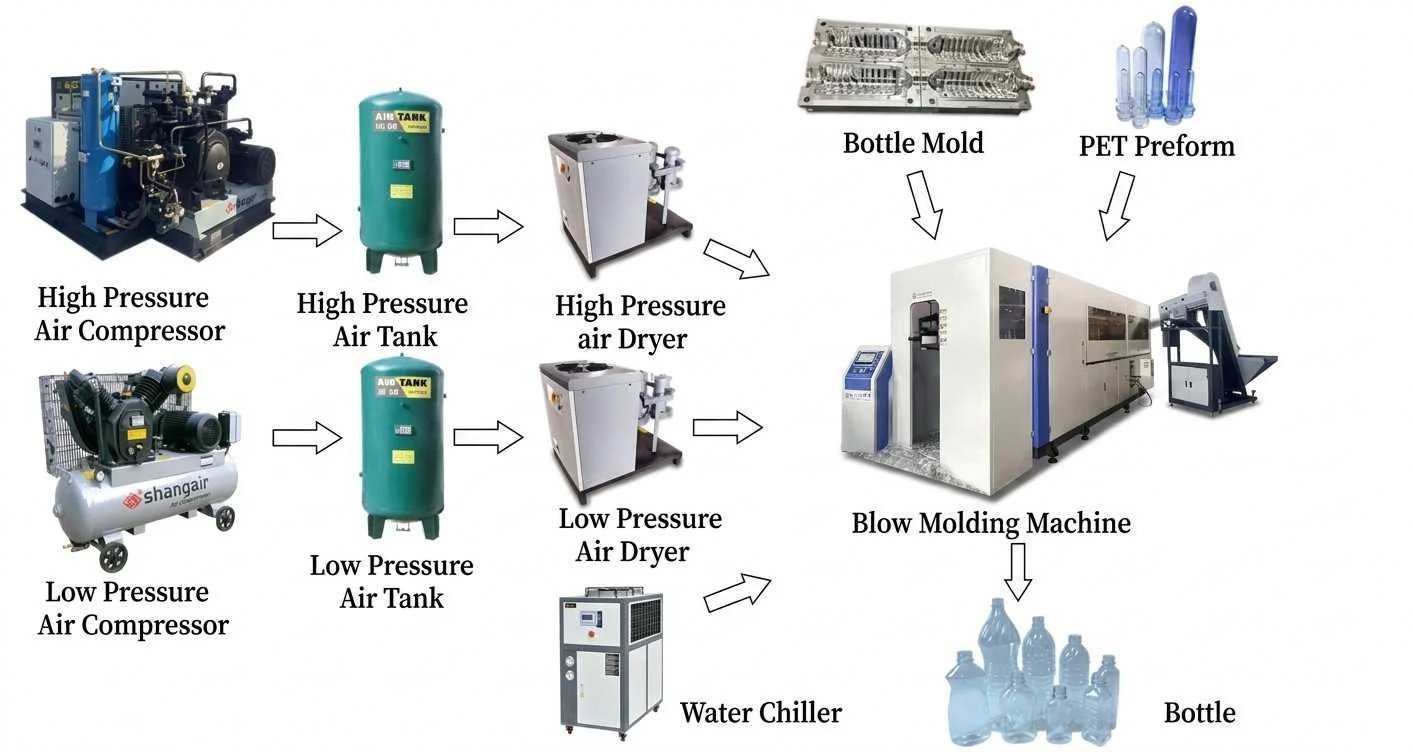
If acetaldehyde is a hard requirement in your specification, machine selection is where you make it achievable. The range below covers the automatic PET blow molding models Sailwin builds.
| Model | Cavities | Output | Max bottle volume |
|---|---|---|---|
| SW-F2-650 | 2 | 2,800 BPH | ≤650 ml |
| SW-F4-650 | 4 | 5,500 BPH | ≤600 ml |
| SW-F4-2000 | 4 | 4,500 BPH | ≤1,800 ml |
| SW-F6-2000 | 6 | 7,500 BPH | ≤1,800 ml |
| SW-F6H-800 | 6 | 12,000 BPH | ≤800 ml |
| SW-F8H-800 | 8 | 16,000 BPH | ≤800 ml |
Send the container drawing including neck finish (PCO 28, 30 or 38 mm, wide-mouth up to 130 mm), the target bottle weight, the agreed AA limit, the required output in bottles per hour and your available air and chilled water services. Sailwin engineers return a cavity count, machine model and factory-direct quotation within 24 hours; delivery is typically 30–45 days, or 45–60 days for custom configurations.
Frequently Asked Questions
Get an AA Control Plan Built Around Your Bottle and Resin
Send your bottle drawing, container sample or target output. Our engineering team replies with a machine recommendation, mould assessment and factory-direct quotation within 24 hours.
Related Reading:
• PET Blow Molding Machines — 2-cavity to 8-cavity models
• Reducing Acetaldehyde at the Preform Stage
• PET Water Bottle Blowing Machines
• Mould Cooling Water Control on PET Lines
• PET Carbonated Bottle Blow Molding Machines
• PET Blow Molding Machine Buying Guide