Updated: 2026 Thermal Guide · By Sailwin Auxiliary Division
Sizing Water Chillers for PET Blow Molds: Heat Dissipation Formulas
While high-pressure compressed air provides the kinetic energy to inflate a hot 115°C preform, it is the mold water cooling circuit that freezes the plastic into a rigid, self-standing container. If your factory pairs a high-speed blow molder with an undersized industrial chiller for blow molding, cavity temperatures gradually rise during continuous shifts. Bottles eject warm, base petaloids sag into convex rocker bottoms, and line technicians are forced to artificially lengthen cycle times, sacrificing 20% or more of machine capacity.
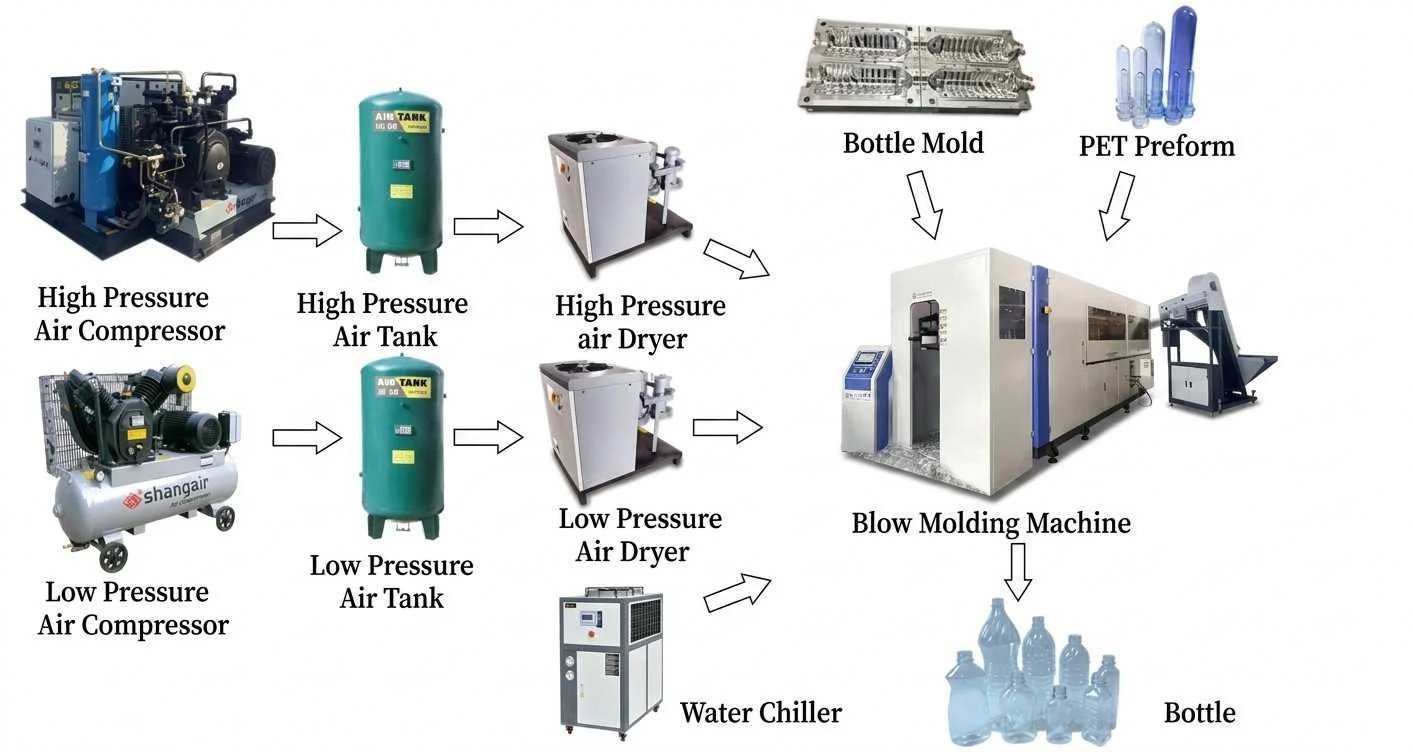
Sailwin supplies complete turnkey packaging solutions, matching our blow molders with dedicated industrial scroll chillers engineered for high-pressure mold cooling. We help plant engineers calculate exact thermal heat extraction loads, design turbulent water channel circuits, and eliminate summertime mold condensation sweating.
This technical sizing manual details mathematical heat dissipation formulas, compares air-cooled vs. water-cooled chiller architectures, and outlines closed-loop fluid treatment protocols.
Key Takeaways
- Mathematical Thermal Sizing Formula: Chiller cooling capacity must equal hourly PET throughput (kg/hr) × specific heat capacity (1.3 kJ/kg·°C) × temperature delta (85°C), plus a 20% safety factor.
- Dedicated Dual-Circuit Temperature Zones: Feeding 8°C water to base petaloid inserts and 12°C water to bottle body cavities optimizes cycle speed while preventing mold sweat condensation.
- Turbulent Flow Prevents Thermal Lag: Maintaining 5.0 to 6.0 bar pump delivery pressure ensures a Reynolds number above 4,000, maximizing convective heat transfer through aluminum mold baffles.
Need an exact chiller sizing calculation for your blowing line?
Send us your bottle output (BPH) and preform weights for an engineered thermal balance report.
1. Chiller Sizing Matrix by Machine Output and Preform Mass
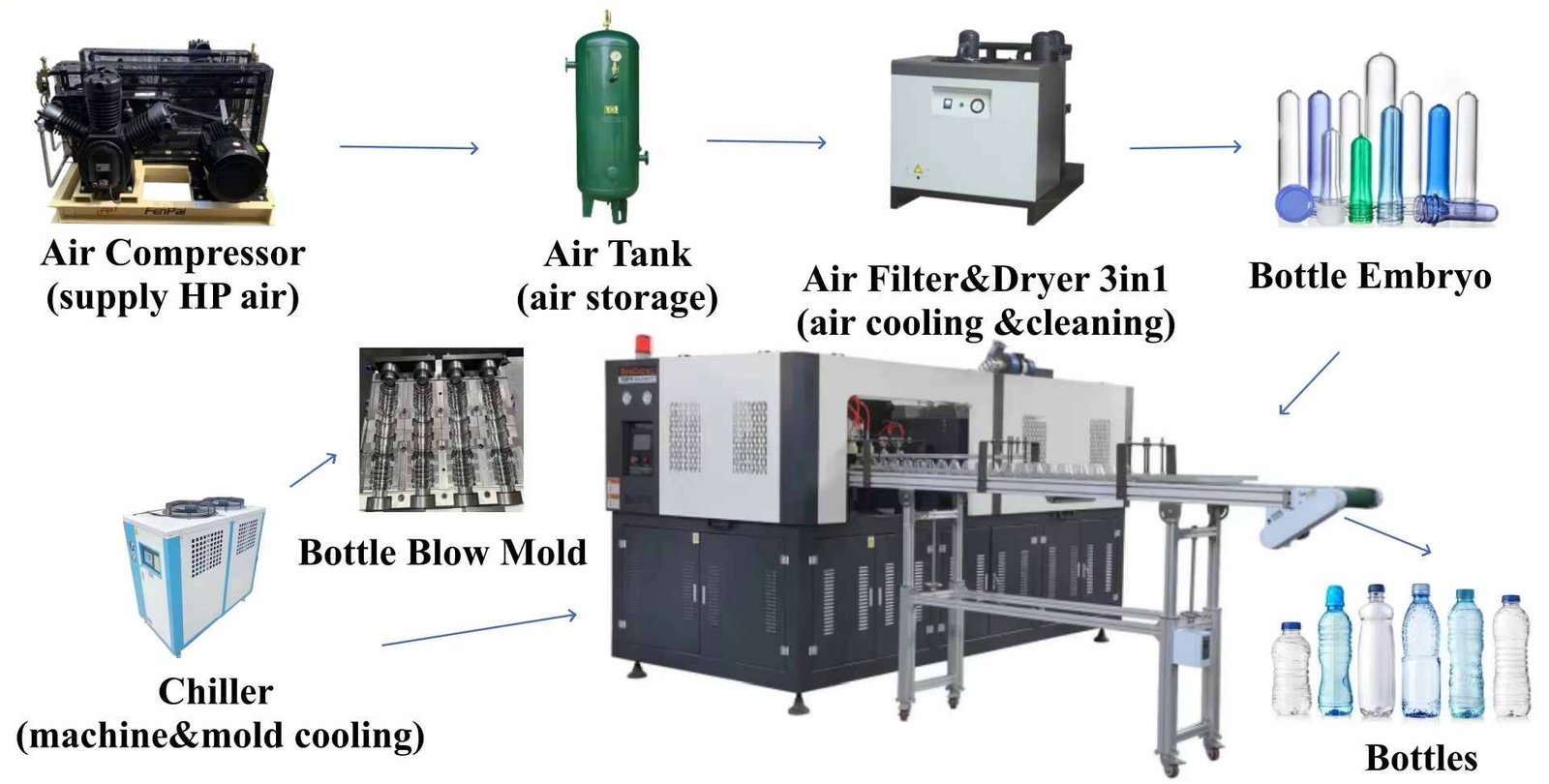
Chiller sizing is governed strictly by the hourly weight of plastic processed, not by cavity count alone. Blowing 2,000 BPH of 5L edible oil jugs (110g each) requires far more chiller tonnage than 6,000 BPH of lightweight 500ml water bottles (12g each).
| Line Speed (BPH) | Bottle Size / Preform Weight | Resin Throughput (kg/hr) | Recommended Chiller Size | Cooling Capacity (kW / Tons) |
|---|---|---|---|---|
| 2,000 BPH (2-Cavity) | 500ml Water (13g) | 26 kg/hr | 3 HP Air-Cooled | 8.5 kW / 2.4 Tons |
| 4,000 – 6,000 BPH (4-Cavity) | 500ml Water (13g) | 78 kg/hr | 5 HP Air-Cooled | 14.5 kW / 4.1 Tons |
| 6,000 BPH (4/6-Cavity) | 1.5L Water (28g) | 168 kg/hr | 7.5 HP Air-Cooled | 22.0 kW / 6.2 Tons |
| 1,200 BPH (2-Cavity) | 5L Edible Oil (110g) | 132 kg/hr | 7.5 HP Air-Cooled | 22.0 kW / 6.2 Tons |
Check out our complete line of automatic blowers on our PET blow molding machine catalog, or review auxiliary budgeting in our blow molding machine cost guide.
Need an auxiliary equipment quote including chiller and compressor?
Sailwin delivers turnkey auxiliary packages with stainless steel water reservoirs and high-pressure pumps.
2. Sailwin Case Study: Beverage Bottler Cures Base Rocking & Speeds Cycle
A water packaging facility in Iraq solved summertime bottle deformation by upgrading from an aging cooling tower to a Sailwin 7.5HP dedicated industrial chiller, cutting cycle time by 0.6 seconds.
- Client: Bottled water plant producing 500ml still water bottles at 5,000 BPH during 48°C ambient summer heat.
- Problem: Relied on an ambient cooling tower; water temperature reached 36°C, causing bottles to eject soft and deform.
- Throughput Loss: Operators were forced to extend mold cooling dwell by 0.9s, reducing line speed by 25%.
- Equipment Upgrade: Installed Sailwin SW-CH-75 7.5HP air-cooled industrial scroll chiller delivering 10°C water at 5.5 bar.
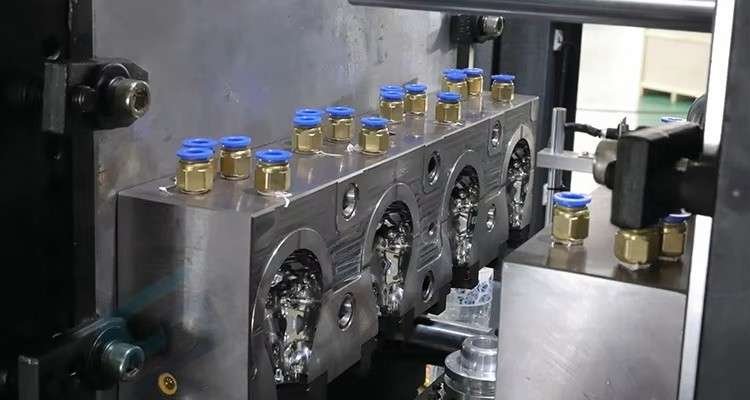
- Dual-Zone Piping: Separated base mold cooling lines to run 8°C chilled water directly through petaloid inserts.
- Dehumidifier Integration: Added an enclosed cabin air dryer to prevent condensation on mold faces.
- Cycle Restored: Mold cooling time dropped by 0.9s, restoring full 5,500 BPH production capacity.
- Base Defect Eliminated: Rocker bottoms dropped to zero, with 100% of bottles standing perfectly upright on conveyors.
- Annual Value: Additional bottle capacity generated $34,000 in net profit during peak summer beverage demand.
Data source: Sailwin Engineering Field Log #IRQ-2025-06. Equipment: SW-CH-75 Industrial Water Chiller.
Having issues with bottle cooling or summer mold sweating?
Connect directly with Sailwin’s auxiliary cooling engineers on WhatsApp for instant technical advice.
3. Frequently Asked Questions: Industrial Water Chillers for Blow Molding
Need custom chiller sizing for an upcoming packaging project?
Connect directly with Sailwin’s auxiliary cooling engineers on WhatsApp for instant equipment quotes.
4. Summary: The Power of Thermal Stability
Pairing your stretch blow molder with an accurately sized industrial water chiller ensures rapid bottle solidification, rock-solid vertical container stability, and sustained maximum line speed. Sailwin provides integrated chiller packages tailored to blow molding duty cycles.
- Size chiller tonnage based on hourly resin weight throughput plus a 20% safety margin.
- Maintain 5.0+ bar delivery pressure to ensure turbulent heat-stripping flow through mold channels.
- Partner with Sailwin for turnkey blow molders, chillers, air compressors, and complete packaging engineering.
SAILWIN AUXILIARY · CHILLER EXCELLENCE
Ready to Optimize Your Blow Mold Water Cooling System?
Send us your bottle blower specifications and hourly output targets. Our thermal engineering team will calculate exact heat dissipation loads and configure an industrial chiller proposal within 24 hours.
Explore Complete PET Packaging Solutions:
• PET blow molding machine – Comprehensive catalogue of linear and rotary stretch blowers.
• pet blow molding machine cost guide – Complete 2026 pricing and auxiliary breakdown.
• contact our engineering team – Request customized machinery blueprints and quotations.
• Need dedicated technical advice? Contact our machinery specialists for a 1-on-1 equipment evaluation.