Updated: 2026 Engineering Standard · By Sailwin Technical Team
Extrusion Blow Molding Defects and Remedies: Solving Parison Sagging, Flash & Wall Thinning
In industrial extrusion blow molding (EBM)—producing everything from 1L motor oil bottles to 20L stackable jerrycans and 200L L-Ring chemical drums—a minor process deviation triggers immediate container scrap. A parison with thermal sagging, die swell instability, or pinch-off misalignment causes thin container corners, weak bottom weld seams, and catastrophic failures during UN-standard drop testing.
Unlike preform stretch blowing with rigid dimensional cores, EBM relies on hanging molten hollow plastic tubes (parisons) captured between closing tool steel platens on Sailwin extrusion blow molding machines.
This factory-floor troubleshooting manual delivers actionable engineering remedies for the top 6 EBM container defects, helping plant managers boost yield and eliminate resin waste.
Key Engineering Takeaways
- Parison Sagging Control: Excessive gravity draw on heavy parisons causes upper bottle wall thinning. Resolved by raising extrusion speed, lowering die head temperature by 5°C–8°C, or utilizing accumulator head shot cylinders.
- Pinch-Off Seam Integrity: Bottom weld leaks occur when pinch land width is razor sharp (<0.2mm) or clamp tonnage is insufficient. Standardizing lands to 0.4–0.7mm with 35° relief pockets guarantees hermetic drop-test survival.
- 100-Point Parison Profiling: Wall thickness variation on asymmetrical containers (such as offset handle jerrycans) is eliminated by programming multi-point servo parison die gap curves.
Experiencing Drop-Test Failures or Flashing on EBM Containers?
Submit photos and container specifications for expert root-cause diagnosis by Sailwin blow molding specialists.
1. Troubleshooting Matrix: Top Extrusion Blow Molding Defects and Remedies
EBM Golden Rule: 80% of container drop-test failures are caused by improper mold pinch-off land geometry or incorrect die head temperature balance.
Review the comprehensive diagnostic table below to solve hollow container defects on your plant floor:
| Defect Phenomenon | Visual Manifestation | Primary Root Cause | Engineering Corrective Action |
|---|---|---|---|
| Parison Sagging | Upper bottle shoulder walls are paper-thin; bottom is heavy | Melt temperature too high or extrusion speed too slow | Lower die zone temperatures by 6°C–10°C; increase screw RPM or accumulator discharge speed. |
| Bottom Weld Rupture | Container splits along the pinch seam during drop testing | Pinch-off land too sharp or insufficient clamping force | Widen pinch land to 0.5mm; polish relief angle to 35°; check hydraulic toggle clamp lockup pressure. |
| Die Lines / Streaks | Vertical scratch lines on bottle outer surface | Carbonized resin particles or nicked die tooling lips | Purge extruder with high-viscosity purge compound; polish die lip with brass wool and diamond paste. |
| Rocker Bottom (Unstable) | Bottle wobbles or bulges outward at the base center | Residual internal pressure or slow mold base cooling | Extend exhaust blow delay by 0.3s; lower chiller water temperature on bottom mold cooling circuit. |
| Curling / Flashing | Heavy plastic flash requires manual trimming along parting | Excessive parison diameter or clamp platen deflection | Install smaller diameter die tooling pin; check mold alignment pins; inspect tie-bar platen parallelism. |
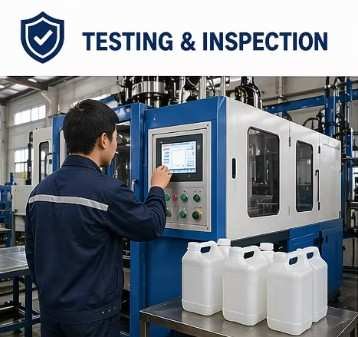
Sailwin Customer Case Study: Chemical Container Producer Passes UN Drop Test with Sailwin EBM Retrofit
How an industrial chemical packaging plant in South Africa eliminated 20L Jerrycan bottom weld splitting under UN hazardous goods certification.
- Containers dropped from 1.8 meters ruptured at the bottom weld seam, failing UN Level II dangerous goods testing.
- Container rejection rate reached 6.5% during quality audits.
- Older machine lacked parison programming, causing heavy, overweight containers (+180g resin waste per drum).
- Supplied Sailwin SC-T2S25L heavy-duty extrusion blow molding machine with MOOG 100-point parison control.
- Engineered hardened D2 steel pinch-off inserts with calibrated 0.65mm crushing lands and 38° relief pockets.
- Optimized resin melt profile using high-molecular-weight HDPE (HMW-HDPE).
- 100% of tested containers passed the 1.9-meter sub-zero drop test without seam leaks.
- Average container weight optimized by 120g without sacrificing corner structural rigidity.
- Annual resin material savings exceeded $68,000 USD.
Data source: Sailwin Factory Commissioning Record & UN Certification Compliance Certificate, 2026.
Frequently Asked Questions
SAILWIN MACHINERY · FACTORY-DIRECT PACKAGING SYSTEMS
Upgrade Your Extrusion Blow Molding Precision
Sailwin manufactures high-stability EBM systems equipped with MOOG 100-point parison controllers and servo hydraulic clamping. Request consultation today.
Explore Integrated Packaging Machinery on Sailwin:
• PET Preform Injection Molding Machine – High-speed 140T to 550T systems for multi-cavity bottle preform lines.
• PET Water Bottle Blowing Machine – Linear automatic servo stretch blow molding equipment.
• Liquid Filling Machine & Bottling Line – 3-in-1 rotary monoblocs for drinking water and beverage factories.
• HDPE Extrusion Blow Molding Machine – Industrial continuous blow molding systems for jerrycans and drums.
• Need technical plant advice? Contact our engineering team for free turnkey consultation.