Updated: 2026 Engineering Standard · By Sailwin Technical Team
Liquid Filling Line Troubleshooting: Practical Solutions for Foaming, Dripping & Level Variation
In continuous bottling operations running between 4,000 and 18,000 BPH, filling room downtime directly erodes operating profit margins. A minor nozzle calibration drift or air leak triggers severe product foaming, sticky bottle neck residue, carton moisture damage, and erratic fill volume rejections.
Whether you are running purified water, carbonated soft drinks, or hot-filled juices on Sailwin rotary 3-in-1 monobloc filling machines, identifying root causes swiftly separates profitable plants from chaotic operations.
This factory-tested maintenance guide correlates visual bottling line faults with specific valve, seal, pneumatic, and starwheel mechanical adjustments to keep your packaging line operating at peak OEE.
Key Engineering Takeaways
- Foaming Root Causes: Liquid foaming is usually caused by turbulent nozzle fluid velocity, air leaks in product supply suction lines, or warm filling temperatures (especially in carbonated CSD lines above 5°C).
- Drip-Free Nozzle Sealing: Nozzle dripping after fill shutoff indicates worn silicone or Viton valve diaphragm seals, or uncalibrated vacuum suck-back return timers.
- Starwheel Timing Precision: Bottle scuffing or infeed conveyor crushing occurs when synchronization sensors drift or starwheel pocket pockets wear beyond 0.5mm tolerance.
Experiencing Bottling Line Jams or Inaccurate Filling?
Contact Sailwin beverage engineering specialists for valve calibration blueprints and remote technical diagnosis.
1. Troubleshooting Matrix: Top Liquid Filling Line Faults and Remedies
Maintenance Golden Rule: 70% of fill level inconsistencies are caused by uneven liquid supply tank head pressure or blocked air vent return pipes inside filling nozzles.
Review the comprehensive diagnostic table below to solve filling and capping issues on your plant floor:
| Fault Symptom | Visual Condition | Probable Root Cause | Engineering Corrective Action |
|---|---|---|---|
| Product Foaming | Excessive foam overflows bottle neck during fill | High nozzle velocity, warm liquid temp (>5°C in CSD), air in line | Lower liquid inlet velocity; chill CSD product to 2°C–4°C; check supply pump intake gaskets. |
| Nozzle Dripping | Liquid drips onto bottle conveyor after filling carousel | Worn nozzle sealing ring or defective vacuum suck-back | Replace Viton valve tip seals; inspect pneumatic spring actuation; increase suck-back by 0.2s. |
| Fill Level Variation | Bottles exhibit ±5mm height difference in carton | Unbalanced liquid bowl pressure or clogged vent tubes | Maintain constant liquid level in bowl via analog float sensor; clear product scale from nozzle vent pipes. |
| Crooked / Tilted Caps | Caps cross-threaded on bottle neck finish | Misaligned cap chute or worn capping chuck jaws | Align cap transfer starwheel tangency; replace worn polyurethane chuck gripper pads. |
| Bottle Infeed Jams | Bottles topple or crush entering the starwheel | Air conveyor guide rails misaligned or backpressure too high | Adjust air conveyor neck rails to bottle collar clearance (+0.8mm); reduce blower inverter speed. |
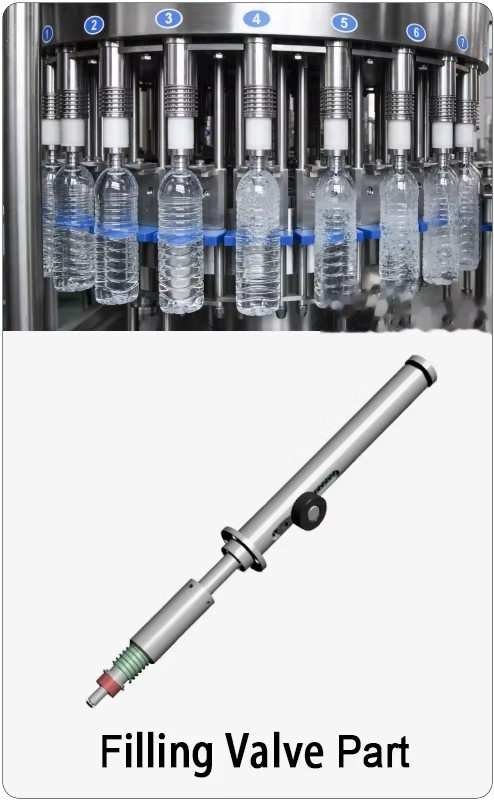
Sailwin Customer Case Study: Beverage Plant Solves Hot-Fill Foaming, Boosting Line Speed by 22%
How a tropical juice bottler resolved severe foaming on ready-to-drink mango and guava lines by recalibrating nozzle flow dynamics.
- High viscosity juice foamed intensely at 88°C hot-fill temperatures, overflowing 4.2% of containers.
- Line operators were forced to throttle line speed from 6,000 BPH down to 4,200 BPH.
- Liquid spills on bottle exteriors caused mold growth inside secondary shrink-wrapped cases.
- Upgraded to Sailwin laminar-flow submerged filling nozzles with 2-speed pneumatic descent.
- Calibrated micro-negative pressure return circuits to evacuate hot air pockets during filling.
- Integrated bottle neck air-knife drying stations prior to automatic labeling.
- Foam spillage dropped to zero; fill level consistency narrowed to ±1.5mm.
- Line speed safely restored to full 6,000 BPH rated capacity.
- Secondary packaging mold contamination completely eliminated.
Data source: Sailwin Plant Engineering Commissioning Record #SW-BF-2026, 2026.
Frequently Asked Questions
SAILWIN MACHINERY · FACTORY-DIRECT PACKAGING SYSTEMS
Maintain Maximum Bottling Uptime with Sailwin Engineering
Sailwin manufactures high-reliability sanitary rotary filling systems engineered with SUS304/316L stainless steel. Request service consultation today.
Explore Integrated Packaging Machinery on Sailwin:
• PET Preform Injection Molding Machine – High-speed 140T to 550T systems for multi-cavity bottle preform lines.
• PET Water Bottle Blowing Machine – Linear automatic servo stretch blow molding equipment.
• Liquid Filling Machine & Bottling Line – 3-in-1 rotary monoblocs for drinking water and beverage factories.
• HDPE Extrusion Blow Molding Machine – Industrial continuous blow molding systems for jerrycans and drums.
• Need technical plant advice? Contact our engineering team for free turnkey consultation.