The PET blow molding machine spare parts list is usually written after the first long stoppage, by whoever was on shift when it happened. A machine that was bought for 16,000 BPH sits idle for two weeks because a seal kit worth almost nothing was not on the shelf, and the production plan for the whole month is rewritten. This is not a maintenance failure; it is a procurement decision that was never made at the right time.
The pattern repeats predictably. The plant stocks what is cheap and available, which is generally the wrong list. Consumables that wear gradually and can be predicted are held in quantity, while assemblies that fail suddenly and stop the line completely are not held at all, because they cost more and nobody expects them to fail. The result is a shelf full of items that were never the constraint and an empty shelf where the constraint lives.
Sailwin has delivered PET stretch blow molding machines into 500+ installations across 60+ countries over 15+ years. Machines are FAT-tested at full load before shipment, built to CE marking under ISO 9001:2015, covered by a 2-year whole-machine warranty, with common wear parts shipped within 48 hours and 7×24 remote support for diagnosis. The 48-hour route is fast, but it is still days of lost output — which is why the list below separates what you must hold locally from what you can reasonably order when you need it.
Key Takeaways
- Stock by consequence, not by price. The items that must be on site are those that stop the line immediately and take days to source, regardless of what they cost.
- Seals, lamps and filters are the real consumables. Track them by hours and cycles logged on the controller rather than by calendar, and replace them as condition requires.
- One spare of every long-lead electronics item is worth more than ten of anything fast-moving. A PLC module, a drive or a controller board cannot be substituted locally at any price.
Get a Spare Parts Kit Quoted With Your Machine
Send your model, cavity count and container range — our engineers return a recommended first-order spare parts list with lead times for each item.
1. Why a Low-Cost Part Stops a High-Output Line
Output is what makes a PET line expensive, so the cost of a stoppage is measured in containers not produced rather than in parts not purchased. A 6-cavity machine rated 12,000 BPH or an 8-cavity machine rated 16,000 BPH produces a very large number of containers in the days it takes an unexpected part to arrive. Against that arithmetic, holding a spare of every critical item is trivially cheap.
There is a second, less obvious cost. When a part is not held, the maintenance team improvises. A substitute seal is fitted, a valve is reassembled with an incorrect component, a sensor is bypassed to keep the line running. Improvised repairs extend the original fault into a series of secondary faults, and the machine’s parameter history — 40+ values logged in real time — becomes contaminated by a period nobody can explain. Stocking the right parts is as much about protecting the diagnostic baseline as it is about speed.
2. PET Blow Molding Machine Spare Parts: Critical Shutdown Items
These are the items that stop production outright and justify local stock. The list is organised by system so it doubles as a storage plan.
| System | Item to hold | Why it stops the line | Stocking guidance |
|---|---|---|---|
| Blow air | Blow valve seal and rebuild kits (FESTO combined blow valve assemblies) | Leaking blow valve means unstable 25–40 bar pressure and rejected containers | One full kit per machine, plus spare seals |
| Heating | Infrared heating lamps, reflectors, lamp holders and thermocouple or RTD sensors | A failed zone ends the 90–115°C heating window and stops production | Hold a percentage of total lamps plus spares of every sensor type |
| Control | PLC I/O module, PLC backup battery, HMI or controller board (Siemens / Mitsubishi) | No local substitute exists at any price; sourcing takes days or weeks | Hold one of each long-lead electronic item |
| Drive | Servo drive or inverter module and its cooling fan | Motion stops entirely; servo drive is also where power savings are realised | One spare per drive size used on the machine |
| Pneumatics | SMC cylinders, solenoid valves, high-pressure filter elements and regulators | Gripper, ejector and stretch functions fail without cylinders | One spare of each cylinder size; filters in quantity |
| Electrical | Contactors, relays, MCBs, fuses and proximity or position sensors (Schneider) | Safety interlocks and sequencing depend on them | Hold across every rating used; sensors in pairs |
| Tooling contact | Neck gripper or clamp jaws, stretch rod assembly, mould guide bushes and leader pins | Damages neck finish or causes misalignment and mould damage | One set per gripper type; bushes and pins in sets |
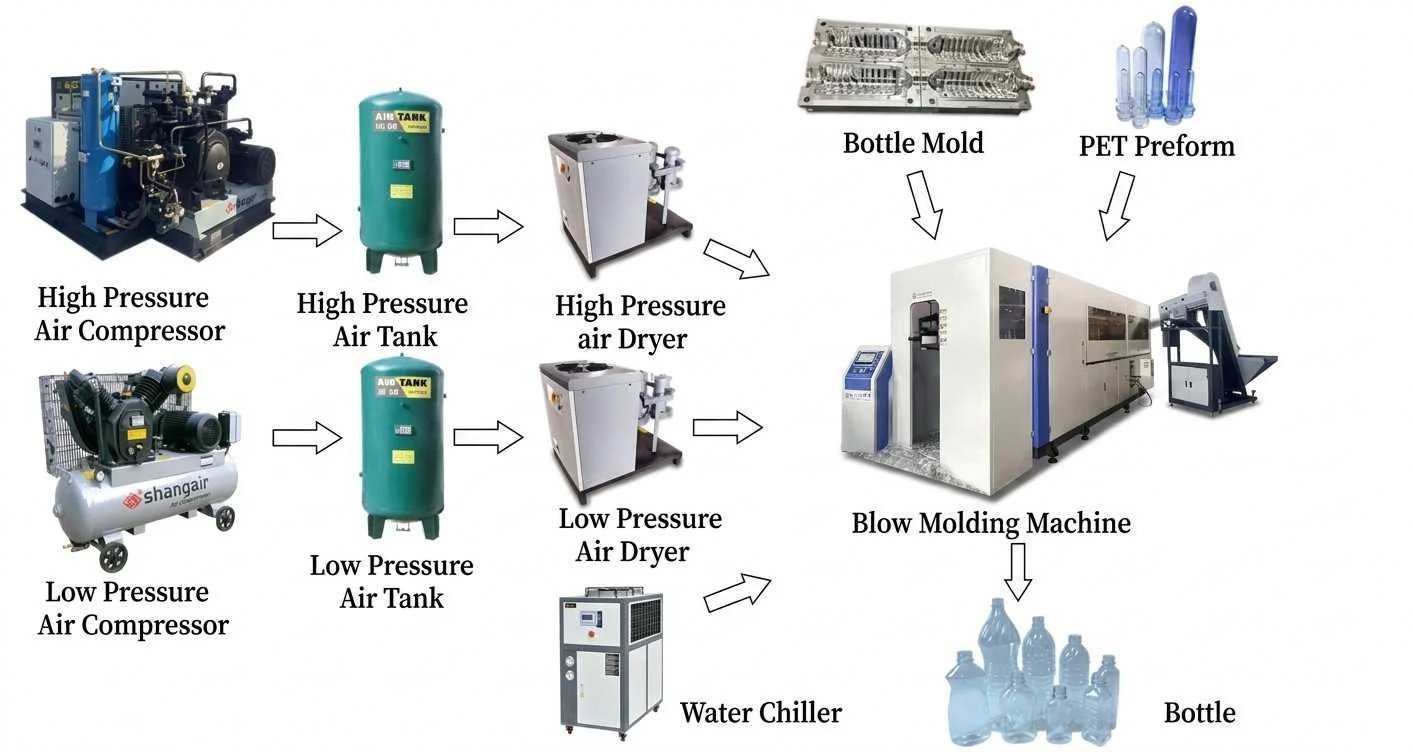
| Utilities | Chiller filters, air dryer consumables, water circuit seals and O-rings | Mould cooling and air quality affect every container produced | Full O-ring kit for the machine, filters in quantity |
Two entries on that list are systematically under-stocked and deserve a comment. The first is the O-ring and seal assortment, because the individual items are cheap and are therefore bought in ones and twos when a leak appears, which guarantees a second stoppage. The second is the drive and controller electronics, because they are expensive and their failure feels unlikely — but they are also the items with the longest replacement lead time and the least possibility of local substitution.
Check Your Spare Parts List Before It Costs You a Week
Send your current stock list and machine model — we return a gap analysis showing which critical items are missing.
3. PET Blow Molding Machine Spare Parts: Consumables and Intervals
Consumables behave differently from the items above: they degrade gradually and give warning. The right approach is to have them on the shelf and to replace them on evidence rather than on a calendar, because calendar-based replacement either wastes parts or misses failures caused by heavy duty cycles.
Heating lamps. Lamps age, and an aged lamp delivers less radiant energy to the preform than a new one at the same controller setpoint. That is why wall thickness can drift while every zone reads correctly. Log lamp hours, watch for zones that need a higher setpoint to hold the same result, and replace lamps as a set across a zone rather than singly, so the profile stays even.
Reflectors and lamp housings. Contamination on a reflector changes the energy reaching the preform, and it changes unevenly. Clean them on a defined schedule and inspect for degradation at the same time, because a cleaning interval that is not written down is a cleaning interval that quietly stops.
Seals and O-rings. Blow valve seals, water circuit seals and cylinder seals all harden with heat and cycle count. Track them against cycles logged by the controller, inspect at every mould change, and replace against condition. Because mould changes are designed to be completed in under 30 minutes, the changeover window is the natural inspection point.
Filtration and lubrication. High-pressure air filter elements, chiller filters and air dryer consumables protect the parts that are expensive to replace. Replace them on measured pressure drop or temperature performance wherever the measurement exists, and on a conservative fixed interval where it does not — the filters cost a fraction of the valves and drives they protect.
4. Building Your First Spare Parts Order
A practical first order has four tiers, and the sequence matters because it decides what gets bought when the budget is limited.
Tier one — long-lead electronics. One PLC I/O module matching the machine, one PLC battery, one drive or inverter per size used, and one HMI or controller board. This is the tier with the longest lead time and the least scope for substitution, so it goes first even though it is the most expensive.
Tier two — seals and valve kits. A complete O-ring and seal assortment for the machine, one full blow valve rebuild kit, and spare neck gripper jaws or clamps. This tier protects the two most frequent causes of quality-driven stoppages.
Tier three — heating and sensing. Spare lamps sufficient to re-lamp a zone, a set of reflectors, and spare thermocouples or RTDs of every type fitted. Nothing here is expensive individually, and all of it stops production immediately when it fails.
Tier four — fast-moving utilities and electrical. Filter elements, contactors and relays across every rating, fuses, proximity sensors in pairs, and pneumatic fittings. Much of this can be sourced locally in an emergency, which is why it comes last — but having it on the shelf removes the improvisation that turns a small fault into an extended one.
5. Case Study: Two Weeks Lost for a Missing Valve Kit
A water bottler running an automatic PET line had stocked lamps, filters and consumables carefully, but held no spare blow valve assemblies or electronics. A blow valve fault developed on one station and the line was stopped while a replacement was sourced.
- Blow valve fault on one station, causing pressure instability and container rejects
- No spare valve kit or electronics held on site; the stocked shelf held only fast-moving consumables
- Production stopped while a replacement was sourced and shipped
- Existing stock assessed against the critical shutdown list rather than against consumption history
- First order restructured into four tiers, with long-lead electronics and valve kits moved to the top
- Lamp hours, seal condition and filter pressure drop added to the maintenance record so replacement follows evidence
- Wear parts consumption tracked per shift, giving a predictable reorder point instead of an emergency call
- The critical gap was closed, with the parts whose absence caused the stoppage now held on site
- Reorder decisions became predictable, driven by logged hours and cycles instead of by a fault
- Improvised repairs were designed out of the maintenance routine by removing the reason for them
Scenario based on a Sailwin customer project; site-specific figures available on request during engineering review.
Frequently Asked Questions
Stock the Parts That Stop the Line
Send your bottle drawing, container sample or target output. Our engineering team replies with a machine recommendation, mould assessment and factory-direct quotation within 24 hours.
Related Reading:
• PET Blow Molding Machines — models and rated output
• Automatic PET Blow Molding Machines: SW-F series
• Power, Air and Water Requirements for a PET Line
• PET Blow Mould Cost Breakdown
• Operator Training Checklist for PET Blow Molding Machines
• Semi-Automatic PET Blow Molding Machines