Updated: 2026 Engineering Standard · By Sailwin Technical Team
PET Preform Defects Troubleshooting: Practical Solutions for Flash, Hazing, Sink Marks & High AA
In industrial bottle production, discovering preform quality flaws after containers reach the stretch blow molder results in thousands of dollars in wasted downtime and scrap. A defective preform with neck ovalization, gate brittleness, or wall thickness eccentricity cannot be saved by adjusting blow molder reheat lamps—it will burst or produce reject bottles.
Whether you are producing 14g lightweight water bottle preforms or 750g 5-gallon water jug preforms, understanding root-cause troubleshooting on your PET preform injection molding machine is the foundation of high-profit manufacturing.
This factory-floor troubleshooting matrix deconstructs the top 7 PET preform defects, correlating visual symptoms with immediate machine parameter and mold maintenance remedies.
Key Engineering Takeaways
- Flash Elimination: Parting line and neck thread flash is resolved by reducing peak injection pressure, checking mold clamping tonnage, or inspecting mold parting face flatness for debris.
- Thermal Haze vs. Moisture Haze: Uniform cloudiness indicates resin moisture hydrolysis (>50 ppm); localized cloudiness at the base or thick wall indicates sluggish mold water cooling.
- Short Shot Diagnosis: Premature solidification is cured by boosting injection speed, raising nozzle/hot runner temperatures by 5°C, or cleaning blocked mold cavity micro-vents.
Experiencing High Scrap Rates on Your Preform Line?
Send photos of your defective preforms for expert root-cause diagnosis by Sailwin tooling specialists.
1. Troubleshooting Matrix: Top Preform Defects and Solutions
Quality Rule: 80% of preform defects trace back to either incomplete resin drying or uncalibrated mold cooling circuits. Check water chiller flow and dryer dew point first.
Review the comprehensive diagnostic table below to identify and resolve defects on your injection floor:
| Defect Symptom | Visual Appearance | Probable Root Cause | Immediate Corrective Action |
|---|---|---|---|
| Parting Line Flash | Excess thin plastic fins along preform neck split or mold face | Clamp tonnage too low or excessive injection velocity. | Increase clamp tonnage by 10%; reduce transfer pressure; inspect mold parting face for damage. |
| Preform Hazing (Cloudy) | Milky opaque haze in preform body or gate area | Moisture hydrolysis or slow mold cooling crystallization. | Verify dryer dew point < -40°C; increase chiller flow velocity (Re > 4,000); lower melt temp 5°C. |
| Short Shots | Incomplete preform base or unfilled neck threads | Insufficient melt volume, low injection pressure, or air traps. | Increase shot size; raise injection speed; inspect and clean mold parting line micro-vents. |
| Sink Marks / Depressions | Surface dimples on thick preform neck collar or base | Inadequate holding pressure or premature gate freeze. | Increase holding pressure; extend pack timer by 0.5s; lower chiller water temperature. |
| Gate Stringing (Drooling) | Long plastic hairs hanging from the injection gate pip | Nozzle or hot runner gate tip temperature too hot. | Lower hot runner tip temp by 5°C; increase decompression suck-back distance by 2mm. |
| Internal Bubbles (Voids) | Vacuum voids or moisture bubbles inside preform walls | Volumetric shrinkage (void) or damp resin (bubble). | If bubble flattens upon heating, it is a vacuum void (increase pack pressure); if it expands, it is moisture. |
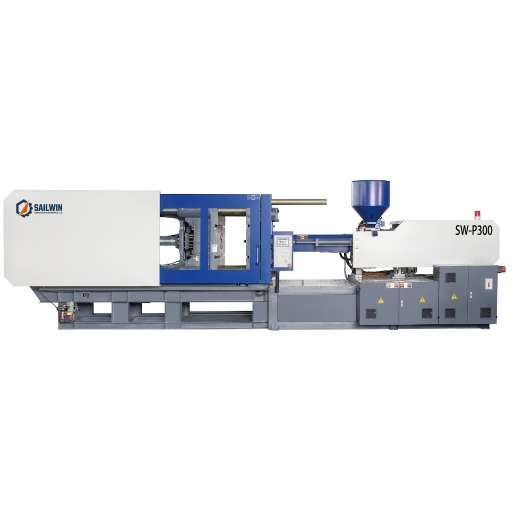
Sailwin Customer Case Study: Water Bottler Eliminates 4.5% Flash Scrap on 48-Cavity Preform Mold
How a high-speed packaging converter resolved parting line flash and gate stringing by retrofitting to a Sailwin SW-P368 servo system.
- Severe neck flash jammed preform infeed guide rails on downstream stretch blow molders.
- Manual trimming added $35,000 annually in labor costs and scrap.
- Mold platens on older machine bowed under peak injection pressure.
- Replaced old press with Sailwin SW-P368 (3,680 kN) featuring finite-element-analyzed box platens.
- Calibrated 4-stage injection pressure curves and electronic backpressure control.
- Integrated mold platen protection to prevent tool damage from unreleased preforms.
- Flash completely eliminated across all 48 cavities.
- Automated preform infeed into blow molders achieved 99.8% uptime.
- Annual resin and labor savings exceeded $52,000 USD.
Data source: Sailwin Quality Control Field Audit & Client FAT Acceptance Record, 2026.
Frequently Asked Questions
SAILWIN MACHINERY · FACTORY-DIRECT PACKAGING SYSTEMS
Eliminate Preform Molding Defects with Sailwin Engineering
Upgrade to Sailwin SW-P high-stability servo preform injection machines. Guaranteed shot-to-shot weight consistency within ±0.08g.
Explore Integrated Packaging Machinery on Sailwin:
• PET Preform Injection Molding Machine – High-speed 140T to 550T systems for multi-cavity bottle preform lines.
• PET Water Bottle Blowing Machine – Linear automatic servo stretch blow molding equipment.
• Liquid Filling Machine & Bottling Line – 3-in-1 rotary monoblocs for drinking water and beverage factories.
• HDPE Extrusion Blow Molding Machine – Industrial continuous blow molding systems for jerrycans and drums.
• Need technical plant advice? Contact our engineering team for free turnkey consultation.