Updated: 2026 Engineering Standard · By Sailwin Technical Team
How to Pass the Drop Test and Top-Load Strength Test for 5-Gallon and Heavy Water Bottles
In the commercial 5-gallon (18.9L / 20L) water delivery business, container physical durability is the paramount operational metric. Unlike lightweight single-serve water bottles that are discarded after one use, a returnable 5-gallon water jug must survive 30 to 50 refill cycles, rigorous route truck vibration, and 3-tier vertical pallet stacking.
If a 5-gallon bottle fails the 1.5-meter drop test or buckles under 250kg top-load pallet weight, water warehouses suffer massive product loss and commercial liability. On Sailwin 5-gallon PET blow molding machines, achieving superior impact strength requires mastering preform core heating and reinforcing structural chime ribs.
This engineering quality manual details the precise thermal profiling, pre-blow pressure curves, and bottle design rib geometry necessary to pass rigorous international packaging drop and compression standards.
Key Engineering Takeaways
- Drop Test Standard: Filled 5-gallon bottles must survive a flat bottom drop and a 45-degree angle chime drop from 1.5 meters onto a flat concrete surface without water leakage or corner cracking.
- Top-Load Compression Requirement: Bottles must withstand a minimum of 200 kg to 280 kg vertical compressive load to support 3-tier warehouse pallet stacking over 6 months of summer storage.
- Preform Core Thermal Penetration: With heavy preform wall thicknesses (7.0mm to 9.5mm on 650g–750g preforms), infrared heating must penetrate deep into the core using long-wave quartz lamps without blistering outer surfaces.
Having Cracking or Crushing Issues on 5-Gallon Bottles?
Submit photos and technical drawings of your 5-gallon bottle profile for structural rib analysis and preform heating optimization.
1. Engineering Parameters for Passing the 5-Gallon Testing Protocol
5-Gallon Structural Rule: Top-load strength is governed by horizontal rib geometry; drop strength is governed by uniform wall thickness along bottom chimes.
Review the standard international testing benchmarks and corrective molding parameters below:
| Quality Test | Target Benchmark | Failure Mechanism | Molding Engineering Solution |
|---|---|---|---|
| 1.5m Vertical Bottom Drop | Zero leaks across 5 consecutive drops | Base petaloid center star-cracking | Reduce preform base oven heat; increase high-pressure blow to 35 bar; check stretch rod tip clearance (2.0mm). |
| 1.5m 45° Angle Chime Drop | Zero corner rupture or crease tearing | Excessive wall thinning on bottom chime radius | Increase preform shoulder heating; increase mold chime transition radius to R15mm. |
| Vertical Top-Load Compression | Withstands 220kg – 280kg compressive force | Sidewall accordion buckling or shoulder collapse | Optimize horizontal reinforcing rib depth (minimum 6mm depth); ensure vertical rib sidewall wall thickness > 0.85mm. |
| Neck Finish Sealing Integrity | Zero liquid leak under 0.5 bar inverted pressure | Neck collar ovalization or cap thread distortion | Shield preform 55mm neck from infrared oven heat with water-cooled neck protection masks. |
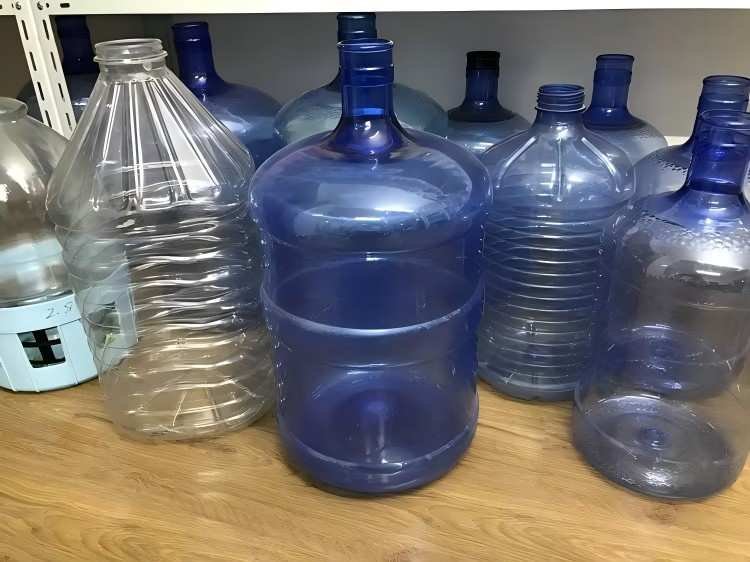
Sailwin Customer Case Study: Water Bottler Achieves 100% UN Drop Compliance on 700g PET 5-Gallon Jugs
How a commercial 5-gallon water provider in the Philippines eliminated delivery truck bottle bursting by adopting Sailwin internal-heating technology.
- Older blow molder scorched outer preform walls while leaving inner cores cold, causing 8.5% drop-test rupture rates.
- Delivery trucks reported 15–20 ruptured jugs daily during transit over rough regional roads.
- Pallet stacking in warehouse was limited to 2 tiers, wasting vertical storage space.
- Supplied Sailwin MW-5G specialized 5-gallon blow molder equipped with rotary internal-heating ovens.
- Extended preform heating cycle across 16 independent quartz lamp zones with cooling dwell pauses.
- Engineered heavy-duty aircraft aluminum mold with high-strength chime geometry.
- 100% of tested jugs survived 1.5m 45-degree angle drop tests onto concrete.
- Top-load capacity exceeded 260kg, allowing safe 3-tier warehouse pallet stacking.
- Zero transport container rupture claims over 12 months of distribution.
Data source: Sailwin 5-Gallon Commissioning Log & Warehouse Compression Test Report, 2026.
Frequently Asked Questions
SAILWIN MACHINERY · FACTORY-DIRECT PACKAGING SYSTEMS
Produce Heavy-Duty 5-Gallon Water Bottles with Sailwin
Sailwin manufactures specialized semi-automatic and linear automatic 5-gallon blow molders engineered for 650g–750g PET jugs. Request quote today.
Explore Integrated Packaging Machinery on Sailwin:
• PET Preform Injection Molding Machine – High-speed 140T to 550T systems for multi-cavity bottle preform lines.
• PET Water Bottle Blowing Machine – Linear automatic servo stretch blow molding equipment.
• Liquid Filling Machine & Bottling Line – 3-in-1 rotary monoblocs for drinking water and beverage factories.
• HDPE Extrusion Blow Molding Machine – Industrial continuous blow molding systems for jerrycans and drums.
• Need technical plant advice? Contact our engineering team for free turnkey consultation.