Every week, packaging buyers contact Sailwin with the same expensive mistake already made: they ordered an extrusion blow molding machine for a PET water bottle line, or specified a stretch blow molding machine for a jerrycan application. Both errors require a full machine replacement. Understanding extrusion blow molding vs stretch blow molding is not a minor technical detail — it is the single most fundamental decision in blow molding equipment selection, and getting it wrong costs $15,000–$80,000 in equipment replacement plus months of lost production.
This guide gives you a definitive answer: which process your product requires, why the two technologies are not interchangeable, and how to specify the right machine from Day 1.
| Factor | Extrusion Blow Molding (EBM) | Stretch Blow Molding (SBM) |
| Primary Materials | HDPE, PP, LDPE, multilayer EVOH/PA | PET, PP (ISBM) |
| Preform / Starting Material | Resin pellets → extruded parison | Injection-molded preform |
| Handle Integration | ✓ Native (in-mold) | ✗ Not possible |
| Wall Thickness Control | Parison programming (PWDS) | Preform design |
| Typical Applications | Jerrycans, drums, chemical tanks, automotive | Water bottles, CSD, juice, edible oil |
| CO₂ Barrier (CSD) | ✗ HDPE not suitable | ✓ PET excellent CO₂ barrier |
| Optical Clarity | Translucent (HDPE) | Crystal clear (PET) |
| Volume Range | 100ml – 10,000L+ | 100ml – 20L |
The Process Difference That Makes These Machines Non-Interchangeable
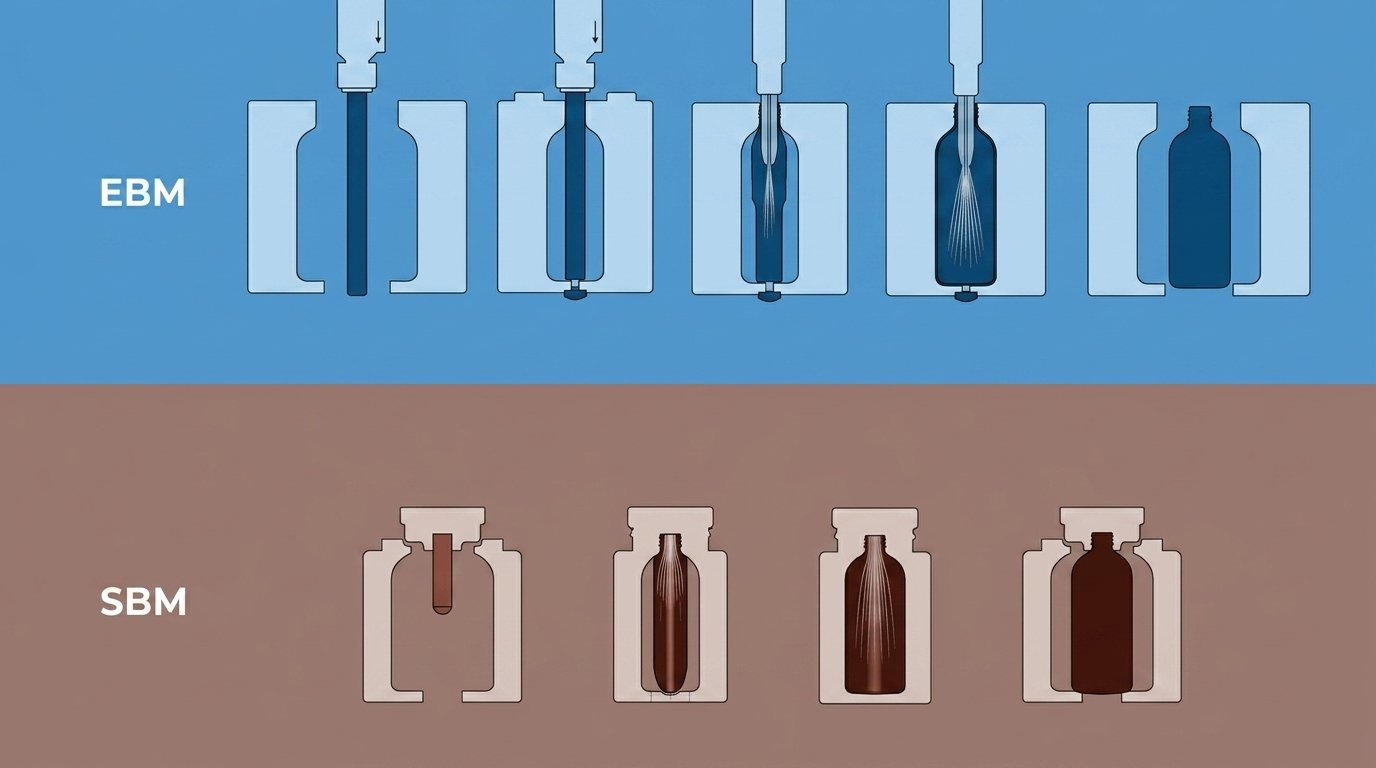
Most buyers who select the wrong technology do so because they understand both machines as “blow molding” — and assume the difference is only material compatibility. The reality is that EBM and SBM are fundamentally different manufacturing processes with different physics, different economics, and different quality outcomes.
How Extrusion Blow Molding (EBM) Works
EBM begins with resin pellets — HDPE, PP, LDPE, or a multilayer combination — fed into an extruder screw. The screw melts and conveys the resin through a die head, where it emerges as a hollow tube of molten plastic called a parison. The mold closes around the parison, a blow pin introduces pressurized air, and the parison inflates against the mold cavity walls. After cooling, the mold opens and the finished container is ejected — complete with any integrated handles, pinch welds, or flash.
The critical capability of EBM is parison wall thickness programming (PWDS): by varying the die gap dynamically during extrusion, the machine can deliver more material to areas of the container that experience higher stress during drop tests — handles, corners, base pinch welds. This is why HDPE jerrycans and chemical drums pass UN dangerous goods drop certification requirements that no PET bottle could survive.
How Stretch Blow Molding (SBM) Works
SBM begins not with resin but with a pre-manufactured injection-molded preform — a thick-walled test-tube-shaped piece of PET. The preform is heated in an infrared oven to the PET stretch temperature range (90–110°C), then transferred to the blow station where a stretch rod simultaneously extends the preform axially while blow air expands it radially against the mold cavity.
This biaxial orientation is the key to PET’s performance advantages: the molecular chains align in two directions, producing a container with exceptional clarity, CO₂ barrier properties (critical for carbonated drinks), and a high strength-to-weight ratio. A 500ml PET water bottle weighing 9.5 grams can withstand 3.5–5 bar internal pressure — impossible to achieve in HDPE of comparable weight.
The fundamental constraint of SBM: you cannot blow a PET preform into a container with an integrated handle. The preform geometry and biaxial stretch process are physically incompatible with handle formation. If your container requires a handle, EBM is the only option regardless of your preferred material.
Not sure which process your container requires? Send Sailwin your product drawing or sample — our engineers will confirm the correct technology and machine specification within 24 hours.
Get a Free Technology Consultation →
Material-to-Process Matrix: Which Resin Requires Which Machine
The fastest way to eliminate the wrong machine is to start with your container material — which is usually determined by your product’s regulatory requirements, barrier properties, or end-market standards, not by machine preference.
| Material | Correct Process | Why | Typical Application |
| PET | SBM only | PET requires biaxial orientation to achieve its strength and clarity — EBM cannot process PET effectively | Water, CSD, juice, edible oil, cosmetics |
| HDPE | EBM only | HDPE does not stretch-orient; requires extrusion and parison inflation | Jerrycans, drums, chemical containers, milk bottles |
| PP | EBM (standard) / ISBM (hot-fill) | Standard PP: EBM; heat-resistant PP for hot-fill: injection stretch blow molding | Automotive, food containers, hot-fill |
| LDPE / LLDPE | EBM only | Soft, squeezable containers requiring EBM’s parison-based process | Squeeze bottles, personal care, condiments |
| Multilayer EVOH/PA | EBM (multilayer coextrusion) | EVOH barrier layer requires coextrusion die head — only possible in EBM | Pesticides, fuel tanks, barrier food packaging |
Common mistake: Buyers specify “I want a clear container with a handle.” Clear = PET = SBM. Handle = EBM. These two requirements are physically incompatible in a single blow molding process. The solution is either to accept HDPE (translucent, not crystal clear) with EBM for the handle, or accept no handle with PET SBM for clarity.
Application-First Decision Guide: Start With Your Product, Not the Machine
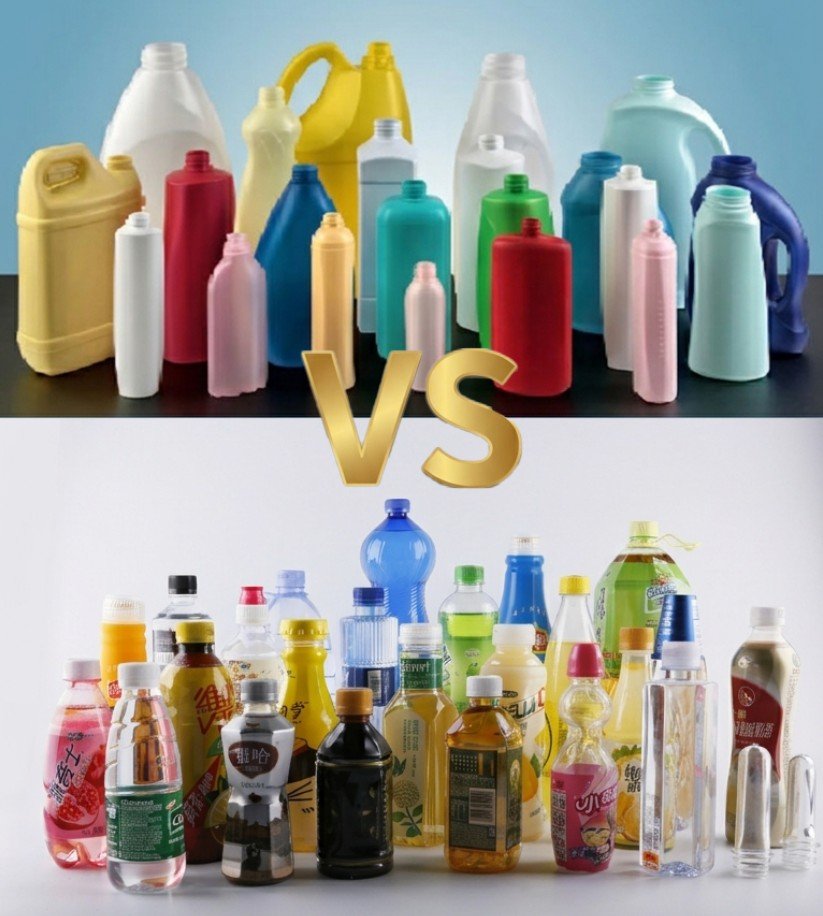
Choose Extrusion Blow Molding (EBM) When:
- Your container requires an integrated handle — jerrycans (5L–30L), chemical drums, motor oil containers, agricultural chemical tanks
- Your product is aggressive chemical — HDPE’s chemical resistance covers a wider range of solvents, acids, and bases than PET
- Your container exceeds 20 liters — SBM preform technology is limited to approximately 20L; larger containers require EBM accumulator head technology
- You need multilayer barrier packaging — EVOH or PA barrier layers for pesticides, fuel, or oxygen-sensitive food products require coextrusion EBM
- Drop test certification is required — UN-certified jerrycans and drums for hazardous goods transport must pass drop tests that only HDPE EBM containers can reliably pass
- Your container is automotive — fuel tanks, windshield washer fluid reservoirs, coolant expansion tanks: all EBM in HDPE or multilayer
Sailwin’s EBM range covers small-volume small extrusion blow molding machines, jerrycan blow molding machines, large extrusion blow molding machines, and accumulator head blow molding machines for containers up to 1,000L.
Choose Stretch Blow Molding (SBM) When:
- Your product is a beverage — still water, CSD, juice, sports drinks, RTD tea: all PET SBM globally
- Optical clarity is a sales requirement — PET’s crystal transparency is a shelf-appeal requirement in cosmetics, premium food, and personal care
- CO₂ retention is required — carbonated drinks require PET’s CO₂ barrier properties; HDPE cannot retain carbonation
- Lightweight is a cost driver — PET’s biaxial orientation delivers superior strength at lower wall thickness; a 500ml PET water bottle can be under 9 grams
- Your volume is high and your format is standard — high-speed PET SBM lines run at 12,000+ BPH for standard round bottle formats
Sailwin’s PET SBM range: fully automatic PET blow molding machines from 2-cavity to 6-cavity, plus high-speed PET blow molding machines for beverage lines.
Your product doesn’t fit neatly into either column? Describe your container requirements to Sailwin’s engineers — material, volume, application, and market — and we’ll specify the exact machine configuration.
Describe My Container — Get a Machine Recommendation →
The Container Comparison Buyers Get Wrong: HDPE Jerrycan vs PET Water Bottle
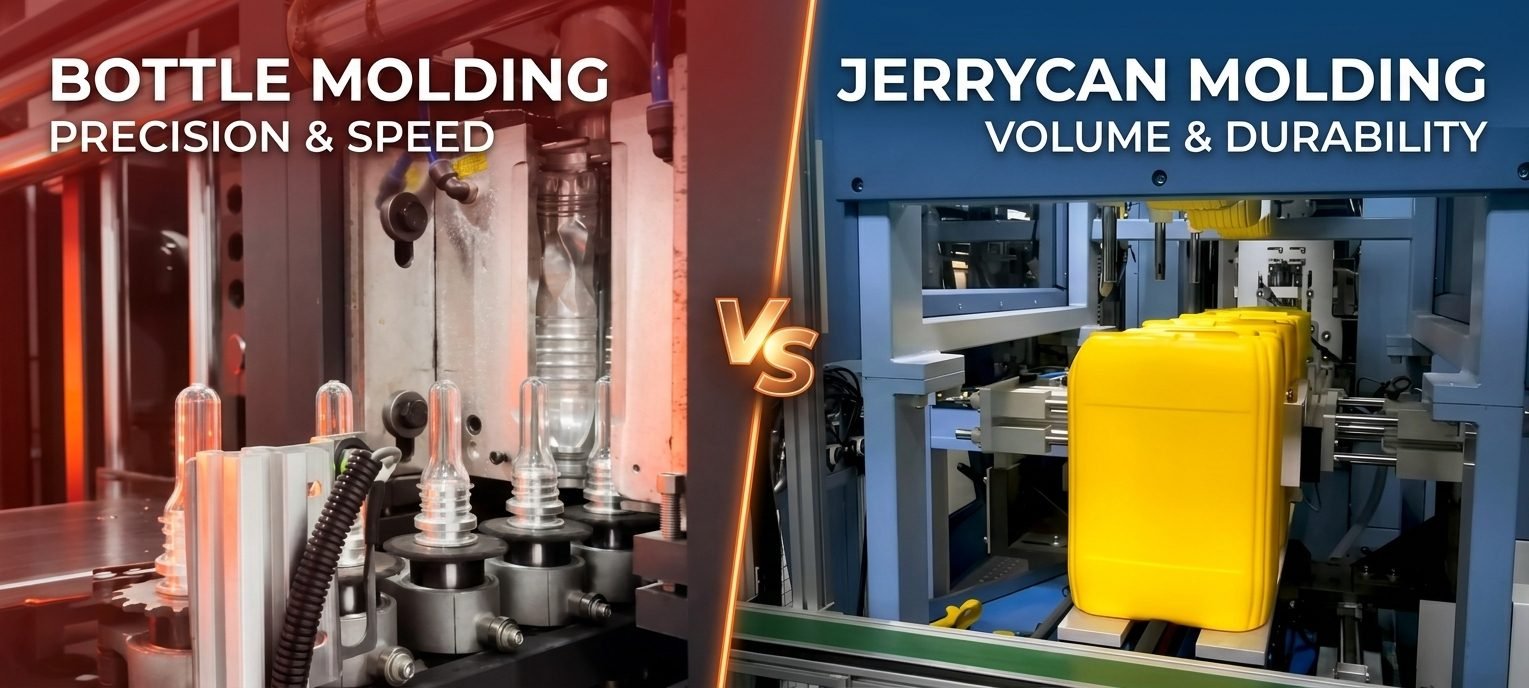
This is the most common specification error Sailwin engineers encounter: a buyer who needs a 10-liter container with a handle, and asks for a PET blow molding machine because PET is “more premium.”
| Property | HDPE Jerrycan (EBM) | PET Water Bottle (SBM) |
| Integrated handle | ✓ Yes — native EBM capability | ✗ No — physically impossible in SBM |
| UN drop certification | ✓ Achievable | ✗ PET too brittle for drop certification |
| Optical clarity | Translucent (milky white) | Crystal clear |
| Chemical resistance | Excellent (most acids, solvents) | Limited (not suitable for strong solvents) |
| CO₂ barrier | Poor — not suitable for CSD | Excellent — standard for CSD globally |
| Volume range | 1L – 1,000L+ | 100ml – 20L |
| Wall thickness control | PWDS parison programming | Preform design |
The conclusion is not that one material is better — it is that each material has a specific domain where it is technically correct and economically optimal. Specifying outside that domain is an engineering error, not a preference.
3-Question Decision Framework: Which Machine Do You Need?
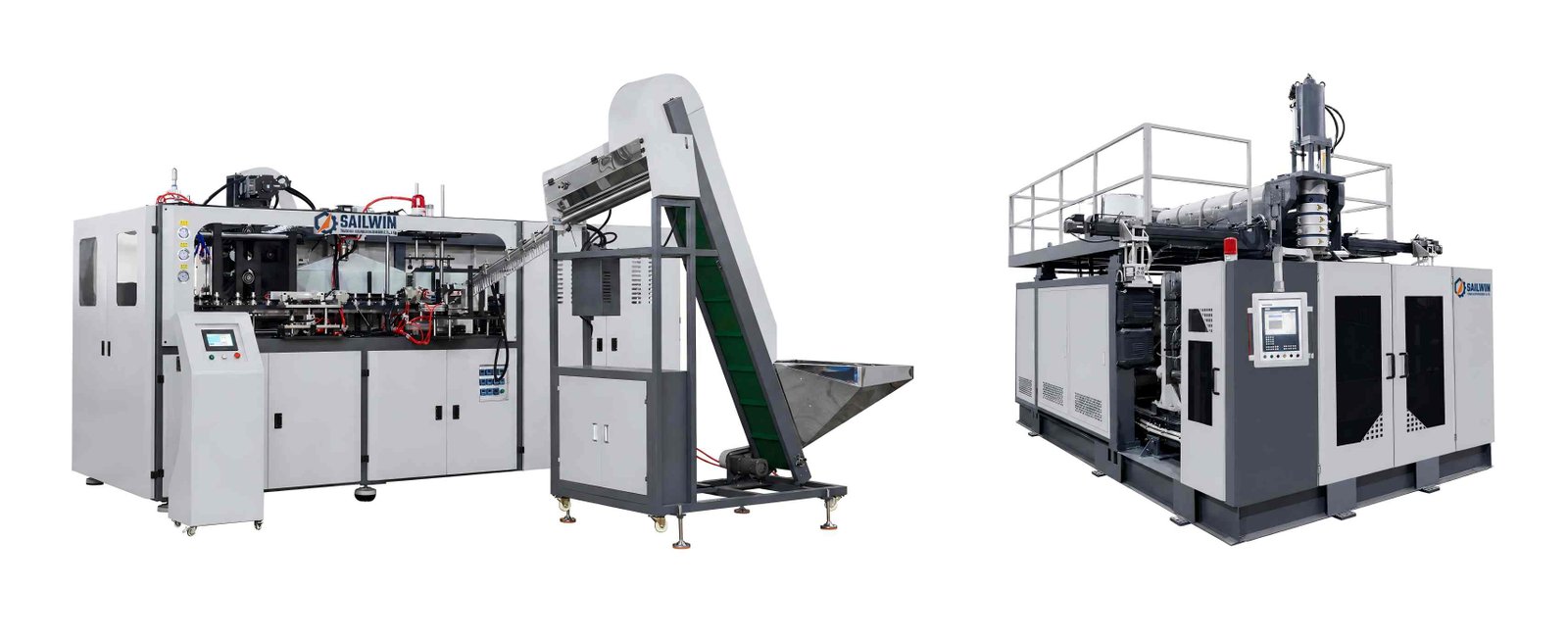
Answer these three questions in order. The first definitive answer determines your machine.
Question 1: Does your container require an integrated handle?
→ Yes → EBM. Stop here. Handle integration is physically impossible in SBM.
→ No → Continue to Question 2.
Question 2: Is your container material PET?
→ Yes → SBM. PET requires biaxial orientation — EBM cannot process PET effectively.
→ No → Continue to Question 3.
Question 3: Is your container volume above 20 liters?
→ Yes → EBM (accumulator head for large containers).
→ No → Review material: HDPE/PP → EBM. PET → already answered in Q2.
If you have reached Question 3 without a clear answer, your product likely requires EBM — because the dominant remaining materials (HDPE, PP, LDPE) all require extrusion blow molding.
Still uncertain after the 3-question test? It means your container has a non-standard specification that requires engineering review. Contact Sailwin with your product drawing — we respond within 24 hours.
Case Study: Chemical Distributor Avoids $40,000 Machine Error
The Situation
A chemical packaging distributor in Southeast Asia approached Sailwin needing a machine for 10-liter containers for agricultural chemical distribution. Initial inquiry: “We need a PET blow molding machine — our customers prefer clear containers.”
The Engineering Review
Sailwin’s application team reviewed the requirements against the product specification:
- 10-liter volume ✓ — achievable in both EBM and SBM
- Agricultural chemical content — requires UN certification for transport classification
- UN certification requires drop test from 1.2 meters — PET fails this test at 10-liter volume
- Handle required for field dispensing — physically impossible in SBM
Correct specification: HDPE jerrycan blow molding machine with UN-certified mold tooling.
The Outcome
Customer received an EBM jerrycan line producing UN-certified 10L HDPE containers. Total machine cost was 18% lower than the PET SBM machine originally requested — and the containers met market certification requirements that the PET option could not have achieved. The clarification call that prevented a $40,000 replacement took 20 minutes.
Frequently Asked Questions
What is the difference between extrusion blow molding and stretch blow molding?
Extrusion blow molding (EBM) extrudes molten plastic resin into a hollow parison, then inflates it in a mold. It processes HDPE, PP, LDPE, and multilayer materials, and can produce containers with integrated handles. Stretch blow molding (SBM) starts from an injection-molded PET preform, heats it, and simultaneously stretches and blows it into a mold. The biaxial orientation gives PET containers their clarity, CO₂ barrier, and strength. The two processes use different starting materials and different physics — they are not interchangeable.
Can I use a PET blow molding machine to make HDPE jerrycans?
No. PET blow molding machines are stretch blow molding machines designed for PET preforms. HDPE jerrycans require extrusion blow molding — a fundamentally different process that begins with HDPE resin pellets, not preforms. A PET SBM machine cannot process HDPE. An EBM machine cannot process PET preforms.
Which blow molding process is better for food and beverage packaging?
For beverages (water, CSD, juice, edible oil): SBM with PET — the CO₂ barrier, clarity, and lightweight are optimal. For milk, liquid foods requiring HDPE, or squeezable food containers: EBM. The correct answer depends on the specific product and its regulatory requirements, not a general preference.
What materials can be processed in an extrusion blow molding machine?
HDPE (most common), LDPE, LLDPE, PP, PVC (limited applications), and multilayer combinations with EVOH or PA barrier layers. EBM is the only blow molding process that can produce multilayer coextruded containers for high-barrier applications such as pesticides and fuel tanks. See Sailwin’s multilayer coextrusion blow molding machine for barrier packaging specifications.
Is stretch blow molding only for PET?
Predominantly yes. Standard two-stage SBM machines are designed for PET. Injection stretch blow molding (ISBM) machines can also process PP for hot-fill applications, but this is a specialized segment. For standard beverage and consumer packaging, SBM is essentially synonymous with PET processing.
What is the largest container size for stretch blow molding?
Approximately 20 liters — typically 5-gallon (18.9L) water bottles, processed on 5-gallon PET blow molding machines. Above 20 liters, containers require EBM accumulator head technology. Sailwin’s accumulator head blow molding machines cover containers from 30 liters to 1,000 liters.
Which process gives better wall thickness control?
EBM gives more direct wall thickness control through parison wall thickness programming (PWDS) — the die gap is varied dynamically during extrusion to deliver more material to stress-critical areas. SBM wall thickness is controlled through preform design and heating profile, with less real-time variability. For containers requiring UN drop certification, EBM’s parison control is essential.
Can one machine do both extrusion blow molding and stretch blow molding?
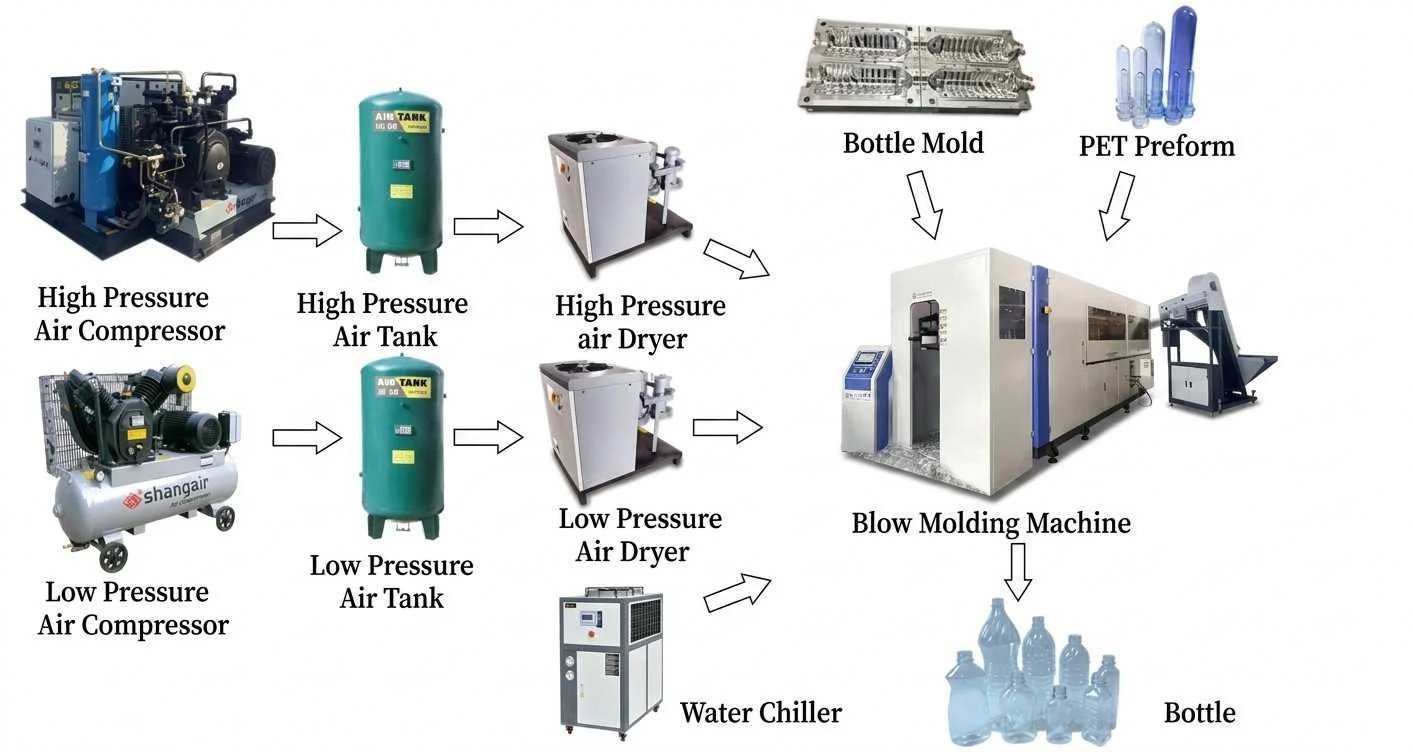
No. The two processes require fundamentally different machine architectures — EBM uses an extruder and die head; SBM uses an infrared heating oven and a stretch rod blow station. There is no commercially viable machine that performs both. You need two separate machines if you need to produce both HDPE containers and PET bottles.
Summary: The One-Sentence Rule
If your container is PET and has no handle, you need a stretch blow molding machine. If your container has a handle, is HDPE, or exceeds 20 liters, you need an extrusion blow molding machine. Every other variable — output speed, automation level, cavity count — is secondary to this fundamental process decision.
Sailwin manufactures both EBM and SBM machines with full engineering support to verify your specification before any purchase commitment. The clarification costs nothing. The wrong machine costs everything.
Confirm My Machine Specification — Free Engineering Review →