Most buyers who search for an extrusion blow molding machine already know they need one — but they underestimate how many distinct machine types exist under that name, and how significantly the wrong selection affects production efficiency, container quality, and tooling cost. This guide covers what an extrusion blow molding machine actually does, the five main machine types and how to choose between them, the two technical capabilities that separate competent machines from exceptional ones (parison wall thickness control and die head configuration), and the six questions you must ask any supplier before placing an order.
| Factor | Key Facts |
| Primary Materials | HDPE, PP, LDPE, multilayer EVOH/PA |
| Container Size Range | 50ml (small bottles) to 10,000L+ (IBC tanks) |
| Key Differentiating Feature | Parison wall thickness control (PWDS) & die head count |
| Machine Types | Continuous / Shuttle / Accumulator Head / Rotary / Multilayer Coextrusion |
| Certifications Required | CE, ISO 9001; UN certification for hazardous goods containers |
| Typical Lead Time | 35–60 days (standard); 60–90 days (accumulator head / multilayer) |
What Is an Extrusion Blow Molding Machine and How Does It Work?
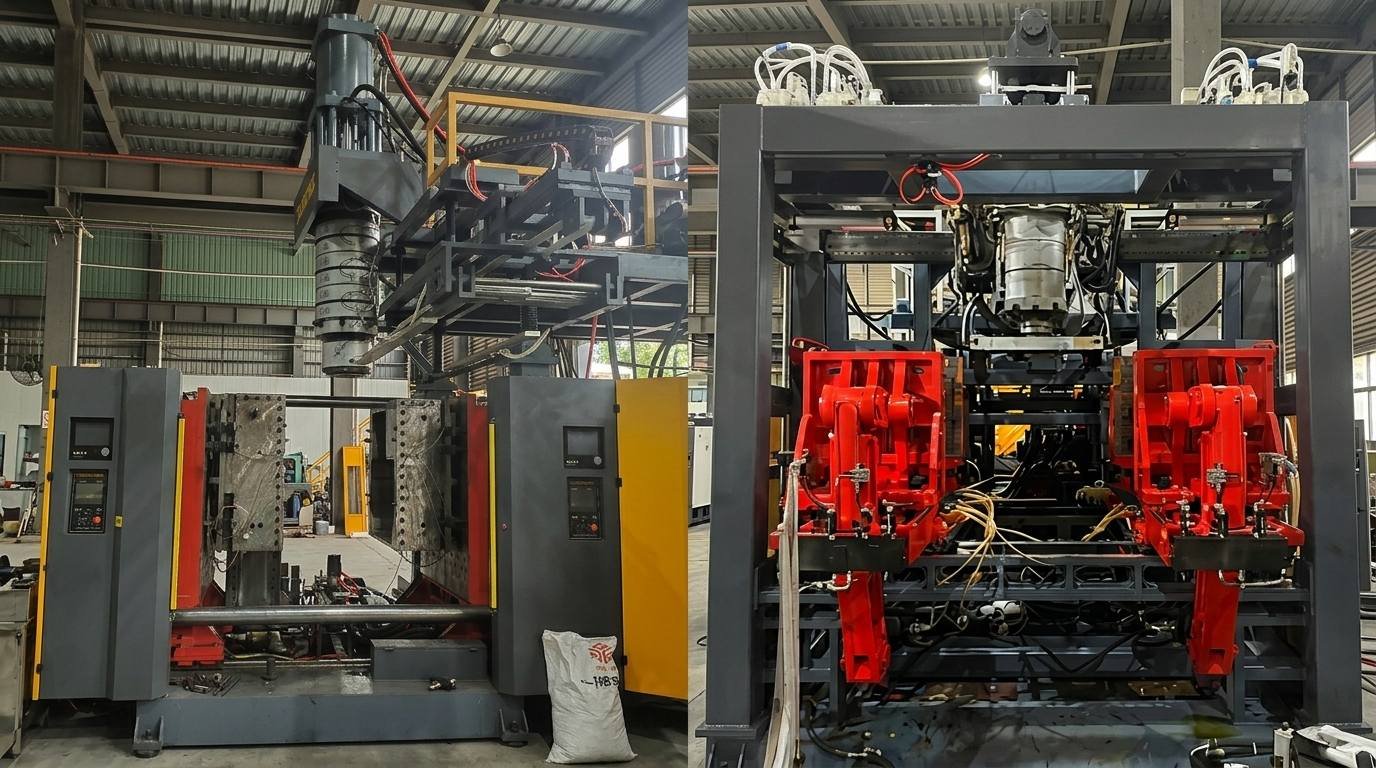
An extrusion blow molding machine converts plastic resin pellets into hollow containers through a three-stage process: extrusion, mold closure, and inflation. Unlike injection molding, which produces solid parts, or stretch blow molding, which starts from a preformed blank, EBM creates the container geometry entirely within the machine — from raw pellet to finished container in a single continuous cycle.
The 5-Step EBM Production Cycle
Step 1 — Plasticisation: Resin pellets (HDPE, PP, LDPE, or multilayer combinations) are fed into the extruder hopper and conveyed by a rotating screw through a heated barrel. Friction and conduction melt the resin to a homogeneous viscous melt, typically at 170–220°C depending on material.
Step 2 — Parison Formation: The molten resin passes through the die head and exits as a hollow tube — the parison. The parison hangs under gravity between the open mold halves. Parison wall thickness is controlled by the die gap, which can be varied dynamically by a PWDS (Parison Wall Thickness Distribution System) to deposit more material at areas of high mechanical stress.
Step 3 — Mold Closure: When the parison reaches the programmed length, the mold closes. The mold pinches the parison at the top and bottom — the bottom pinch weld seals the base; the top pinch is trimmed as flash. Integrated handles are formed at this stage by additional mold geometry.
Step 4 — Blow and Cool: A blow pin or needle introduces compressed air (6–10 bar) into the sealed parison, inflating it against the mold cavity walls. The mold is water-cooled; the container solidifies against the cavity in 5–40 seconds depending on wall thickness and material.
Step 5 — Ejection and Deflashing: The mold opens, the container is ejected, and flash (excess material at pinch welds) is trimmed automatically or manually. In continuous extrusion machines, the extruder runs uninterrupted throughout all stages.
This cycle is why EBM is the only viable process for containers with integrated handles, asymmetric geometries, or multilayer barrier walls — the parison and mold closure mechanics make these features native to the process.
Need an EBM machine for a specific container application? Sailwin’s application engineers can confirm machine type, die head configuration, and mold specification within 24 hours of receiving your container drawing.
Submit Your Container Drawing →
5 Types of Extrusion Blow Molding Machines: Which One Fits Your Application
The term “extrusion blow molding machine” covers five distinct machine architectures. Selecting the wrong type results in either a machine that cannot produce your container geometry, or one that is severely over-specified for your volume — both costly errors.
Type 1: Continuous Extrusion Blow Molding Machine (Shuttle Type)
The most common EBM configuration for small-to-mid volume production. The extruder runs continuously, producing an uninterrupted parison. Two mold platens alternate — while one mold is closed, cooling, and ejecting, the other is open and positioning under the die head to capture the next parison segment.
Best for: Containers from 50ml to approximately 30L; HDPE bottles, jerrycans up to 10L, personal care containers, chemical bottles.
Output: Typically 200–2,000 containers/hour depending on container size and cycle time.
Sailwin range: Small extrusion blow molding machines and standard HDPE blow molding machines.
Type 2: Accumulator Head Blow Molding Machine
For large containers (30L–1,000L+), continuous extrusion cannot deliver sufficient melt volume fast enough before the parison stretches under gravity. The accumulator head solves this: molten resin is accumulated in a reservoir (the accumulator), then discharged as a rapid-shot parison of precise volume in 1–3 seconds — far faster than continuous extrusion can deliver.
Best for: IBC tanks (1,000L), chemical drums (200L), automotive fuel tanks, agricultural spray tanks, large industrial containers.
Key specification: Accumulator volume (in kg or cm³) determines the maximum single-shot container weight.
Sailwin range: Accumulator head blow molding machines covering 30L–1,000L containers.
Type 3: Jerrycan Blow Molding Machine
A specialized continuous extrusion machine engineered specifically for UN-certified jerrycan production — typically 5L, 10L, 20L, and 30L HDPE jerrycans for fuel, chemical, and agricultural applications. Jerrycan machines incorporate integrated handle formation, flash trimming systems, and leak-test stations as standard equipment.
Best for: Fuel jerrycans, chemical jerrycans, agricultural jerrycans requiring UN 3H2 or UN 4G certification.
Sailwin range: Jerrycan blow molding machines with UN-certified mold tooling.
Type 4: Large Volume Extrusion Blow Molding Machine
Optimized for containers in the 30L–500L range that do not require accumulator head technology — large water tanks, septic tanks, agricultural storage containers. These machines use heavy-duty extruder screws and reinforced clamp systems to handle the larger mold weights and parison volumes.
Best for: Water storage tanks (100L–500L), agricultural tanks, large industrial containers.
Sailwin range: Large extrusion blow molding machines.
Type 5: Multilayer Coextrusion Blow Molding Machine
The most technically complex EBM type. Multiple extruders (typically 3–6) feed different materials simultaneously into a coextrusion die head, producing a parison with distinct concentric layers. The inner and outer layers are typically HDPE; the barrier layer is EVOH or PA, bonded by adhesive tie layers.
Best for: Pesticide containers, agricultural chemical tanks, fuel system components, food containers requiring oxygen barrier, pharmaceutical packaging requiring moisture and oxygen barrier.
Key technical requirement: The barrier layer (EVOH or PA) must maintain structural continuity at pinch weld areas — this requires careful die head design and PWDS programming.
Sailwin range: Multilayer coextrusion blow molding machines (2–6 layer EVOH/PA barrier).
| Machine Type | Container Volume | Key Application | UN Certification |
| Continuous / Shuttle | 50ml – 30L | HDPE bottles, small jerrycans, personal care | Optional |
| Jerrycan Specialist | 5L – 30L | Fuel / chemical / agricultural jerrycans | ✓ Standard |
| Large Volume | 30L – 500L | Water tanks, agricultural storage | Not applicable |
| Accumulator Head | 30L – 1,000L+ | IBC tanks, chemical drums, fuel tanks | ✓ Available |
| Multilayer Coextrusion | 1L – 30L | Pesticides, fuel, oxygen-barrier food | ✓ Standard |
Not sure which type fits your container? Tell us your container volume, material, and application — Sailwin will recommend the correct machine type with no obligation.
Get a Machine Type Recommendation →
Parison Wall Thickness Control: The Technical Capability That Determines Container Quality
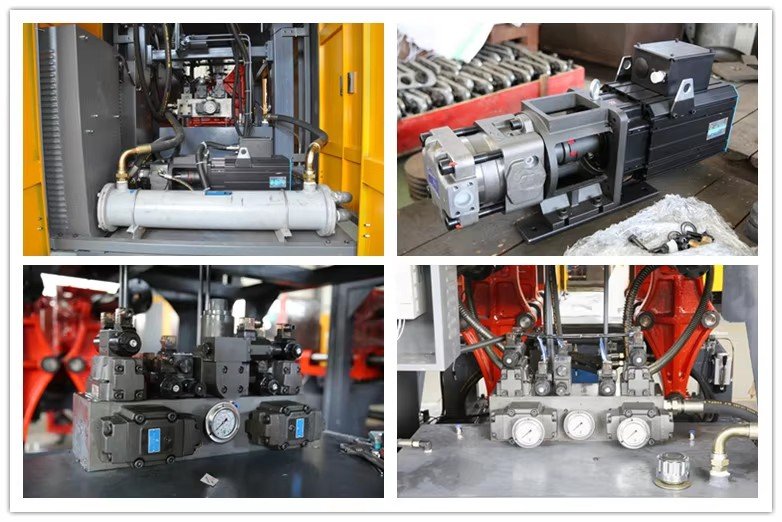
The most important technical differentiator between EBM machines is not output speed or clamp force — it is parison wall thickness control capability. Most buyers overlook this until they encounter container failures in drop testing or production scrap rates above 8%.
Why Uniform Wall Thickness Is Not What You Want
A common misconception is that uniform wall thickness across the entire container is the target. It is not. Blow molding by nature produces non-uniform wall distribution — as the parison inflates, areas furthest from the die head stretch more and thin out. The corner radii, handle attachment points, and base pinch weld areas are the most mechanically stressed parts of the container — and they are also the areas most likely to thin.
A machine without PWDS compensates by increasing average wall thickness across the entire container — adding material weight and cost to achieve minimum wall thickness at the critical points. A machine with PWDS delivers more material precisely to the stress-critical areas, achieving UN drop certification at lower average wall thickness — meaning lower resin cost per container and better drop performance simultaneously.
PWDS in Practice: What the Numbers Mean
A 20-point PWDS system can vary the die gap at 20 discrete positions across the parison length — giving the machine 20 “thickness zones” to program. A 100-point system gives finer control. For standard HDPE jerrycans and drums, a 20–40 point system is typically sufficient. For accumulator head machines producing large drums with complex geometry, 100-point systems are standard.
Without PWDS: A 10L HDPE jerrycan might require an average wall thickness of 2.2mm to achieve 1.2mm minimum at corners — total container weight: ~320g.
With PWDS: The same container at 1.8mm average wall, 1.2mm at corners — total weight: ~265g. A 17% resin saving per container, compounding across millions of production cycles.
For buyers purchasing EBM machines for UN-certified containers, PWDS is not optional — it is a prerequisite for reliably passing the 1.2m drop test at commercially viable container weights.
Die Head Types and Selection: 1 to 6 Heads and What Each Configuration Means
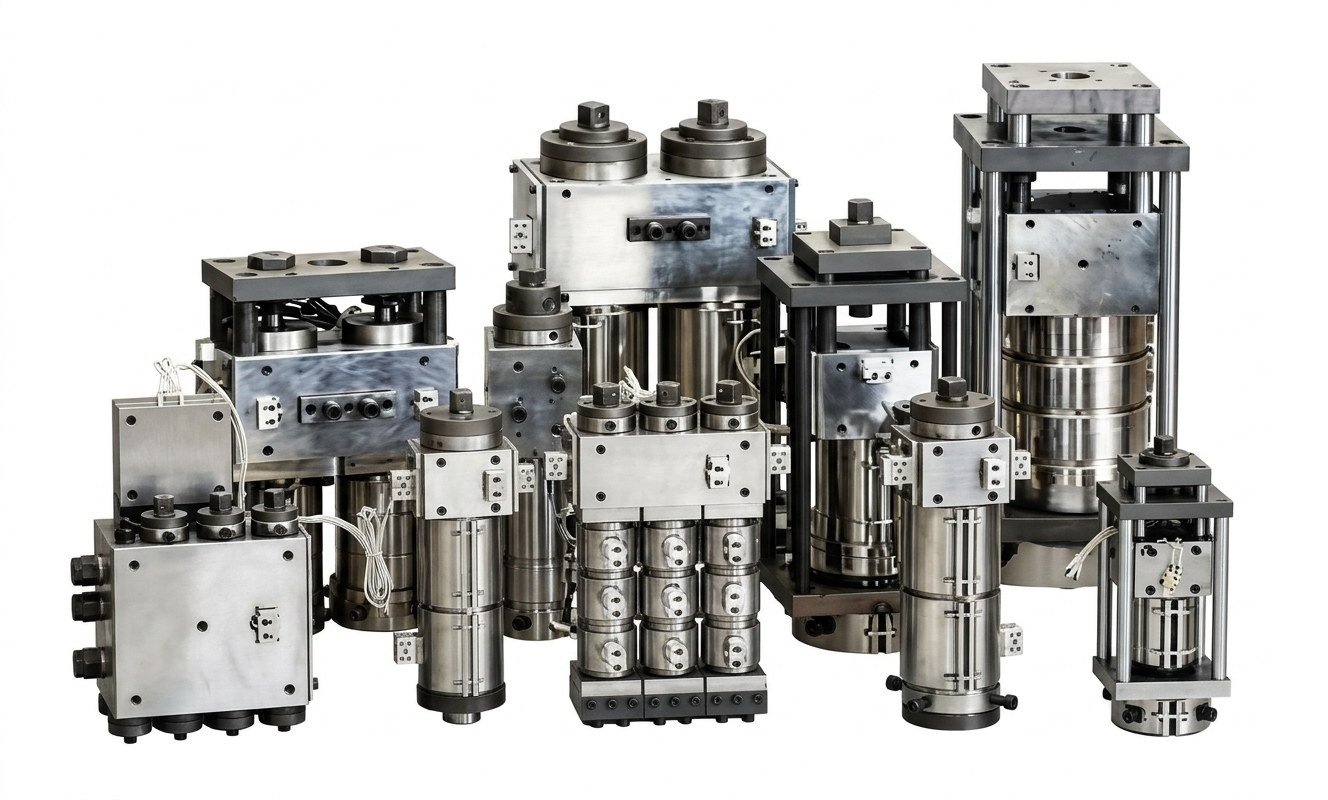
The die head is the component through which molten resin exits to form the parison. The number of die heads on a machine directly determines output per cycle — a 2-head machine produces 2 containers per cycle; a 6-head machine produces 6. But die head count selection involves more than simply maximising output.
Single Die Head (1-Head)
Standard configuration for large containers (10L+), asymmetric shapes, containers with offset handles, and accumulator head machines. Single-head machines offer the simplest parison control and easiest mold changeover. All accumulator head machines are single die head.
2-Head and 4-Head Configurations
The standard range for continuous extrusion machines producing smaller containers (50ml–5L). Two or four parisons drop simultaneously; the mold closes on all simultaneously. Output doubles or quadruples vs. single head for the same cycle time. Resin distribution must be balanced across all heads — unbalanced flow produces containers with inconsistent wall thickness across the machine.
6-Head Configuration
Used for very high-volume small container production — typically small HDPE bottles (50ml–500ml) for personal care, household chemicals, or pharmaceutical applications. Six-head machines require precise melt distribution systems and are more sensitive to resin viscosity variation. Mold changeover time is longer than 2 or 4-head configurations.
How to Choose Die Head Count
| Container Volume | Recommended Die Heads | Reason |
| 10L and above | 1 head | Container weight requires full extruder output per parison |
| 2L – 10L | 2 heads | Balance of output and melt distribution simplicity |
| 500ml – 2L | 2–4 heads | High output with manageable distribution complexity |
| Below 500ml, high volume | 4–6 heads | Maximum output per cycle; requires consistent resin quality |
Need help selecting the right die head configuration for your container? Sailwin’s engineering team will specify head count, PWDS point count, and extruder size based on your container drawing and production volume.
Get a Technical Specification →
Accumulator Head Machines: Why Large Containers Require a Different Architecture
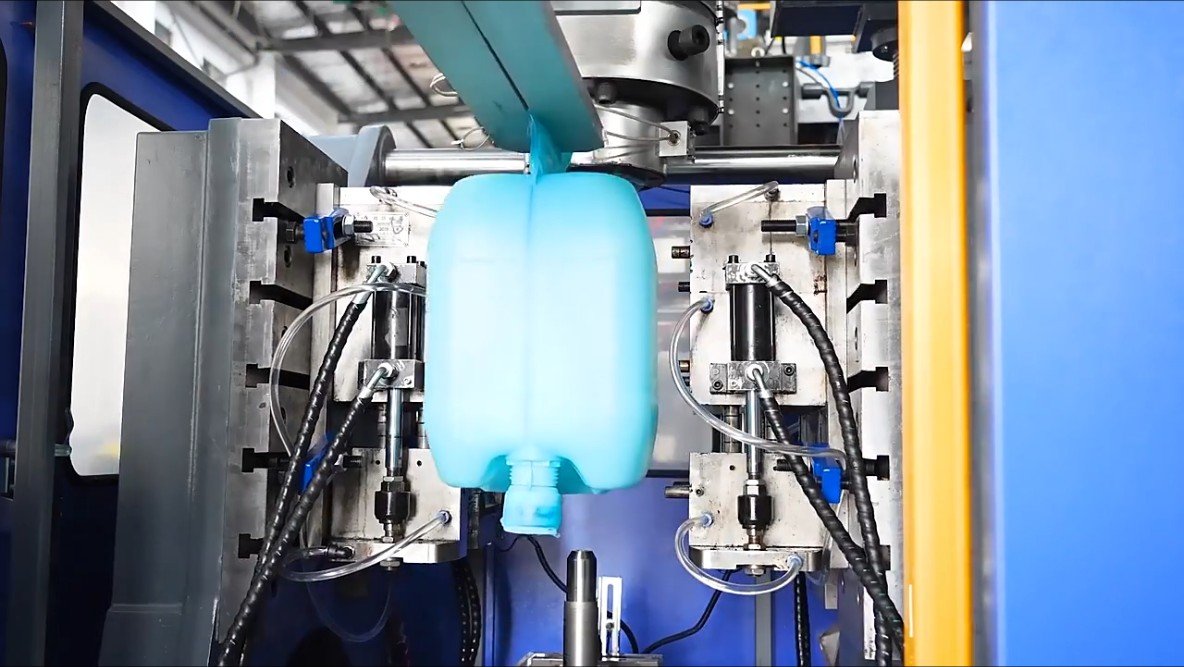
The physics of large container production create a problem that continuous extrusion cannot solve: a 200L HDPE drum requires a parison weighing approximately 8–12kg. A continuous extruder producing this parison at standard output rates takes 40–90 seconds to accumulate sufficient melt volume. During that time, the parison hangs freely under gravity, stretching and thinning its own wall — defeating PWDS programming before the mold even closes.
The accumulator head eliminates this problem. Melt is stored under controlled conditions in the accumulator chamber. When the programmed shot weight is reached — in 20–40 seconds — the entire accumulated volume is discharged as a single rapid parison shot in 1–3 seconds. The parison is short and fast; gravitational stretch is minimal; PWDS control is effective across the full container height.
When accumulator head is required:
- Containers above approximately 30L single-cavity
- 200L chemical drums and IBC tanks
- Automotive fuel tanks (typically 30L–120L)
- Any container where gravitational parison stretch would compromise wall thickness distribution
Sailwin’s accumulator head blow molding machines are available in accumulator volumes from 8kg to 80kg shot weight, covering containers from 30L to over 1,000L.
6 Questions to Ask Any EBM Supplier Before Placing an Order
Most EBM machine failures — wrong container quality, UN test failures, excessive scrap, premature breakdown — can be traced to due diligence gaps at the purchase stage. These six questions separate competent suppliers from those who will create expensive problems post-delivery.
1. What PWDS point count does your machine use for this container?
Accept 20+ for standard jerrycans. Reject any supplier who cannot specify the point count or does not offer PWDS as standard.
2. Has this machine type passed UN drop certification testing for my container specification?
Request the test report, not just a claim. UN 3H2 certification for HDPE jerrycans is the standard; confirm the specific container size and resin grade tested.
3. What is the standard extruder L/D ratio on this machine?
Higher L/D ratio (typically 24:1 to 30:1) produces better melt homogeneity, particularly important for HDPE and multilayer applications. A low L/D ratio is a cost-cutting indicator.
4. What brands are the hydraulic system and electrical control components?
Look for: Siemens or Mitsubishi PLC, Rexroth or Bosch hydraulics, Omron or Schneider electrical. Generic or unbranded components are the most common source of early failure and difficult field repairs.
5. What is the standard warranty period and what does it cover?
Minimum acceptable: 12 months on the complete machine, with clear exclusions stated in writing. Demand a spare parts list with the offer.
6. Can you provide references from installations in my region for this container type?
A supplier with genuine regional installations can provide verifiable customer contact details. Inability or unwillingness to do so is a significant due diligence flag.
Sailwin provides factory test reports, customer reference contacts, and full CE and ISO 9001 certification documentation before any payment is required.
Ready to evaluate Sailwin against these six criteria? Request our full technical documentation package — CE certificate, ISO 9001 certificate, PWDS specification, and customer references — with no purchase obligation.
Request the Documentation Package →
Frequently Asked Questions
What is an extrusion blow molding machine used for?
An extrusion blow molding machine produces hollow plastic containers from thermoplastic resin pellets. Common applications include HDPE jerrycans (5L–30L), chemical drums (200L), IBC tanks (1,000L), HDPE milk bottles, automotive fuel tanks, agricultural spray tanks, and multilayer barrier containers for pesticides and fuel. It is the correct process for any container requiring an integrated handle or made from HDPE, PP, or LDPE.
What is the difference between extrusion blow molding and injection blow molding?
Extrusion blow molding starts from resin pellets and forms a parison in-line. Injection blow molding starts from an injection-molded preform, then inflates it in a second station. EBM handles a wider material range and can produce much larger containers; injection blow molding is limited to small, precise containers (typically under 500ml) with excellent wall thickness consistency.
What materials can an extrusion blow molding machine process?
HDPE (most common), LDPE, LLDPE, PP, PVC (limited), and multilayer combinations with EVOH and PA barrier layers. EBM cannot process PET effectively — PET requires biaxial orientation through stretch blow molding. For a full process-material comparison, see our EBM vs SBM comparison guide.
How does parison wall thickness control work?
The PWDS (Parison Wall Thickness Distribution System) dynamically varies the die gap during parison extrusion, depositing more material at programmed positions along the parison length. These positions correspond to stress-critical areas of the finished container — handle attachment points, corner radii, base pinch welds. This allows UN drop certification at lower average wall thickness, reducing resin cost per container.
What is an accumulator head on a blow molding machine?
An accumulator head is a melt reservoir that stores plastic melt between shots. For large containers (30L+), continuous extrusion cannot deliver sufficient melt volume before gravitational parison stretch degrades wall thickness distribution. The accumulator stores a full shot volume and discharges it in 1–3 seconds, eliminating gravitational stretch. It is standard on all machines for containers above approximately 30L.
How many die heads should my EBM machine have?
Die head count equals containers per cycle. Single head for containers above 10L or asymmetric shapes. 2 heads for 2L–10L. 4 heads for 500ml–2L at medium-high volume. 6 heads for below 500ml at high volume. More heads increase output but add melt distribution complexity — always verify balanced flow across all heads with the supplier.
What certifications should an extrusion blow molding machine have?
Minimum: CE marking (required for EU use and widely required in other markets) and ISO 9001 quality management certification. For machines producing UN-certified containers (jerrycans, drums for hazardous goods), the mold tooling and machine must be capable of producing containers that pass UN 3H2 or equivalent drop, stacking, and leak tests. Request test reports, not just certificates.
What is the difference between EBM and HDPE blow molding?
HDPE blow molding is not a separate process — it is EBM using HDPE as the resin. “HDPE blow molding machine” and “extrusion blow molding machine” refer to the same machine type; the distinction is only the material being processed. Most EBM machines can process multiple materials with extruder parameter adjustment; a machine sold as an HDPE blow molding machine is an EBM machine optimized for HDPE processing conditions.
Summary
An extrusion blow molding machine is the correct equipment for any hollow container made from HDPE, PP, LDPE, or multilayer materials — particularly containers with integrated handles, asymmetric geometry, or UN certification requirements. The five machine types (continuous/shuttle, jerrycan specialist, large volume, accumulator head, multilayer coextrusion) cover the full range from 50ml HDPE bottles to 1,000L IBC tanks.
The two technical capabilities that most significantly affect production economics and container quality are PWDS parison wall thickness control and die head configuration — both of which must be specified to your container before purchase, not selected from a standard catalogue.
Sailwin manufactures the complete EBM range — from small extrusion blow molding machines to accumulator head machines and multilayer coextrusion machines — with full engineering support, CE and ISO 9001 certification, and UN-capable mold tooling. All machines are part of the Sailwin blow molding machine range.
Get a Free EBM Machine Specification →