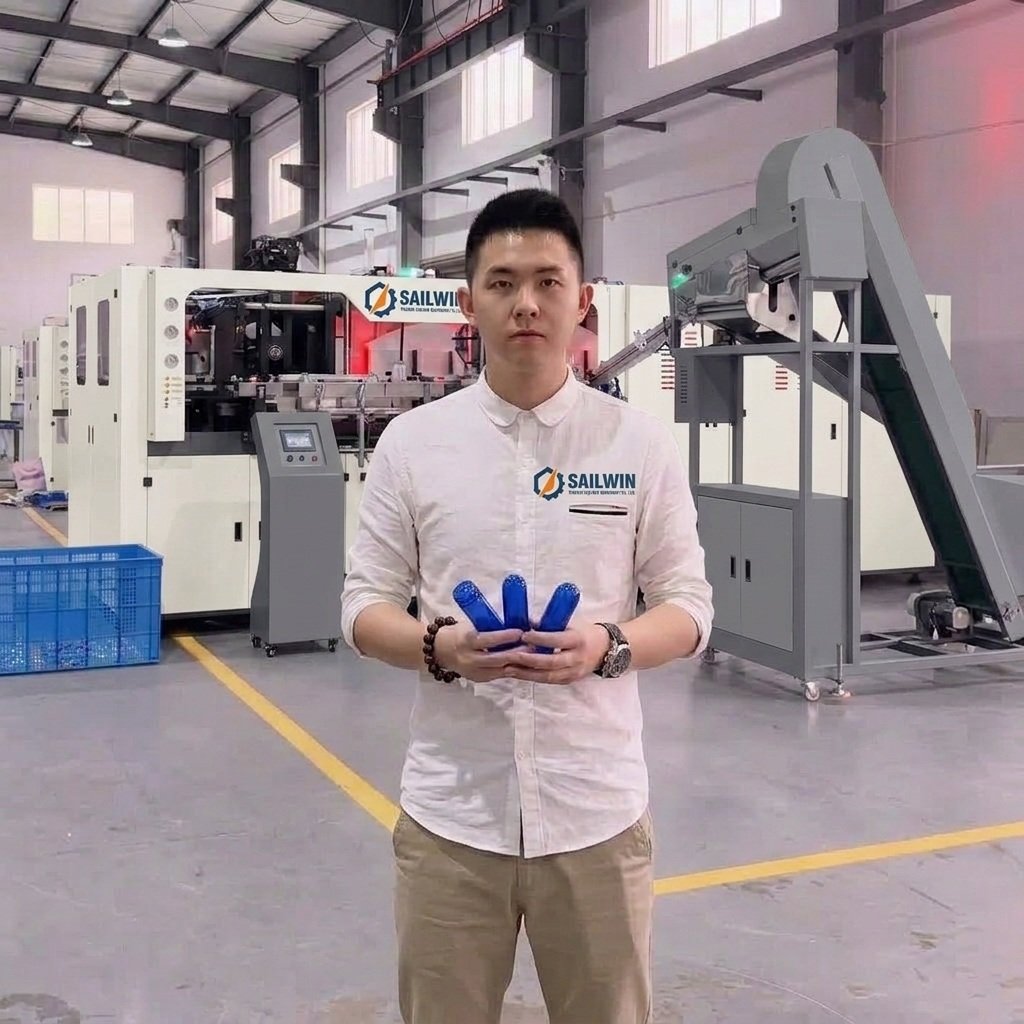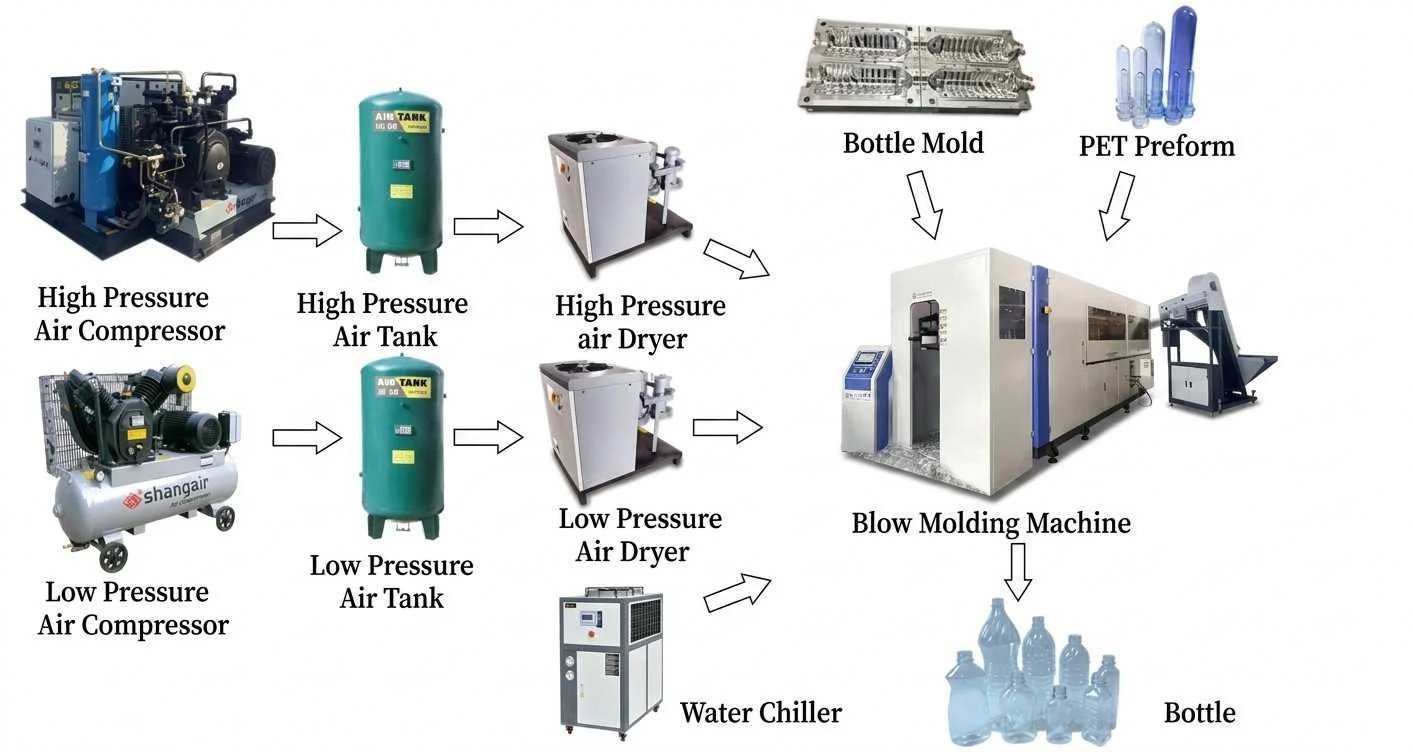
Buyers who search for a “blow molding machine” without a clear specification framework make the same set of avoidable errors: they select the wrong process for their material, underestimate output requirements, or purchase equipment they will outgrow in 18 months. This guide gives you a structured, four-step decision framework covering the two fundamental questions — which process (EBM or SBM) and which scale — and then maps your answers to the correct machine configuration. It is the guide to read before you contact any supplier.
| Decision Factor | EBM (Extrusion) | SBM (Stretch / PET) |
| Primary Material | HDPE, PP, LDPE, multilayer EVOH/PA | PET |
| Handle Integration | ✓ Native | ✗ Not possible |
| Max Single Container | 1,000L+ | ~20L |
| CO₂ Barrier (CSD) | ✗ HDPE unsuitable | ✓ Excellent |
| Optical Clarity | Translucent | Crystal clear |
| Typical Applications | Jerrycans, drums, chemical tanks, automotive | Water, CSD, juice, edible oil, cosmetics |
Step 1: Choose the Process — EBM or SBM
The single most consequential decision in blow molding machine selection is process — and it is determined by your container, not your preference. EBM and SBM are not interchangeable alternatives; they are fundamentally different manufacturing processes suited to different materials and container geometries. Selecting the wrong process requires a complete machine replacement.
Answer these two questions to determine your process:
Q1: Does your container require an integrated handle?
→ Yes → EBM. Handle formation is native to EBM’s mold closure mechanics. It is physically impossible in stretch blow molding. This is a hard stop.
Q2: Is your primary material PET?
→ Yes → SBM. PET requires biaxial orientation — the simultaneous axial stretch and radial blow that gives PET containers their clarity, CO₂ barrier, and strength-to-weight ratio. EBM cannot achieve biaxial orientation and cannot process PET effectively.
If your answer to both questions is No, your material is almost certainly HDPE, PP, or LDPE — all of which require EBM.
For a detailed technical comparison of both processes, see our full EBM vs SBM guide.
The most expensive mistake in blow molding procurement: specifying a PET blow molding machine for a container that requires a handle, or an EBM machine for a PET beverage bottle. Both errors require full machine replacement. Confirm your process before any other decision.
Step 2a: If EBM — Choosing the Right Machine Across the Full EBM Range
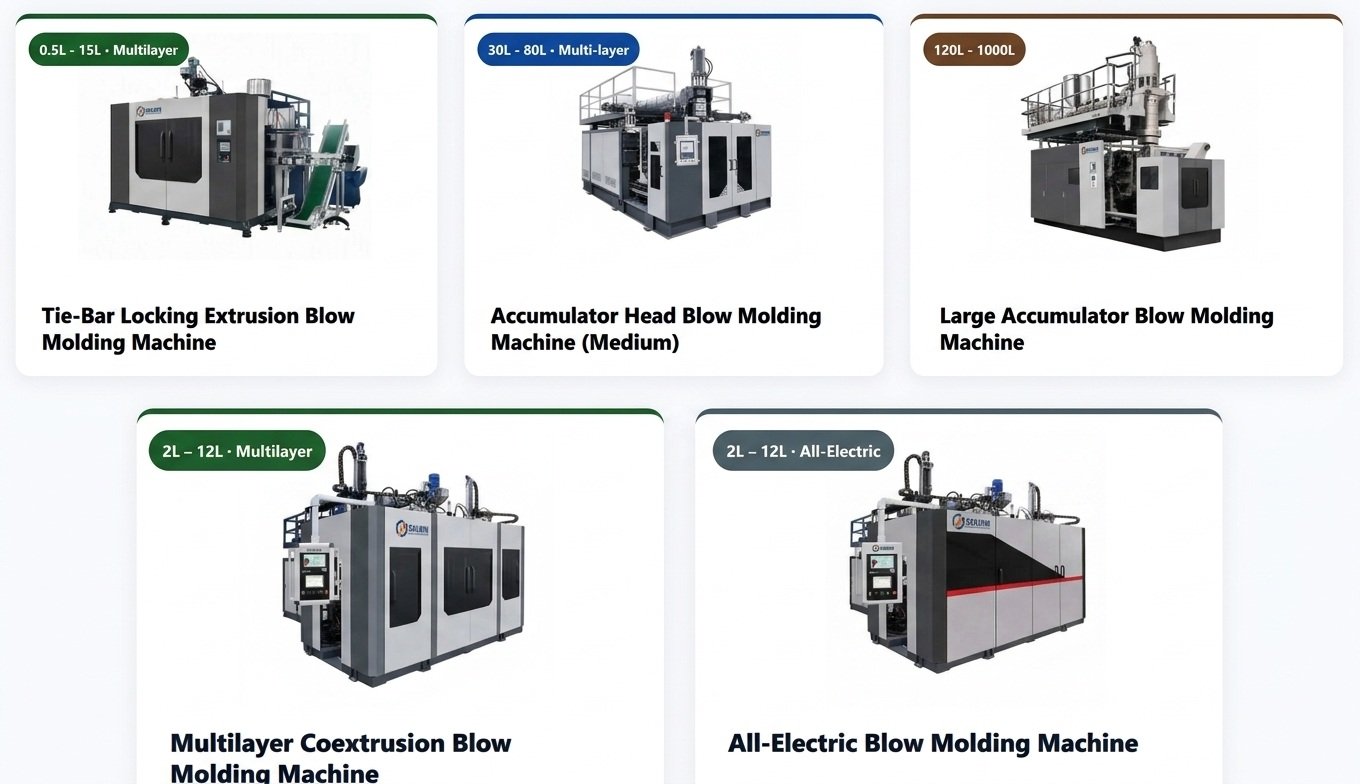
The EBM machine category spans from 50ml HDPE bottles to 1,000L IBC tanks — a 20,000x volume range served by five distinct machine architectures. Container volume is the primary axis for machine selection within the EBM category.
Small Volume EBM (50ml – 5L): Small Extrusion Blow Molding Machine
Continuous extrusion with 2–6 die heads. Best for: HDPE personal care bottles, household chemical bottles, small food containers. High output per hour (600–3,000 containers/hour depending on container size and head count). Fastest mold changeover in the EBM range.
→ Small extrusion blow molding machine
Jerrycan Range (5L – 30L): Jerrycan Blow Molding Machine
Continuous extrusion engineered specifically for UN-certified jerrycan production. Integrated handle formation, flash trimming, and leak test station as standard. Mold tooling verified against UN 3H2 drop, stacking, and leak certification requirements for fuel, chemical, and agricultural applications.
→ Jerrycan blow molding machine
HDPE General Range: HDPE Blow Molding Machine
Continuous extrusion optimized for standard HDPE container production across a wide volume range (500ml – 30L). The standard configuration for dairy, agriculture, industrial cleaning, and lubricant packaging.
→ HDPE blow molding machine
Large Volume (30L – 500L): Large Extrusion Blow Molding Machine
Heavy-duty extrusion for large storage tanks, water tanks, and agricultural containers where continuous extrusion is still viable and accumulator head is not yet required.
→ Large extrusion blow molding machine
Very Large Containers (30L – 1,000L+): Accumulator Head Blow Molding Machine
For containers where gravitational parison stretch during continuous extrusion would compromise wall thickness distribution. The accumulator stores a full shot of melt and discharges in 1–3 seconds, producing accurate wall thickness on 200L drums, IBC tanks, and automotive fuel tanks.
→ Accumulator head blow molding machine
Barrier Packaging: Multilayer Coextrusion Blow Molding Machine
3–6 layer coextrusion with EVOH or PA barrier layer for pesticide containers, fuel system components, and oxygen-sensitive food packaging. Required wherever regulatory or product integrity demands a functional barrier layer.
→ Multilayer coextrusion blow molding machine
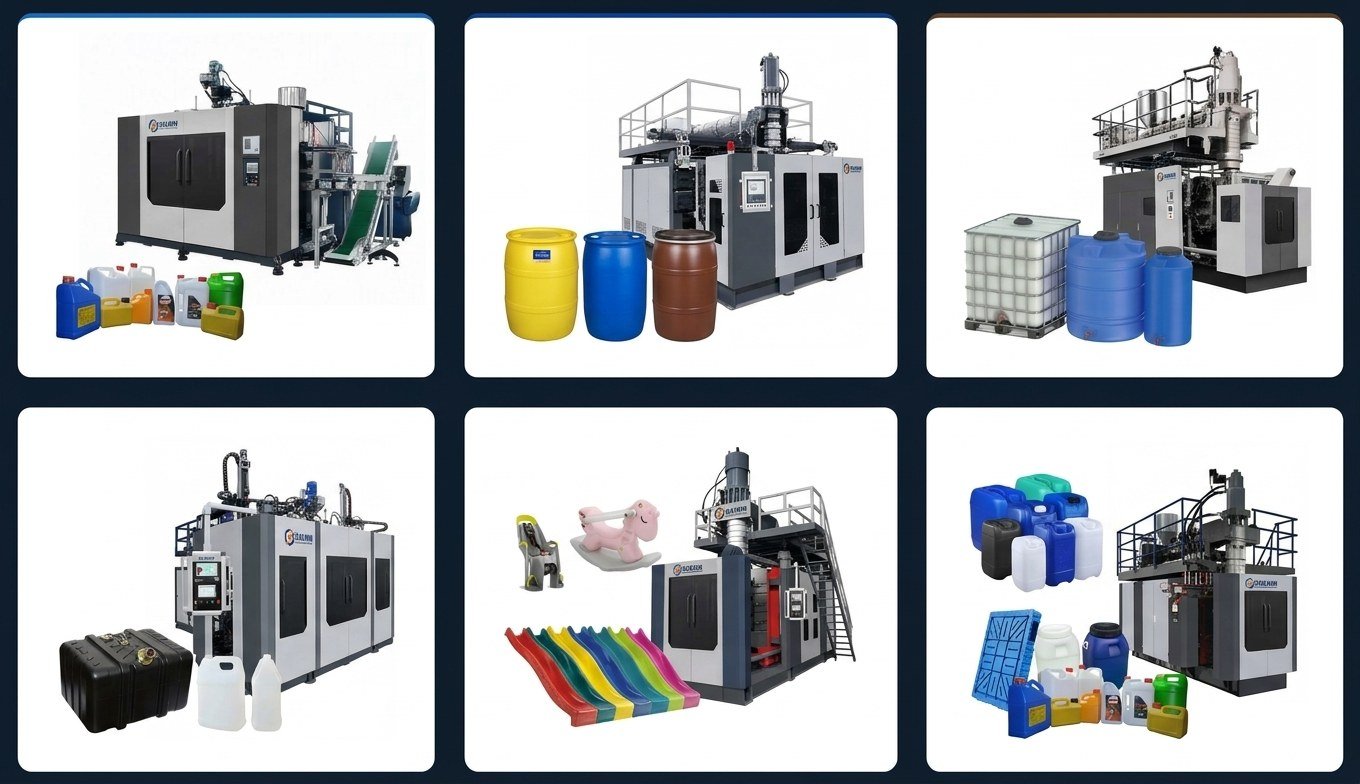
| Container Volume | Application Example | Recommended Machine |
| 50ml – 5L | HDPE bottles, personal care, household chemical | Small EBM |
| 5L – 30L (with handle) | Fuel jerrycans, agricultural chemical, UN-certified | Jerrycan EBM |
| 500ml – 30L (general HDPE) | Dairy, lubricant, industrial cleaning | HDPE EBM |
| 30L – 500L | Water storage tanks, agricultural storage | Large EBM |
| 30L – 1,000L+ | 200L chemical drums, IBC tanks, fuel tanks | Accumulator Head EBM |
| 1L – 30L (barrier) | Pesticides, fuel, oxygen-barrier food | Multilayer Coextrusion EBM |
Need help selecting the right EBM machine for your container? Send Sailwin your container drawing, volume, and material — we’ll confirm the correct machine type and die head configuration within 24 hours.
Get an EBM Machine Recommendation →
Step 2b: If SBM/PET — Choosing the Right Machine Across the Full PET Range
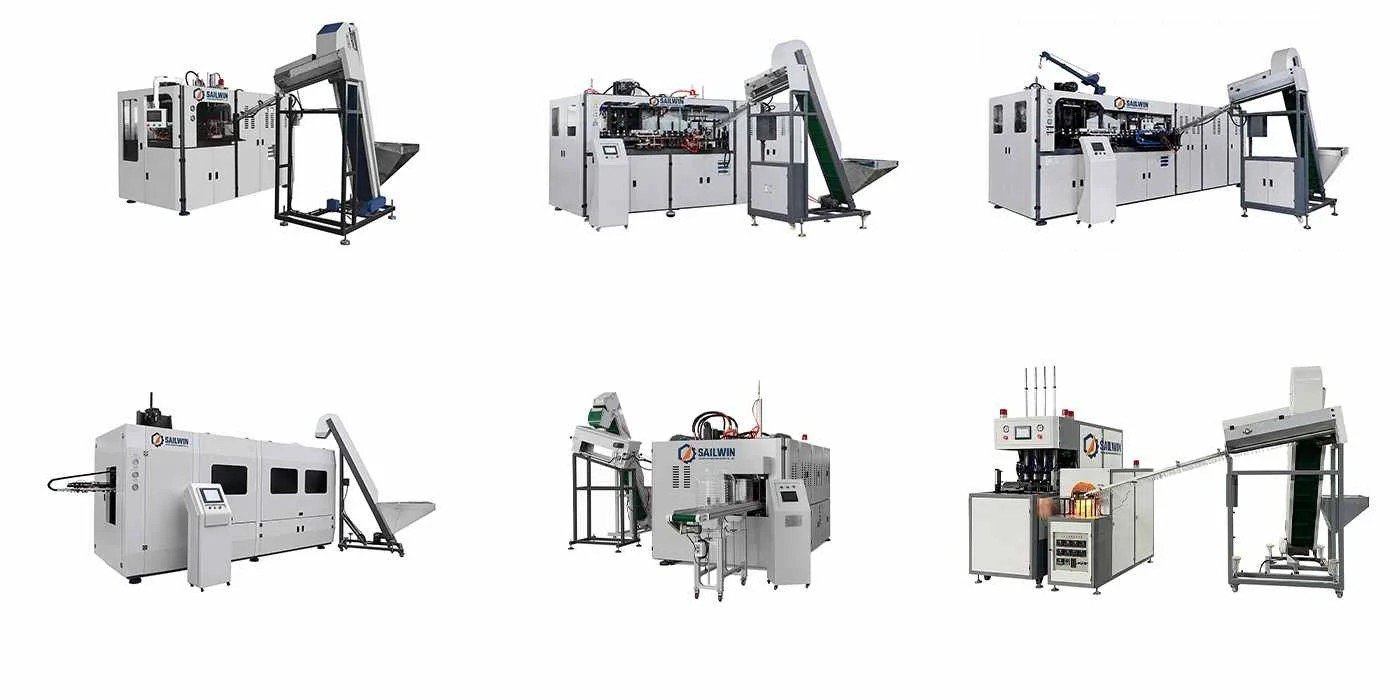
Within the PET SBM category, machine selection is determined by two variables: monthly production volume and bottle format (cavity count requirement). Both determine which configuration delivers the correct output at the lowest total cost of ownership.
Entry Level / Market Validation: Semi-Automatic PET Blow Molding Machine
Manual preform loading per cycle. Best for under 500,000 bottles/month, wide-mouth or non-standard bottle formats, and buyers entering a new market where volume certainty is low. Lower upfront investment; higher per-bottle labor cost. Mold tooling is cross-compatible with Sailwin’s fully automatic range — Phase 1 investment is protected for future upgrade.
→ Semi-automatic PET blow molding machine
Standard Production: 2-Cavity Fully Automatic
The standard entry point for continuous production. 2 bottles per cycle; suitable for 500,000–1,500,000 bottles/month on 2 shifts. Lower mold cost than 4 or 6-cavity; easier changeover for multi-format operations.
→ 2-cavity PET blow molding machine
Growth Phase: 4-Cavity Fully Automatic
The most common configuration for established beverage and edible oil producers. 4 bottles per cycle delivers 2× the output of a 2-cavity machine at the same cycle time. Optimal balance of capital cost and output for 1,500,000–4,000,000 bottles/month.
→ 4-cavity PET blow molding machine
High Volume: 6-Cavity Fully Automatic
Maximum output per machine for standard bottle formats. 6 bottles per cycle; suited to above 4,000,000 bottles/month on continuous operation. Longer mold changeover time than 2 or 4-cavity; optimized for high-volume, stable-format production.
→ 6-cavity PET blow molding machine
Beverage Lines: High-Speed PET Blow Molding Machine
Linear or rotary configurations optimized for maximum BPH output on standard round bottle formats. Designed for large beverage production facilities running 2–3 shifts with minimal format changeover.
→ High-speed PET blow molding machine
Specialty Formats
- Wide-mouth jars (yogurt, cosmetic, food): → Wide-neck PET blow molding machine
- 5-gallon water bottles (18.9L): → 5-gallon PET blow molding machine

| Monthly Volume (500ml bottle) | Recommended Machine | Notes |
| Under 500,000 | Semi-automatic | Lower capex; higher labor cost per bottle |
| 500,000 – 1,500,000 | 2-cavity fully automatic | Standard entry to automated production |
| 1,500,000 – 4,000,000 | 4-cavity fully automatic | Best capex-to-output ratio in the range |
| Above 4,000,000 | 6-cavity or high-speed | Optimized for stable high-volume formats |
| Wide-mouth / non-standard | Wide-neck or semi-automatic | Format flexibility over raw output speed |
| 18.9L / 5-gallon | 5-gallon specialist | Dedicated mold tooling for large PC/PET jugs |
Not sure which cavity count fits your production plan? Sailwin’s engineers will calculate your required BPH from monthly volume and shift pattern, and recommend the exact machine configuration.
Step 3: Verify These 5 Technical Specifications Before Finalising Any Machine
Once you have identified the correct process and scale, these five specifications determine whether a specific machine will actually meet your production requirements — and whether it will continue to do so for the next 8–10 years.
1. Clamp Force (kN or tons)
Clamp force must exceed the blow pressure multiplied by the projected container area. Insufficient clamp force produces flash at the parting line and dimensional inconsistency. Always request the clamp force specification relative to your specific container size — not the maximum machine rating.
2. Extruder L/D Ratio (EBM) / IR Heating Zone Count (SBM)
EBM: a higher L/D ratio (24:1 to 30:1) produces better melt homogeneity, particularly for HDPE and multilayer materials. SBM: more independent IR heating zones give finer preform temperature control, critical for consistent wall thickness across complex bottle geometries.
3. PWDS Point Count (EBM only)
For EBM machines producing UN-certified containers, confirm PWDS point count (20-point minimum for standard jerrycans; 100-point for accumulator head large drums). This specification directly determines whether you can achieve UN drop certification at commercially viable container weights.
4. Control System Brand
Siemens or Mitsubishi PLC; Rexroth or Bosch hydraulics; Omron or Schneider electrical components. These brands have global service networks and spare parts availability. Generic control components are the single most common source of unresolvable field failures in markets far from the manufacturing country.
5. Mold Cross-Compatibility (PET machines)
If you are purchasing a semi-automatic machine with intent to upgrade to fully automatic, confirm in writing that mold tooling dimensions are identical across both machine types. Sailwin guarantees this across the full semi-automatic and fully automatic PET range — your Phase 1 mold investment is always transferable.
Step 4: How to Evaluate the Supplier — Not Just the Machine
The machine specification is only half the purchase decision. The supplier’s manufacturing capability, after-sales infrastructure, and documentation standards determine whether the machine continues to perform after delivery — especially in markets far from the manufacturing facility.
Five supplier evaluation criteria:
- Factory verification: Request a video factory tour or third-party inspection. A supplier unwilling to facilitate either is concealing something about manufacturing capability or quality control standards.
- Certification documentation before payment: CE certificate, ISO 9001 certificate, and test reports should be provided on request before any deposit. A supplier who provides these only after payment has already secured your commitment.
- Regional installation references: Request verifiable contacts from customers in your region operating the same machine type for the same application. Inability to provide these after a reasonable request is a significant flag.
- Spare parts availability and lead time: Ask for the standard spare parts list and confirm availability in your region. For accumulator head and multilayer machines, hydraulic seal kits and die head components are the most critical items — confirm lead time for replacement.
- Warranty scope in writing: Minimum 12 months on the complete machine. Confirm what is excluded. A warranty that excludes “wearing parts” without defining them is effectively no warranty at all.
Sailwin provides all certification documentation before payment, factory video verification, and regional customer references for all machine types and container applications.
Ready to apply this framework to your specific requirement? Send Sailwin your container spec — material, volume, application, monthly production target — and receive a machine recommendation with full technical documentation within 24 hours.
Get a Machine Recommendation + Documentation Package →
Frequently Asked Questions
What is the difference between a PET blow molding machine and an HDPE blow molding machine?
A PET blow molding machine is a stretch blow molding machine — it starts from an injection-molded PET preform and uses simultaneous axial stretching and radial blowing to produce the container. An HDPE blow molding machine is an extrusion blow molding machine — it starts from HDPE resin pellets and extrudes a parison that is then inflated in a mold. The two machines use different processes, different starting materials, and different physics. They cannot be substituted for each other.
How do I choose between a small and large blow molding machine?
Start with your container volume (in liters), not your production volume. Container volume determines machine type (small EBM, accumulator head, etc.). Then use your monthly production target and shift pattern to determine the output specification required — which determines cavity count for PET machines, or extruder size and head count for EBM machines.
Can one blow molding machine produce both HDPE and PET containers?
No. EBM machines process HDPE, PP, LDPE, and multilayer materials — not PET. SBM machines process PET preforms — not HDPE resin. If you need to produce both container types, you need two separate machines. There is no commercially viable machine that performs both processes.
What is the minimum monthly volume to justify a fully automatic PET blow molding machine?
At mid-cost region labor rates ($12,000/year per operator), the break-even point between semi-automatic and fully automatic is typically 800,000 bottles/month on 2 shifts — where labor savings recover the fully automatic machine’s price premium within 12–18 months. At higher local labor costs, the break-even moves lower. See our detailed semi vs fully automatic comparison guide for the full TCO model.
What blow molding machine do I need for jerrycans?
HDPE jerrycans require an extrusion blow molding machine — specifically a jerrycan-specialist machine with integrated handle formation, flash trimming, and UN-certification capable mold tooling. A PET blow molding machine cannot produce jerrycans — HDPE does not process through stretch blow molding, and integrated handles are physically impossible in SBM.
What blow molding machine do I need for 5-gallon water bottles?
18.9L (5-gallon) water bottles are typically produced in PET or PC. For PET, a dedicated 5-gallon PET blow molding machine with appropriate preform size and mold tooling is required. Standard PET machines optimized for smaller bottles (500ml–2L) are not suitable — the preform weight, heating requirements, and blow pressure specifications differ significantly.
How long does it take to receive a blow molding machine from China?
Standard EBM machines: 35–50 days production lead time. Accumulator head and multilayer machines: 60–90 days. Standard PET machines: 30–45 days. Ocean freight adds 20–35 days depending on destination port. All Sailwin machines ship with CE and ISO 9001 documentation. Production lead time begins after deposit confirmation and technical drawing approval.
What certifications should a blow molding machine have?
CE marking is required for EU markets and widely required or expected in other regions. ISO 9001 quality management certification covers manufacturing process quality. For machines producing containers for hazardous goods transport (fuel, chemical jerrycans, drums), the mold tooling and machine output must be capable of producing UN-certified containers — confirm this with test reports, not just a verbal claim.
Summary: The 4-Step Framework
Step 1 — Process: Handle required or HDPE/PP/LDPE material → EBM. PET material, no handle → SBM. This decision is non-negotiable and must come before every other specification.
Step 2 — Scale: EBM: match container volume to machine type (small → jerrycan → HDPE general → large → accumulator head → multilayer). PET: match monthly production volume to cavity count (semi-auto → 2-cavity → 4-cavity → 6-cavity → high-speed).
Step 3 — Specs: Verify clamp force, extruder L/D or IR zone count, PWDS point count (EBM), control system brands, and mold cross-compatibility before committing.
Step 4 — Supplier: Factory verification, pre-payment certification documentation, regional references, spare parts availability, and written warranty scope.
Sailwin manufactures the complete range — from small EBM machines to accumulator head machines, semi-automatic PET machines to high-speed PET lines — all under the Sailwin blow molding machine brand with CE, ISO 9001, and full pre-delivery documentation.
Apply the Framework to My Requirement — Get a Free Recommendation →