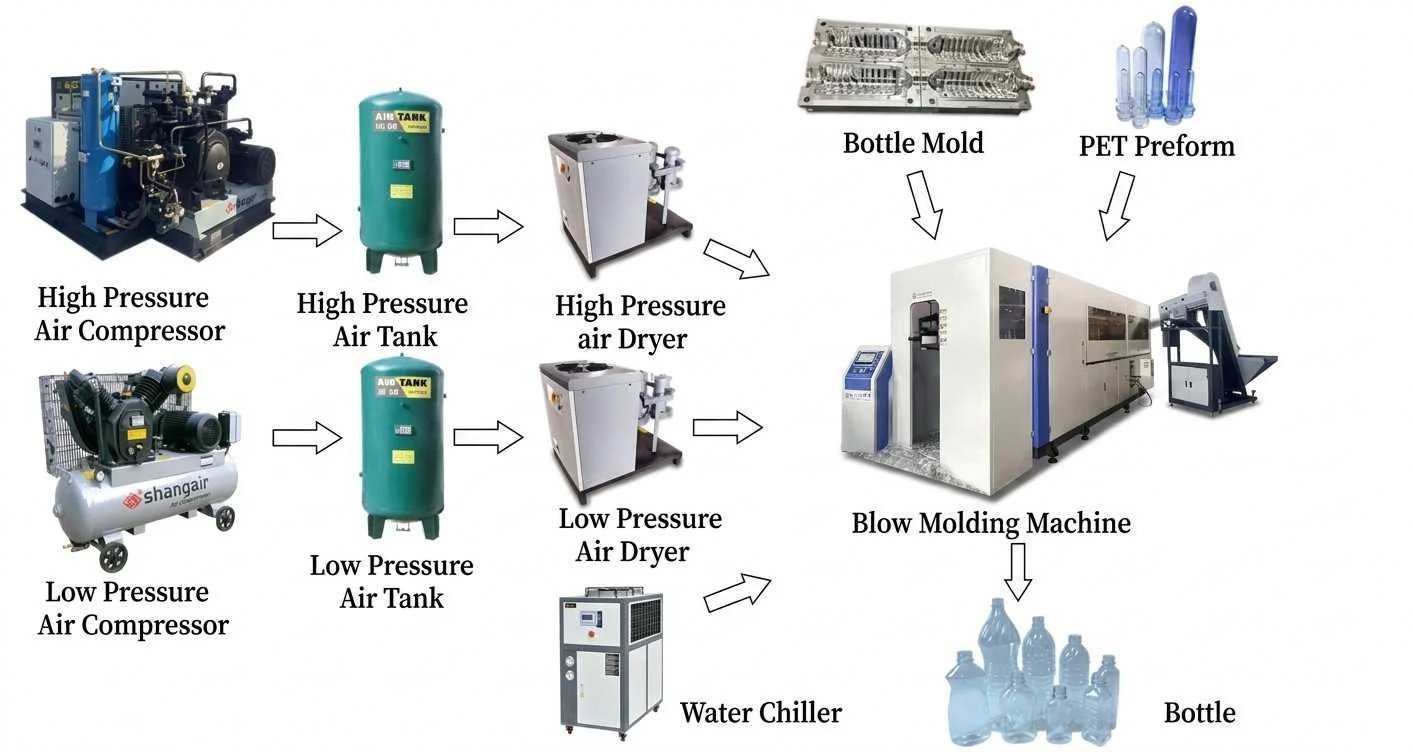
Most buyers comparing PET blow molding machine mould cost make the same mistake: they benchmark machine prices across three suppliers, then negotiate the mould as an afterthought line item. Two weeks later the project stalls, because the tooling quote arrives 40% above the machine price they mentally allocated for it — or arrives with a specification so thin that nobody can tell whether the cavity steel will survive two years of three-shift running.
The cost of getting this wrong is not the invoice difference. It is the scrap rate that creeps from 0.5% to 3% because the cooling circuits were not balanced, the unplanned stops when a neck plate wears past tolerance, and the 6-week lead time to replace a mould you should have specified properly the first time.
Sailwin has built PET stretch blow moulding machines and tooling for 500+ installations across 60+ countries, with moulds and machines manufactured under the same ISO 9001:2015 system. This guide breaks a PET bottle mould down into its actual cost components, ranks the drivers by financial impact, and gives you the amortisation arithmetic to compare tooling quotes on the only number that matters: cost per 1,000 bottles produced.
Key Takeaways
- Cavity count is the dominant driver — but sub-linearly: going from 2 to 8 cavities multiplies output by 4 while mould cost typically rises far less than 4×, because the manifold, frame, platen interface and handling hardware are shared.
- Cooling design decides your real cost: a mould with balanced circuits pays back through cycle time and scrap rate; an unbalanced one costs you every single shift for the life of the tool.
- Compare tooling on cost per 1,000 bottles, never on purchase price: amortise over the mould’s verified service life at your actual OEE, then add scrap and changeover time.
Get Your Mould Costed With the Machine
Send your bottle drawing or sample and receive a cavity-count recommendation plus factory-direct tooling and machine quotation within 24 hours.
1. What Is Actually Inside a PET Blow Mould
A PET stretch blow mould is not a single part — it is an assembly of machined components, each with its own material grade, tolerance and heat treatment. Understanding the assembly is the only way to read a mould quotation and spot what a supplier has quietly deleted.
| Component | Function | Cost Weight (typical share of mould price) |
|---|---|---|
| Cavity body (blow cavity) | Forms the bottle outer surface; carries the surface finish that determines clarity | Highest single item |
| Base insert | Defines the base geometry — petaloid for CSD, champagne or footed base for still water | High; the most commonly replaced item |
| Neck plate / neck insert | Holds the preform neck and thread dimension — the part that determines cap sealing | Moderate but critical to scrap rate |
| Stretch rod and blow nozzle | Mechanical stretch and high-pressure air delivery | Consumable class — plan to stock |
| Cooling circuits and manifolds | Remove heat from cavity and base; drilled, baffled or bubbler depending on geometry | Invisible in photos, decisive in production |
| Frame, platen and guide hardware | Locates cavities relative to the machine; maintains shut-height repeatability | Largely shared as cavity count rises |
PET blow molding machine mould cost is a function of geometry and thermal engineering, not of brand. Two quotations for the same bottle can differ by a factor of two and both be “correct” — the difference is what is inside the cooling circuits, which grade of steel forms the neck, and whether the base insert is a replaceable item or an integral part of the cavity block.
2. The Six Cost Drivers, Ranked
When you ask three suppliers to quote the same bottle, the variance you see is produced almost entirely by six variables. Rank them in this order of financial impact.
| Driver | Effect on Mould Cost | What to Verify in the Quote |
|---|---|---|
| 1. Neck finish standard | Standard PCO 28 / 30 / 38 neck plates cost far less than bespoke finishes, because the neck insert is a repeatable item | Confirm the exact neck standard and whether the insert is replaceable on its own |
| 2. Cavity count and layout | Rises sub-linearly: the frame, platen interface and handling are shared across cavities | Machined cavity count versus machine capability — a 4-cavity mould on a 4-cavity machine is the only matched combination |
| 3. Cooling circuit complexity | Bubblers, baffles and separate base circuits add machining hours; a single-loop mould is cheapest and slowest | Ask for the circuit layout drawing and the number of independent cooling zones |
| 4. Cavity steel grade and heat treatment | Pre-hardened vs through-hardened vs stainless affects both cost and service life between polishing cycles | Specify the grade in writing; refuse “standard steel” as a description |
| 5. Surface finish specification | High-gloss cavities require finer polishing — and more hours — than matte or textured finishes | Define the finish by the bottle requirement (clarity, gloss), not by a polish grade you cannot inspect |
| 6. Special features | Handles, integrated grip, view strips, insert-moulded parts and wide-neck geometries (up to 130 mm) each add dedicated tooling | Confirm whether the feature is blow-formed or a separate part — the cost difference is large |
Compare Tooling and Machine Together
A mould that matches the machine beats a cheaper mould that fights it. Get both quoted as one package.
3. Cost per 1,000 Bottles: The Only Fair Comparison
Purchase price tells you nothing about whether a mould is expensive. The number that decides your bottle margin is tooling cost per 1,000 bottles produced, which you calculate like this:
Tooling cost per 1,000 bottles = (Mould price + Lifetime maintenance + Refurbishment) ÷ (Lifetime output ÷ 1,000)
Lifetime output is the figure most buyers estimate too generously. Calculate it as: cavities × cycles per hour × 24 × operating days × OEE × mould life in years. On a PET blow moulding line, OEE losses are real — a factory running at 75% OEE with a 4-cavity machine at 4,500 BPH produces about 81,000 bottles per 2-hour… use the formula, not a round number.
Worked illustration, deliberately using round figures so you can substitute your own: a mould used on a 4-cavity machine produces 4,500 bottles per hour. Over a 5-year life at 6,000 operating hours per year and 80% OEE, that is 4,500 × 6,000 × 5 × 0.8 ≈ 108 million bottles. If the mould cost 20,000 and absorbed 5,000 in maintenance over that life, tooling cost is 25,000 ÷ 108,000 units of 1,000 bottles ≈ 0.23 per 1,000 bottles. That is the number to put in your cost model — and it is also the reason arguing over a 2,000 tooling difference is usually a distraction compared with a 1% scrap rate difference.
4. Where a Cheap Mould Becomes Expensive
Tooling that saves money at the order stage recovers it during production. The five most common mechanisms, in the order they usually appear:
- Unbalanced cooling. Cavity temperatures drift apart and bottle weight varies between cavities. You will see it as weight spread and wall-thickness variation, and you will chase it through the heating profile forever.
- Soft neck inserts. Neck ovality or thread wear produces cap leaks — a customer complaint that costs far more than the neck plate ever did.
- Longer cycle time. Cooling that cannot be pushed means you buy a second machine to hit the output the first one should have delivered.
- Base insert replaced as a whole block. A design where the base is integral to the cavity means one worn area takes the entire block out of service.
- Missing drawings. Without circuit layouts and cavity machining records, neither you nor a third party can maintain the mould predictably after year two.
5. Sailwin Case Study: Tooling That Paid for Itself Through Cycle Time
A beverage producer replaced a low-cost 4-cavity mould with a Sailwin 4-cavity tool on the same SW-F4-2000 platform. The change was justified by cooling design and replaceable neck inserts, not by a lower price.
- Beverage bottler, South-East Asia, running water bottles on a 4-cavity automatic line
- Existing mould with single-loop cooling; cavity-to-cavity weight spread visible on the checkweigher
- Frequent neck-plate replacement and unpredictable cycle time at high ambient temperature
- New 4-cavity mould with independent cavity and base cooling circuits, sized to the machine’s chiller capacity
- Replaceable neck inserts on the standard PCO 28 finish, stocked as spare parts
- Cooling water targeting the 8–12°C range recommended for PET moulds, with flow verified per circuit at commissioning
- Stable cycle time at rated output — the 4-cavity machine now holds its specified 4,500 BPH band without cooling-driven slowdowns
- Cavity-to-cavity weight spread reduced to a controllable band, verified on the checkweigher
- Neck-related rejects eliminated by replacing inserts instead of entire blocks
Scenario based on a Sailwin customer project; site-specific figures available on request during engineering review.
Frequently Asked Questions
Ready to Price the Machine and the Mould Together?
Send your bottle drawing, container sample or target output. Our engineering team replies with a machine recommendation, mould assessment and factory-direct quotation within 24 hours.
Related Reading:
• PET Blow Molding Machine — full range, 2 to 9 cavities
• PET Blow Molding Machine Buying Guide
• How Much Does a PET Blow Molding Machine Cost?
• 4 Cavity vs 6 Cavity: Cost, Output and ROI
• Blow Mould Design: Materials, Cooling and Pinch-Off