A bottle rinsing machine is the cheapest station on the line and the one most often specified by habit. Buyers ask for “a rinse station” the way they ask for a guard rail, and suppliers price whatever fits the frame. Later, when a fill volume drifts, a cap fails to seat or a customer finds a fibre in a bottle, nobody can prove whether the rinser removed what it was supposed to remove — because the rinser was never given a measurable duty.
The cost of that omission is not only product risk. It is water, air and, above all, time: a rinse station that over-delivers draws litres per bottle and wastes compressed air, while one that under-delivers invites returns. Both failures are invisible on a specification sheet, because rinse performance is rarely written down as a number that can be checked at handover.
Sailwin has built liquid filling equipment for 15+ years, with 500+ machines delivered to 60+ countries, manufacturing under ISO 9001:2015 with CE marking and supporting installations with a 2-year machine warranty. The range includes 3-in-1 rinsing-filling-capping monoblocs with 180° bottle flipping clamps, isobaric lines for carbonated products, hot-fill lines for juice, 5-gallon filling systems, and product-contact parts in SUS304 and SUS316L. This guide compares water, air and ionised-air rinsing on effectiveness, resource consumption and — the part usually skipped — how to prove the station works.
Key Takeaways
- Rinsing removes particulate and loose residue; it does not sterilise. If the microbiology of the product depends on the bottle being sterile, that duty belongs to the filling and sealing system, not to a water jet at ambient temperature.
- Water rinsing is the most effective for particulate, and the most expensive to run badly. Recirculation, nozzle sizing and drain time decide whether the station costs you litres per minute or litres per bottle.
- Rinse quality is measurable, so measure it. A tracer or particle count on the bottle after rinsing, run at handover and repeated on a schedule, is what turns a rinse station from an assumption into a controlled process.
Designing a New Filling Line With a Rinse Station?
Send your container type, target output and hygiene requirements — Sailwin engineers return a rinser configuration with water and air consumption figures plus a factory-direct quotation within 24 hours.
1. What Rinsing Has to Remove — and What It Cannot Fix
Start by listing the actual contaminants, because the list decides the method. A bottle arriving at the filling station can carry carton dust and paper fibre from bulk packaging, plastic fines from the blow moulding or trimming operation, water marks and mineral residue from a previous rinse, condensed moisture from temperature changes in storage, airborne dust from an open pallet, and — in plants with loose handling discipline — insects and larger debris.
The contaminant that drives method selection is almost always particulate, not microbiology. Particulate is what a customer can see, what a cap torque test can pick up as an obstruction on the sealing surface, and what a particle counter will detect in a rinse-water analysis. Water removes particulate by impingement and by carrying it away; air removes it by shear and by blowing it out. Ionised air adds static neutralisation, which matters because a charged PET bottle behaves like a dust magnet: it will pull airborne fibre back inside the neck after a rinse if the charge is left in place.
Two duties do not belong here. Rinsing is not sterilisation: an ambient water rinse will reduce surface contamination but will not deliver a defined log reduction, and treating it as if it did is a validation problem waiting to happen. Rinsing is also not cleaning of product residue from a returned or refilled container unless the station has been designed for that duty with the dwell time, temperature and chemistry it requires.
Write the requirement as a test, not an adjective. “Bottles must be visibly free of fibre and pass a particulate check on the final rinse water” is testable. “Bottles must be clean” is not, and it will be argued about at handover for exactly as long as nobody defined it.
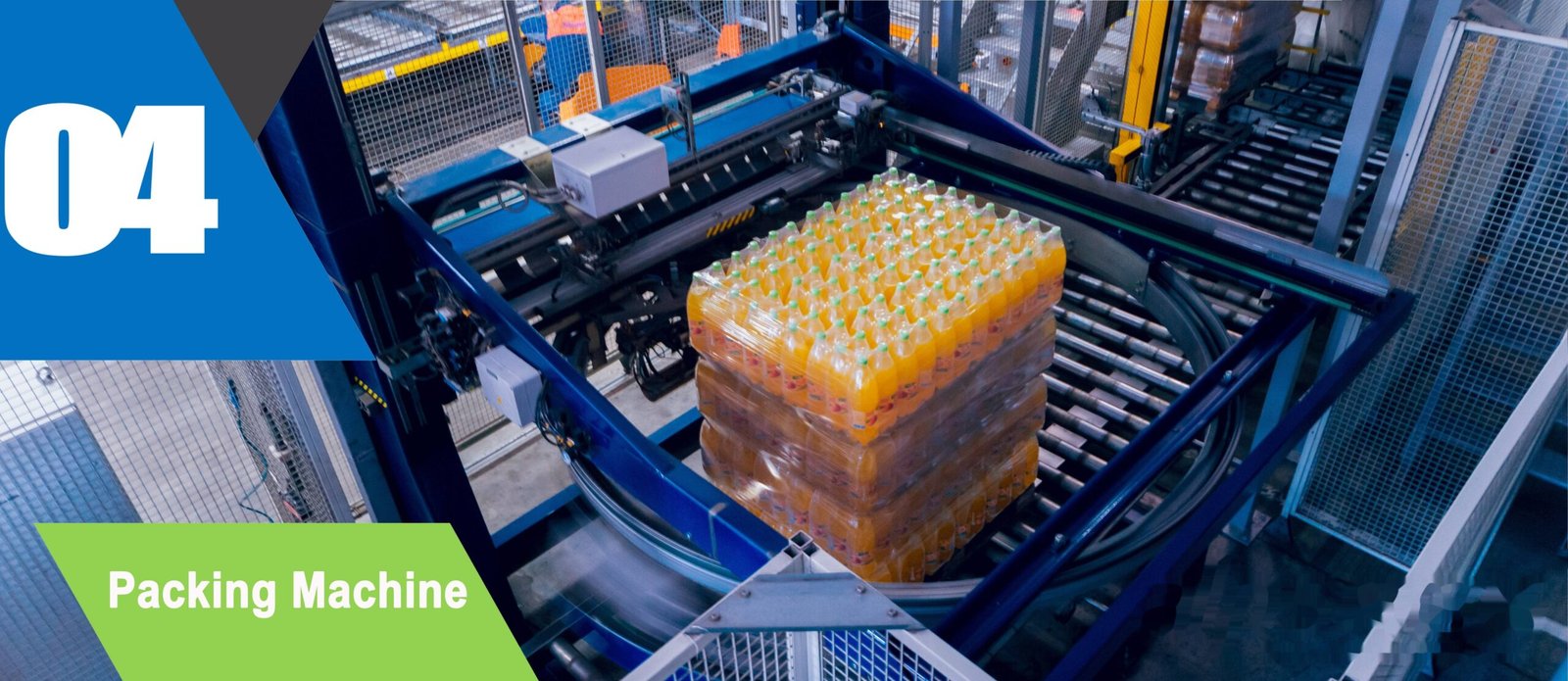
Precision Engineering & Core Components: turnkey bottling line step 04 shrink wrapping packing machine
2. Water Rinsing: Single-Pass, Recirculated and Water Cost per 1,000 Bottles
Water rinsing works because liquid water is heavy, covers surfaces and carries particulate away. That same mass is the reason it costs money. The design question is not whether to use water but how much of it has to be fresh per bottle and how the rest can be reused without moving the contamination from one bottle to another.
In a single-pass design, fresh water is sprayed into each bottle and goes to drain. It is simple, easy to validate and gives the cleanest result per bottle, and it is the appropriate choice when the product is sensitive or the local water supply is cheap. In a recirculated design, water is collected, filtered and reused, with a smaller fresh-water make-up. Recirculation cuts consumption substantially, but it introduces a loop that has to be monitored: filter condition, turbidity or particle count in the loop, and a defined change-out interval. A recirculated loop with a neglected filter is worse than single-pass rinsing, because it redistributes contamination.
Nozzle selection is where the real water consumption is decided. Rinse nozzles that project a straight jet at the bottle base give a strong impingement in a narrow band and leave the neck area relatively untouched. Fan or cone nozzles spread the effect but need more flow to keep the same impact. The practical compromise in most beverage lines is a nozzle that reaches the base and the shoulder, combined with a holding time long enough for the water to drain rather than sit in the bottle.
Drain time is the parameter that gets cut when a line is pushed for speed, and it is the one that most reliably produces a defect. If the bottle leaves the rinse station carrying water, that water becomes part of the fill, dilutes the product and, in a carbonated application, interferes with the counter-pressure cycle. Give the station enough index time for the bottle to empty, and check it by weighing the container immediately after rinsing rather than trusting the layout drawing.
| Method | How it removes soil | Water use | Air use | Where it fits |
|---|---|---|---|---|
| Fresh-water single pass | Impingement plus flushing; contamination leaves the machine | High — one fresh dose per bottle, then to drain | Low, unless an air blow-off is added | Sensitive products, hot fill, plants with reliable treated water |
| Recirculated water | Impingement and carry-away, with filtered reuse of the loop | Medium — reduced by fresh make-up volume | Low | High-speed water and CSD lines where water cost or availability matters |
| Compressed-air blow | Shear and displacement; loose dry particulate only | None | High — continuous demand at low pressure | Dry products, powder filling, lines where no water may enter the container |
| Ionised-air blow | Neutralises static charge, then air carries the freed particulate out | None | High, plus ioniser power and maintenance | PET bottles straight from bulk bags or high-speed air conveyors, dry filling |
| Combined water plus ionised air | Water removes particulate, air dries and neutralises the remaining charge | Medium to high | Medium — timed blow-off only | Lines that need a dry neck finish before capping, and plants fighting recurring fibre findings |
Turning that comparison into a running cost is straightforward arithmetic, and it is worth doing before the purchase order rather than after. Multiply the nozzle flow by the number of bottles rinsed per hour and convert to a daily figure, then compare the two candidate designs:
| Worked comparison (illustrative) | Single pass | Recirculated |
|---|---|---|
| Rinse water per bottle (typical range) | 0.15 – 0.35 L | 0.05 – 0.15 L fresh make-up |
| Water for 12,000 bottles per hour, 16 h shift | Roughly 29 – 67 m³ per day | Roughly 10 – 29 m³ per day |
| Added equipment | None beyond nozzles and drain | Tank, pump, filtration, monitoring |
| Main risk | Operating cost and possible water availability limits | Contamination carried over if filtration and change-out are neglected |
Those per-bottle figures are typical industry ranges, not Sailwin test results, and your own nozzle flow and index time will move them. Run the numbers with your real nozzle flow — the exercise usually shows that recirculation pays for itself quickly on a high-speed line and never on a small one.
3. Air and Ionised-Air Rinsing: Dry Options and Static Control
Air rinsing exists for two kinds of line. The first cannot accept water in the container at all — dry products, powders, or a filling system whose accuracy depends on the bottle being empty and dry. The second has a particulate problem that water cannot solve on its own, because the bottle is holding a static charge that keeps attracting dust after the rinse.
A plain air blow is straightforward: filtered compressed air through a nozzle aimed into the bottle, with enough volume to lift and expel loose particulate. Its limit is mechanical. Air will not remove anything stuck to the wall, and it will not remove a particle held by electrostatic attraction unless the charge is removed first. It also consumes compressed air continuously, which is the most expensive utility on most sites — the same 8–10 bar low-pressure network that feeds the rest of the line.
Ionised air adds a static-neutralising stage. Ionisers are normally mounted so the blow passes through or past the ionising field on its way into the bottle, and the ions discharge the surface so that particles released by the air stream do not settle back. This is the configuration that actually solves the electrostatic problem, and it is the reason a PET bottle line can show a large drop in fibre findings after switching from a plain blow to an ionised blow while the air volume stays the same.
Three practical points decide whether the installation works. Air quality first: the blow is going inside a food or beverage container, so the air needs a filter and, where required, a drying stage that matches the product’s specification — the same audit trail that applies to filling air. Second, ioniser maintenance: electrodes contaminate over time and lose effectiveness gradually, so the station needs a cleaning interval and a check that the ioniser is functioning, not just that the machine is running. Third, timing: a blow that starts while the bottle is still moving or that ends before the bottle is capped wastes air and spreads the problem rather than solving it.
The economically correct rinser is rarely the most powerful one. It is the station whose mechanism matches the contaminant, whose resource consumption has been calculated per 1,000 bottles, and whose performance someone is obliged to measure.
4. Rinse Station Mechanics Inside a 3-in-1 Monobloc
On most beverage lines the rinse station is not a standalone machine but the first of three operations on one frame. In a 3-in-1 rinsing filling capping monobloc the bottle is gripped by the neck, inverted or flipped, rinsed, righted, filled and capped without leaving the same rotary carrier. That architecture decides how effective the rinse can be, because the bottle is held by the neck and the only access to its interior is through a single opening.
The 180° flip clamps that invert the bottle during rinsing are the mechanical heart of the station. Inverting the container lets water or air reach the base under gravity and drains the bottle before it is righted, which is what prevents the rinse liquid from being carried into the filler. The clamp has to hold the neck firmly enough that the bottle cannot slip when inverted, yet gently enough that it does not mark the finish; this is the part of the design that fails first on a machine that has been run at speed beyond its specification for a season.
Nozzle reach follows from bottle geometry, and it is worth specifying in writing. A rinse nozzle has to deliver its jet to the base of the container without touching it and without being so far away that the jet loses structure. Formats of very different heights — a 200 ml water bottle and a 1.5 L carbonated bottle on the same line — need either adjustable nozzle height or a nozzle change as part of the format changeover. Where the change is a nozzle swap, that swap belongs in the changeover procedure with a torque or stop position, not in an operator’s memory.
Contact materials matter for the same reason they matter in the filler. Product-contact parts in SUS304 or SUS316L, with the higher grade used where the product, the cleaning chemistry or local regulations demand it, keep the rinse station inside the same hygienic specification as the rest of the line and let one cleaning procedure cover the whole monobloc. That interoperability is one reason to buy a rinser as part of the filling machine rather than as a separate island with its own materials, its own cleaning routine and its own set of compliance questions.
5. Case Study: A Water Bottling Line Chasing Fibre Findings
A bottled water producer was receiving complaints about occasional visible fibre in 500 ml PET bottles. The rinser was running, the water was treated, and the complaint rate was low enough that nobody could reproduce the defect on demand — which made it easy to treat as noise.
- Intermittent visible fibre, not reproducible in the plant, found by consumers at the point of use
- Bottles delivered in bulk bags and fed by air conveyor, hours after blow moulding
- A water rinse station fitted, but no measurement of what it removed or what left with the bottle
- No record of the rinse station’s water flow, nozzle condition or drain time since commissioning
- Shorten the sampling distance: capture bottles immediately after the rinser instead of after the capper
- Compare three sample points — after blow moulding, after the air conveyor and after the rinse station
- Inspect nozzle condition and measure actual flow and index time at the station instead of reading the drawing
- Test a combined water rinse with ionised-air blow-off to dry the neck and neutralise charge
- Contamination localised to the transfer and rinse stages rather than to the blow moulding stage
- Ineffective nozzles and a shortened drain time identified as the two actionable findings
- A rinse verification routine added to the shift checks, with sample points and a defined limit
- Drain time restored in the recipe so bottles no longer left the station carrying water into the filler
The finding that mattered was not a missing machine. It was a missing measurement. Once the plant could see the difference between the bottle entering and leaving the rinse station, the discussion moved from opinion to evidence within a single shift.
Not Sure Whether Your Rinse Station Is Doing Its Job?
Send your container format, line speed and current rinse configuration — Sailwin engineers return a comparison of water, air and ionised-air options with consumption figures within 24 hours.
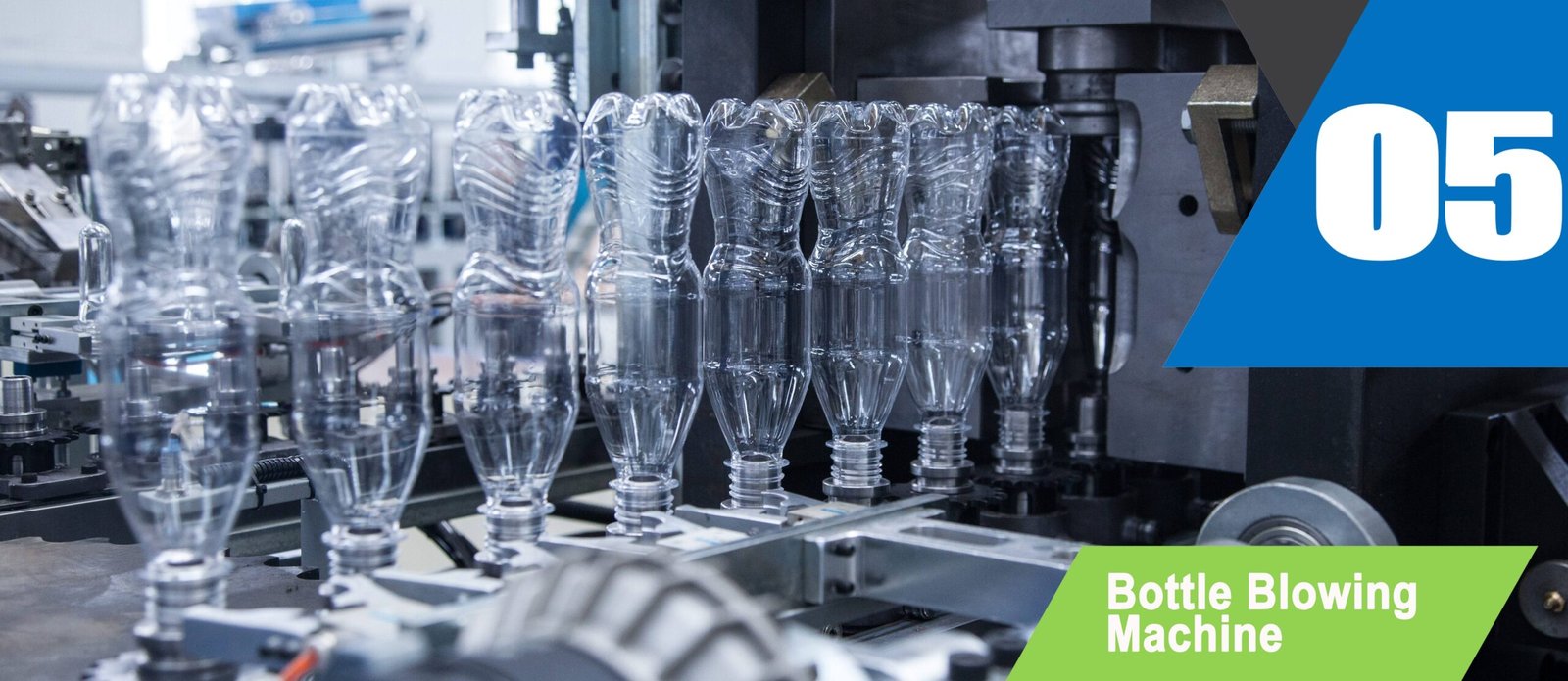
Industrial Machinery Assembly & Workshop: turnkey bottling line step 05 automatic bottle blowing machine
6. Validating Rinse Performance: Tests, Limits and Records
Validation is what separates a rinse station from a rinse assumption. It does not need a laboratory budget; it needs a defined sample point, a defined test and a number that either passes or fails. The four tests below cover most beverage applications, and a plant can choose the two that match its risk.
Visual inspection with a defined method. Cheap, immediate and surprisingly sensitive when standardised. Inspect a fixed number of bottles per shift under consistent lighting against a matt background, looking specifically at the base and the neck, which is where particulate and water residue accumulate. The weakness of visual inspection is that it depends on the observer, so write down the method — light type, viewing angle, number of bottles — and keep it identical between shifts.
Rinse-water or rinse-residue analysis. Collect the water leaving the station, or rinse a sampled bottle with a fixed volume of clean water and analyse that. Particle counting gives a direct figure per bottle; conductivity or turbidity trends give a fast indicator for the recirculated loop. This test is the most useful single acceptance measurement at handover because it produces a number that can be compared against a later re-test.
Tracer or seeded-challenge testing. Deliberately contaminate a set of bottles with a known, harmless particulate — a tracer powder or a counted number of glass or plastic beads of a defined size — then run them through the station and count what remains. This is the only test that measures removal efficiency directly rather than inferring it, and it is the most persuasive evidence that a station meets a specification at the extremes of bottle format and line speed.
Equipment condition checks. Nozzle condition, actual flow, index or dwell time, drain behaviour, filter differential pressure on a recirculated loop, ioniser function and air quality on a dry station. These are the variables that drift between validations, and a short checklist at shift start catches most of them before they become complaints.
Decide in advance what happens on a failure, because the answer is not always “stop the line”. A particulate finding on the visual check might trigger a second check with the tracer method and a nozzle inspection; a failure of the tracer test at a defined limit should stop the station until the cause is corrected. Writing that escalation path at commissioning is much easier than negotiating it during a customer complaint. It also makes the records meaningful: a log that shows limits, results and actions is evidence, whereas a log that only shows that the station ran is paperwork.
Finally, connect the rinse station to the rest of the hygiene system rather than treating it in isolation. The cleaning routine of the monobloc covers the rinser; the water quality feeding the rinse station should match the quality standard used for the product; the compressed air used for a blow-off belongs to the same air-quality specification as filling air. Sailwin machines are delivered with a full-load factory acceptance test before shipment and commissioned on site in 3 to 7 days, which is the practical window in which these checks should be run for the first time — with your product and your bottle, not with a sample from a catalogue.
Frequently Asked Questions
Specify a Rinse Station You Can Actually Verify
Send your bottle drawing, container sample or target output. Our engineering team replies with a machine recommendation, mould assessment and factory-direct quotation within 24 hours.
Related Reading:
• Liquid Filling Machines — Monobloc, Isobaric and Hot Fill
• How a 3-in-1 Rinsing Filling Capping Monobloc Works
• CIP Cleaning Cycles for Filling Machines and Rinsers
• Designing the Layout of a Bottling Line
• Fill Accuracy Standards and How to Hold Them
• 5-Gallon Water Filling and Rinsing Systems