A preform injection moulding machine almost never stops for an exotic reason. It stops because a heater band has reached the end of its thermal life, a thermocouple has drifted and taken the shot weight with it, or a hot runner tip has worn past the point where gate vestige still passes the quality gate. None of those parts is expensive. The problem is that on the day each fails, none of them is on the shelf.
The cost of that gap is not the part price, it is the search. On a 64-cavity tool the machine is making preforms every cycle, and a shift of lost output is worth many multiples of the component that caused the stoppage. Recovery is rarely a single step either: identify the part, contact a supplier, confirm availability, raise the paperwork, clear customs, restart. Each step is another chance to lose a day.
Plants that avoid this do not hold huge stores. They hold a short, deliberate list and classify it correctly. Sailwin has built injection moulding machines for 15+ years, with 500+ machines delivered into 60+ countries, CE marking, ISO 9001:2015 manufacturing and a 2-year whole-machine warranty. The SW-P series covers 14 models from 170 kN to 5,500 kN, supports 64-cavity valve-gate hot runner tooling, uses a dedicated PET screw with far-infrared nano heating coils, and provides an EUROMAP 67 robot interface. Common wear parts ship within 48 hours and remote engineering support runs 7×24. This article sets out the first-order list a preform cell should hold, the classification logic behind it, and how to size reorder points.
Key Takeaways
- Classify by consequence, not by price. A thermocouple and a servo valve both stop the machine, but only one of them is realistically available locally the same day.
- The first order belongs before commissioning. A 48-hour shipping channel still has to clear customs and goods-in before the machine restarts.
- Hot runner spares are quality spares. Tip and gate condition drives part weight, gate vestige and acetaldehyde, so those items belong in the quality budget.
Send Your Preform Cell Layout for a Spares Review
Share your press tonnage, cavity count and resin grade — Sailwin engineers return the recommended first-order spare list and reorder points for your duty cycle.
1. What Actually Stops a Preform Machine
Downtime sorts into three groups. Hard stops: the machine will not restart. Degraded runs: the machine produces, but part weight drifts or acetaldehyde creeps up until a run is rejected. Nuisance stops: a guard, a sensor or a handling fault halts the line for minutes at a time. Most spares strategies cover the first group, ignore the second and underfund the third — even though nuisance stops are what eat a shift in increments.
The ratio that matters is repair time versus sourcing time. A non-return valve swap is a mechanical job measured in hours; sourcing that valve when it is not on site is a procurement project measured in days, and the machine is idle for the sum of the two. That is the whole argument for a first-order list: it does not shorten the repair, it removes sourcing from the critical path.
The failures worth stocking against are consistent across PET preform production, whatever the press tonnage: non-return valve and screw tip wear, which shows up as unstable shot weight; heater band and thermocouple failure, which loses a temperature zone; hot runner tip, gate insert and valve pin wear, which shows up as gate quality and acetaldehyde; hydraulic seals and filtration; pneumatic cylinder seals and gripper consumables on the take-out side; and the control components that turn a two-hour repair into a two-week wait.
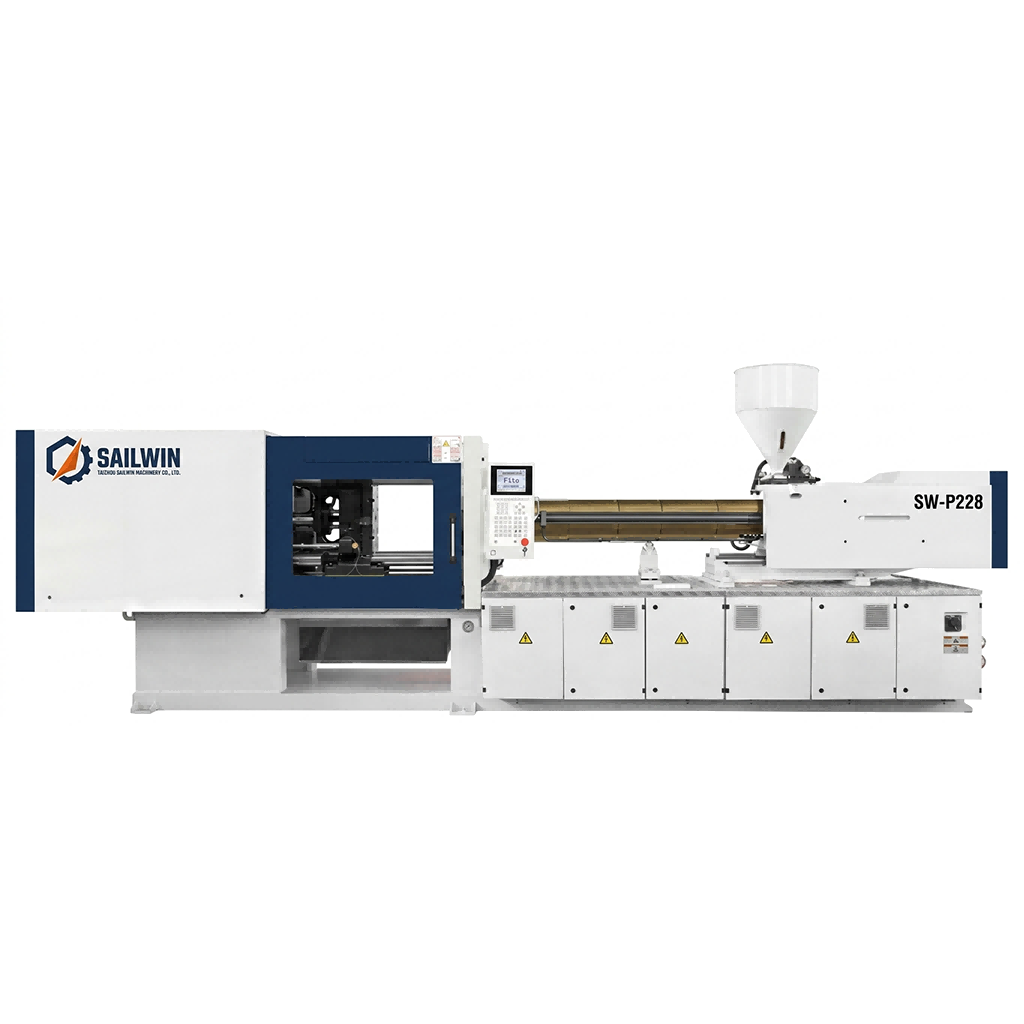
Precision Engineering & Core Components: sw p228 pet preform injection molding machine
2. The First-Order List Before the Machine Runs
The method is to walk the machine and mould set function by function and name one spare for every function you cannot run without. The table below is the structure a preform cell should end up with. It is deliberately expressed as holding logic rather than fixed quantities, because the right quantity depends on how many identical positions you run and how hard you run them.
| Function | Parts to hold | Holding logic |
|---|---|---|
| Heating and temperature | Barrel heater bands, nozzle heaters, thermocouples, solid-state relays | One spare of each heater and thermocouple type fitted |
| Screw and barrel | Non-return valve assembly, screw tip, heater sleeves | One assembly per machine; the NRV is the hardest fault to diagnose |
| Hot runner and gate | Nozzle tips, gate inserts, heater cartridges, valve pins, seals | One set per valve-gate position on continuously run tools |
| Hydraulic and servo | Filter elements, seal kits, proportional or servo valve | Filters at a multiple of measured consumption |
| Pneumatic and take-out | Cylinder seal kits, solenoid valves, gripper pads, proximity sensors | Seal kit per cylinder size; consumables restocked from usage |
| Electrical and control | PLC I/O modules, safety relay, contactors, drive spares | One of each module type; the safety relay is not optional |
| Mould-side utilities | Water and oil hoses, quick couplings, O-rings, mould clamps | Consumable allowance; a leaking cooling circuit becomes a quality fault |
Read it as a checklist. Any row without an answer is a function with no recovery path. On a machine running 64-cavity valve-gate tooling, the hot runner row is the one that decides whether a fault costs you a repair or a quality investigation.
3. The Spares That Are Not Generic
Three groups of parts cannot be substituted from a general industrial catalogue. The first touches the melt path: non-return valve assemblies and screw tips are matched to barrel geometry and to the resin being processed, so a generic equivalent changes shot-weight behaviour in ways that are hard to attribute later. Sailwin SW-P machines use a dedicated PET screw with far-infrared nano heating coils, and those two items most directly decide shot-weight stability.
The second is temperature hardware. A heater that fails open is obvious; a thermocouple that drifts is not. Drift leaves a zone reading correctly on the HMI while the melt in front of it runs cold, and the symptom is a slow change in part weight or a defect that appears and disappears. With PID temperature control to ±1°C, a drifting sensor is a genuine quality risk, which makes spare thermocouples for every zone type one of the cheapest insurance policies on the machine.
The third is hot runner hardware. Tips, gate inserts, heater cartridges and valve pins are dimensionally matched to the manifold and to the gate specification. Substituting a different tip geometry changes gate vestige, changes the thermal profile around the gate and, in PET, changes acetaldehyde generation. On a multi-cavity tool the requirement scales with the number of positions, so the correct first order is a full set per continuously run valve-gate mould — not one tip per mould, which guarantees that a two-position fault becomes a partial repair.
4. Where the Long Lead Times Actually Hide
The most expensive parts are rarely the fastest wearing. They are the cheap-to-hold, slow-to-obtain ones: an I/O module on back order, a safety relay with a single distributor, a drive shipped from another continent. Sailwin machines are built around Siemens and Mitsubishi PLCs, SMC cylinders, Schneider electrical components and ABB drives — mainstream platforms with global distribution, so replacements normally arrive in days rather than weeks. The variable is not the brand, it is whether the plant has to open a procurement process on the morning the machine stops.
Holding a spare anyway is about process risk, not supply risk: a stock-room pick takes minutes, while a purchase order takes days even for a part sitting in a local warehouse. The same logic applies on the hydraulic side, where filter condition quietly decides whether a pump or servo valve reaches its design life — which is why filter elements should be the highest-turnover item on the list.
| Subsystem | Sailwin build platform | First-order holding |
|---|---|---|
| Control | Siemens / Mitsubishi PLC and HMI | One spare of each I/O module type; verified parameter backup off-machine |
| Motion and hydraulics | Servo and proportional valves, seal kits | Valve spares per machine class; seal kit per cylinder size |
| Pneumatics | SMC cylinders and valves | One seal kit per cylinder size on take-out and handling |
| Electrical | Schneider protective devices, ABB drives | Safety relay and contactors per machine; fuse consumables |
A spare parts list is not a maintenance expense. It is a statement about which failures you have decided to accept.
5. Case Study: Building a List After a Hot Runner Failure
A PET preform producer running 64-cavity valve-gate tooling lost the largest part of a shift to a single failed hot runner zone heater, then lost considerably more time sourcing the replacement than the machine had been down.
- High-cavity valve-gate tool in continuous production, with no hot runner cartridge held on site
- Downtime split across two phases: the repair, then a procurement cycle that started only after the diagnosis
- A stock room deep in fittings and fasteners, but empty of the machine’s built-in failure points
- Every heated zone, moving assembly and control module mapped to a named spare with a reorder point
- The list split into hard-stop, degraded-run and consumable classes instead of a flat part list
- A first order sized to one spare per function type, planned around the 48-hour wear-part channel
- Repair time decoupled from sourcing time: a procurement project became a stock-room pick
- Hot runner items funded from the quality budget, where gate condition was already justified
- Reorder points derived from measured consumption and reviewed at each new tool
Scenario based on a Sailwin customer project; site-specific figures available on request during engineering review.
6. How to Size the Stock and Keep the List Alive
Sizing is a two-part problem: how many positions a part serves, and how long replacement takes. A part that fails once a year in a single position needs one spare. A part that fails once a year across 64 positions needs enough to cover realistic simultaneous failure — which is why hot runner items dominate the value of a preform spare store while occupying almost none of its volume.
- Walk the cell function by function. Machine, mould, hot runner, take-out, temperature control, hydraulics, control cabinet. Start from the machine, not from a catalogue.
- Assign every position a consequence class. Hard-stop items reorder at one remaining unit; consumables reorder when lead time equals usage.
- Price the list against one shift. Compare the holding value with the output of a single shift on your fastest line. That comparison is what gets the budget approved.
- Review after every stoppage and tool change. A part used twice in a year belongs in depth; a part bought in a hurry once is a candidate for removal.
Close the loop with documentation: part numbers, positions served, fitted brand, last replacement date and the parameter values linked to that position. On a machine monitored at 40+ parameters by the PLC in real time, a correct recipe and parameter backup is as much a spare as the hardware.
Build Your Preform Cell Spares List With Sailwin
Send the press model, cavity count, resin grade and annual hours — we return a first-order spare list, reorder points and lead times for every item.
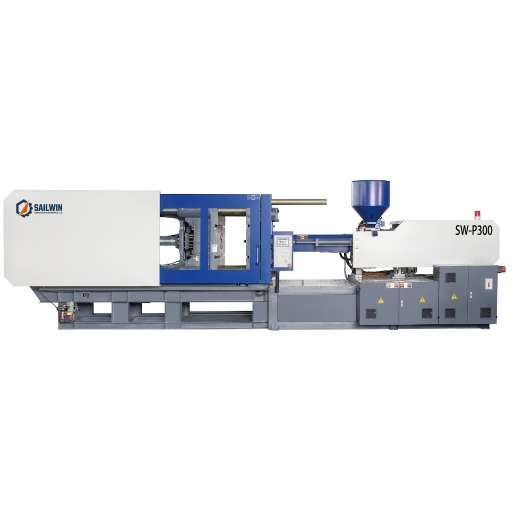
Industrial Machinery Assembly & Workshop: sw p300 pet preform injection molding machine
7. Frequently Asked Questions
Stop Losing Shifts to Parts You Could Have Stocked
Send your bottle drawing, container sample or target output. Our engineering team replies with a machine recommendation, mould assessment and factory-direct quotation within 24 hours.
Related Reading:
• Injection Molding Machines: SW-P Series 170–5500 kN
• Hot Runner Maintenance for Preform Moulds
• 64-Cavity Hot Runner Preform Mould Technology
• PET Screw and Barrel Design for Injection Moulding
• Preform Machine Installation and Commissioning
• Preform Mould Trial Checklist