Updated: 2026 Engineering Standard · By Sailwin Technical Team
How to Calculate Clamping Force & Shot Weight for PET Preform Injection Molding
In high-volume bottle preform manufacturing, choosing an improperly sized injection press is an irreversible capital mistake. Sizing a machine too small leads to severe mold parting line flashing, preform weight drift, and ruined hot runner nozzles under injection pressure. Conversely, buying an oversized machine needlessly inflates kilowatt-hour consumption, slows down platen dry-cycle speeds, and stretches investment payback periods beyond 24 months.
Unlike standard thin-wall injection molded containers, PET preforms feature steep taper draft angles, heavy wall thicknesses (2.5mm to 4.5mm), and deep cavity cores that demand dedicated screw L/D ratios and precision hydraulic clamping.
This engineering handbook provides the exact mathematical formulas used by Sailwin engineers to size clamping forces (1,700 kN to 5,500 kN), shot capacities (354g to 4,815g), and cycle times for 8 to 64-cavity preform production.
Key Engineering Takeaways
- Clamping Formula: Clamping Tonnage (kN) = Total Projected Area (cm²) × Cavity Plastic Pressure (typically 30 to 45 MPa for PET) × Safety Factor (1.15).
- Shot Weight Sweet Spot: Total preform shot weight (including cold sprue or hot runner drop volume) must utilize between 35% and 75% of the machine’s maximum theoretical barrel capacity to avoid thermal degradation.
- Cooling Dominates Cycles: PET preform cycle times range from 10.5s to 14.0s on water preforms, where mold chilled-water cooling represents over 60% of total duration.
Need Engineering Calculations for Your Preform Line?
Send your preform drawing (gram weight & neck finish) for customized tonnage sizing and energy consumption budgets.
1. Clamping Force Calculation: Projected Area & Cavity Pressure
Clamping Sizing Law: Insufficient clamp tonnage causes flashing and ruined neck threads; excessive clamp tonnage crushes mold parting line venting slots. Target 35–45 MPa cavity pressure for PET.
To determine the required clamping force in metric tons or kiloNewtons (kN), engineers calculate the total projected area of all preform cavities perpendicular to the mold parting line:
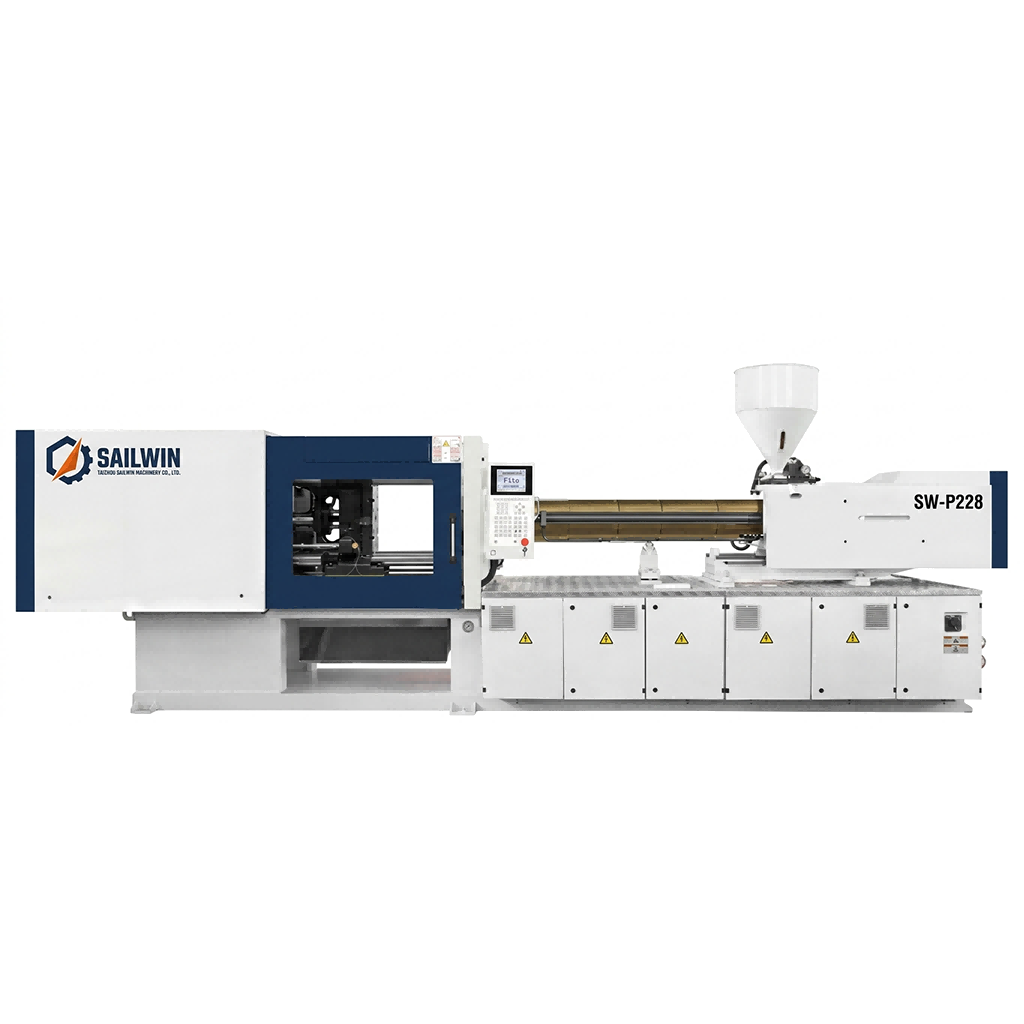
For example, a 24-cavity mold producing standard 28mm PCO1881 water preforms (projected diameter approx. 3.2cm) requires approximately 2,280 kN (228 Tons) of positive clamping force, perfectly matching the Sailwin SW-P228 injection molding machine.
| Preform Type | Neck Diameter | Typical Weight | Cavities | Recommended Sailwin Model | Clamping Force (kN) |
|---|---|---|---|---|---|
| 500ml Water Preform | PCO 1881 (28mm) | 14g – 18g | 16 Cavities | SW-P170 | 1,700 kN (170 T) |
| 1.5L Beverage Preform | PCO 1881 (28mm) | 28g – 35g | 24 Cavities | SW-P228 | 2,280 kN (228 T) |
| 5L Cooking Oil Preform | 38mm / 48mm | 85g – 110g | 16 Cavities | SW-P300 | 3,000 kN (300 T) |
| 5-Gallon Water Jug Preform | 55mm Neck | 650g – 750g | 4 Cavities | SW-P450 / SW-P550 | 4,500 – 5,500 kN |
2. Shot Weight Capacity & Barrel Utilization Guidelines
Barrel Utilization Rule: Never size a mold requiring over 80% or under 30% of barrel shot volume. Between 40% and 70% guarantees uniform melt homogeneity without yellowing.
Unlike commodity polymers, PET (Polyethylene Terephthalate) resin is hygroscopic and thermally sensitive. If the shot size consumes less than 30% of barrel capacity, the molten polymer resides in the heated barrel too long, breaking polymer chains and generating excessive Acetaldehyde (AA > 4 ppm) and thermal yellowing.
Sailwin SW-P machines feature specialized PET screws with length-to-diameter (L/D) ratios of 24:1 to 26:1 and far-infrared nano heating bands, ensuring rapid, low-shear plasticizing without scorching the material.
Sailwin Customer Case Study: Water Bottler Increases Preform Output by 38% with SW-P268
How a commercial water packaging factory upgraded from an outdated hydraulic toggle press to a Sailwin SW-P268 servo-driven preform system.
- Old injection press suffered from shot-to-shot weight variations of ±1.2g on 18g preforms.
- Long cycle times of 17.5 seconds caused bottlenecking for downstream bottle blowers.
- High electric bills due to constant-speed hydraulic pump motors.
- Installed Sailwin SW-P268 (2,680 kN) equipped with synchronized servo pump and 32-cavity valve-gate mold.
- Integrated independent PID nano-infrared temperature zones for exact barrel thermal control.
- Configured dual-circuit chilled water mold cooling at 10°C with automated part extraction.
- Cycle time slashed from 17.5s down to 11.8s (32.5% faster output).
- Preform weight consistency narrowed to ±0.08g, eliminating blowing wall-thinning scrap.
- Power consumption reduced by 41% per kilogram of processed PET resin.
Data source: Sailwin Factory Commissioning Log and Customer Production Verification, 2026.
Frequently Asked Questions
SAILWIN MACHINERY · FACTORY-DIRECT PACKAGING SYSTEMS
Ready to Size Your PET Preform Production Line?
Submit your target daily preform output. Sailwin’s senior engineers calculate exact clamping force, screw diameter, and mold cavitation within 24 hours.
Explore Integrated Packaging Machinery on Sailwin:
• PET Preform Injection Molding Machine – High-speed 140T to 550T systems for multi-cavity bottle preform lines.
• PET Water Bottle Blowing Machine – Linear automatic servo stretch blow molding equipment.
• Liquid Filling Machine & Bottling Line – 3-in-1 rotary monoblocs for drinking water and beverage factories.
• HDPE Extrusion Blow Molding Machine – Industrial continuous blow molding systems for jerrycans and drums.
• Need technical plant advice? Contact our engineering team for free turnkey consultation.