Updated: 2026 Technical Guide · By Sailwin Engineering Team
A PET blow molding machine installation schedule is usually written by the supplier and then quietly broken by the site. The machine arrives on time, but the concrete is not cured, the electrical feed is not terminated, or the compressed air ring main is not pressure tested. The result is a machine sitting in its crate for two weeks while the launch date moves. The difficult part is that none of it is unusual, and all of it is preventable.
The typical failure points are consistent. Utility capacity was assumed rather than measured, so the high-pressure air supply cannot hold pressure at the nozzle. The mould store was not positioned for the intended changeover time, so the fast-change capability of the machine is never realised. Operator training was treated as an afterthought, so the line runs in manual for months. Or the factory acceptance test was skipped in the interests of speed, so problems that should have been solved in the supplier’s plant are solved in yours.
Sailwin has delivered PET stretch blow molding machines into 500+ installations across 60+ countries over 15+ years, with CE-marked machines built under ISO 9001:2015 and a 2-year whole-machine warranty. This guide sets out what happens between the purchase order and the first saleable bottle, who owns each stage, and which stages have the least slack in them.
Key Takeaways
- Machine supply is rarely the critical path: standard configurations are built in 30–45 days, with custom builds at 45–60 days. Civil works, electrical capacity and utility installation usually take longer than that — so start them in parallel with the machine build, not after the machine arrives.
- On-site work is short if the site is ready: installation and commissioning take 3–7 days. That figure assumes the machine can be moved into position, powered, and connected to tested high-pressure air and chilled water on day one. If it cannot, the same work takes weeks.
- The factory acceptance test is your only cheap correction window: every Sailwin machine is full-load FAT tested before shipment. Corrections made in the supplier’s plant are free; corrections made in yours are not.
Planning a PET Line Launch Date?
Send your target start-up date and container specification — we return a machine lead time and site-readiness checklist within 24 hours.
1. The Full Timeline, Stage by Stage
The table below sets out the sequence from order to production, with the duration each stage normally needs and the party that owns it. The right-hand column is the one worth reading twice: it lists what actually slips in practice, which is almost never the machine itself.
| Stage | Typical duration | Owner | What usually slips |
|---|---|---|---|
| Order, drawing approval and mould design | Front end of the build window | Buyer and supplier together | Late decisions on neck finish, decoration or mould layout, which restart part of the design work |
| Machine build | 30–45 days standard; 45–60 days for custom configurations | Supplier | Configuration changes after the order is released, which reset the lead time rather than extend it |
| Factory acceptance test | Full-load running test before shipment | Supplier, with buyer attendance recommended | Buyer absence, which means the acceptance criteria are never formally agreed |
| Crating, documentation and sea freight | Adds transit time on top of the build window, and is destination-dependent | Supplier for packing; buyer for import clearance | Import documentation and customs clearance, which are outside the supplier’s control entirely |
| Site preparation | Should run in parallel with the build, not after it | Buyer | Concrete curing, electrical feed termination and pressure testing of air and water mains |
| Installation and commissioning | 3–7 days | Supplier engineers, with buyer utilities support | Utilities that were signed off as ready but cannot hold pressure or temperature under load |
| Operator training and handover | Overlaps the commissioning window | Supplier and buyer jointly | Operators assigned late, so the machine runs below its capability for the first months |
2. Factory Acceptance Testing: The Cheap Correction Window
Every Sailwin machine is full-load tested before shipment. That matters commercially more than technically: a correction made in the supplier’s plant costs the supplier time, while the same correction made on your site costs you time, and your time is the one that has a launch date attached to it.
To get value from the FAT, agree the acceptance criteria in advance and run the test on the container you actually intend to produce, not on a convenient sample. The test should demonstrate the machine meeting its stated output on your bottle, with the heating profile recorded and wall thickness measured at defined points. Ask for the process parameters to be recorded at the end of the test, because that record becomes the reference for the first production run on your site.
If you cannot attend in person, ask for video evidence and a written process record rather than a statement that the test was passed. The distinction matters later, when a wall thickness question arises and there is nothing to compare against.
A factory acceptance test is not a formality at the end of the build. It is the reference data set that every later production decision on your site will be measured against.
3. Crating, Shipping and Import Documentation
Large machinery travels by sea in a manner that has to be planned: the machine is protected against moisture and movement, and the moulds and loose components are packed so that nothing shifts against a machined surface. The container is loaded at the supplier’s plant after the FAT, so the process sequence is test, then crate, then ship — never the reverse.
On the documentation side, the standard set for an export shipment of industrial machinery typically includes the commercial invoice, packing list, bill of lading, certificate of origin and the CE declaration of conformity, plus any phytosanitary treatment certificate required for wooden packing materials in your destination market. Import clearance is the buyer’s responsibility and is the single largest source of schedule variance outside the supplier’s control, so the documentation set should be reviewed by your customs broker before the container is loaded rather than after it arrives.
Two practical points reduce risk at the destination. First, confirm that the shipping configuration matches what your site can receive — a large machine may need a crane or a heavy forklift on arrival, and that equipment should be arranged before the vessel berths, not after. Second, verify that lifting points and centre-of-gravity information are supplied with the packing documentation, because rigging a blow moulding machine by guesswork is how machines get damaged before they are ever switched on.
Import Documentation and Shipping Checklist
Send your destination port and incoterm — we return the shipping configuration, documentation list and rigging requirements within 24 hours.
4. Case Study: Holding a Launch Date Through a Long-Lead Build
A bottler commissioning a new PET line had a contracted retail launch date that could not move, and a building that was still under construction when the machine order was released.
- Fixed retail launch date with no flexibility, and a greenfield building still under construction
- High-pressure air, chilled water and electrical supply all still to be installed when the machine order was placed
- Operators to be recruited and trained before the first production run
- Site readiness checklist issued with the order, so civil, electrical and utility works ran in parallel with the 30–45 day build window rather than after it
- Utility specification fixed at the enquiry stage: high-pressure air at 30–40 bar, low-pressure air at 8–10 bar on a separate main, and chilled water at 8–12 °C, so the contractors sized their mains from one document
- Full-load FAT completed before crating, with the process parameters recorded and issued as the starting recipe for the site run
- Installation and commissioning planned into a 3–7 day window, with training delivered during the same period so operators were present for the first production runs
- Utilities ready before arrival, so the commissioning window was used for commissioning instead of for construction
- Start-up from a recorded baseline, because the FAT process parameters were carried to site as the first production recipe
- Trained operators at handover, which shortens the period before the line reaches its rated output
Scenario based on a Sailwin customer project; site-specific figures available on request during engineering review.
5. Site Preparation: What Must Be Ready on Day One
The 3–7 day commissioning window is achievable only if every item below is complete before the machine is uncrated. Work through it as a signed checklist, not as a set of assumptions, because each item is cheap to complete early and expensive to complete in a hurry.
| Item | Ready-state test | Consequence if not ready |
|---|---|---|
| Foundation and floor loading | Cured, level and checked against the installation drawing for the specific model | Machine cannot be positioned or levelled; every subsequent step waits |
| Electrical supply and termination | Terminated, labelled and megger-tested to the machine’s requirement, with correct protection devices fitted | No power, therefore no commissioning; a late capacity upgrade can add weeks |
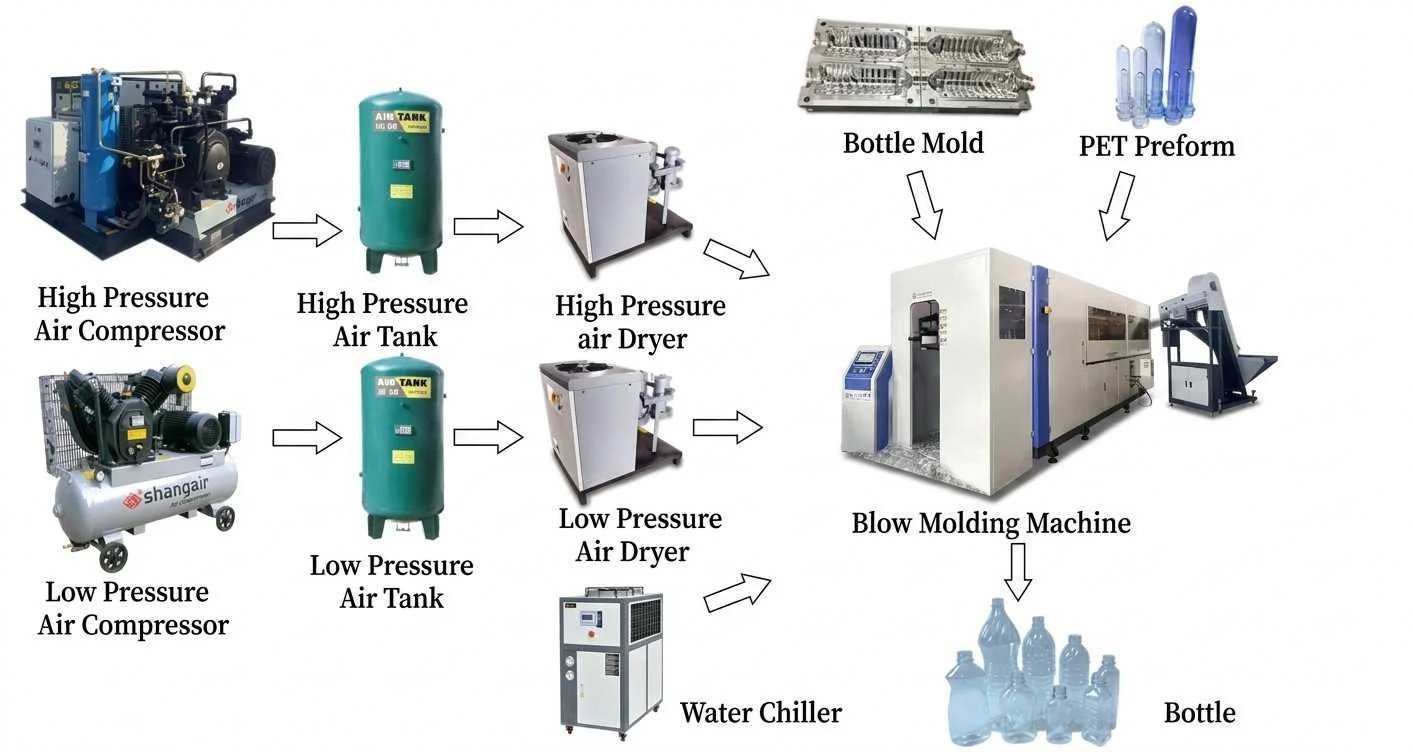
| High-pressure air | Compressor capable of 30–40 bar, receiver in place, main pressure-tested and able to hold pressure at the machine with the blow valve firing | Production cannot start; pressure drop shows up as inconsistent wall thickness rather than a simple fault |
| Low-pressure air | Independent main at 8–10 bar for ancillary functions, not shared with the high-pressure circuit | Ancillary functions pull pressure down during blowing, destabilising the process |
| Chilled water | Chiller sized for the mould load, delivering 8–12 °C at the mould with flow verified at every circuit | Cycle time cannot be met and wall thickness distribution becomes unstable |
| Mould store and handling | Storage within the production area, with lifting equipment available for mould and preform handling | The machine’s under-30-minute mould change will not be achievable in practice |
| Preform supply and storage | Qualified preforms on site, stored closed and clean, with enough stock to run the commissioning trials | Commissioning runs on substitute preforms, which invalidates the wall thickness baseline |
6. Commissioning, Training and Handover
Commissioning is not finished when the machine produces a good bottle. It is finished when the machine produces good bottles repeatably, with the process parameters documented, and when the operators can run and adjust it without a supplier engineer standing beside them. Aim the 3–7 day window at that standard rather than at the first acceptable sample.
The technical content of handover should include the heating profile and the recorded process parameters from the FAT, the wall thickness measurement procedure with defined measurement points, the mould change procedure with a target time, and the daily checks that keep the machine within its window. Sailwin machines monitor 40+ process parameters in real time through the PLC, so the handover should also cover which parameters to watch and what their normal ranges are.
Two further points affect the first months of operation. Sailwin machines use Siemens or Mitsubishi PLC control with FESTO combined blowing valves, SMC cylinders and Schneider electrical components, and PID control holds the heating zone within ±1 °C — which is the reason preform heating is repeatable enough to be documented. Servo-driven machines reduce power consumption by up to 30% and high-pressure exhaust recovery reduces compressor load by roughly 20%, so the utility consumption figures recorded during commissioning become the baseline you later measure against. After handover, common wear parts are dispatched within 48 hours and remote support is available 7×24, with a 2-year whole-machine warranty covering the machine itself.
Frequently Asked Questions
Start Site Work Before the Machine Leaves the Factory
Send your bottle drawing, container sample or target output. Our engineering team replies with a machine recommendation, mould assessment and factory-direct quotation within 24 hours.
Related Reading:
• PET Blow Molding Machines — full model and output range
• Automatic PET Blow Molding Machines: SW-F series
• Power, Air and Water Requirements for a PET Line
• PET Bottle Plant Layout: Space, Flow and Access
• PET Blow Molding Machine Operator Training
• PET Blow Molding Machine Buying Guide