Buyers who search for a PET jar blow molding machine encounter an immediate specification problem: most PET blow molding machines on the market are optimised for narrow-neck bottles (PCO 1881, 3025 finish, 28–30mm), not wide-mouth jars with neck diameters of 38mm, 63mm, 70mm, or larger. Applying a standard bottle machine to wide-mouth jar production results in unacceptable wall thickness distribution, dimensional instability at the jar shoulder, and preform supply chain problems — because standard preforms do not exist for large neck diameters. This guide explains what makes PET jar production technically different, how to specify the correct machine, and which applications drive each neck diameter requirement.
| Specification | Standard PET Bottle Machine | PET Jar / Wide-Neck Machine |
| Neck Diameter Range | 28 – 38mm | 38 – 120mm+ |
| Preform Source | Standard external supply | Custom preform (often in-house) |
| Blow Stage | 2-stage RSBM standard | 1-stage ISBM preferred for large necks |
| Key Applications | Water, CSD, juice, edible oil | Yogurt, honey, cosmetic cream, nut butter, spice |
| Mold Complexity | Standard | Higher (wide core, neck ring tooling) |
| Output (BPH) | Higher | Lower (larger preform, longer cycle) |
What Makes PET Jar Production Technically Different from Standard PET Bottle Production
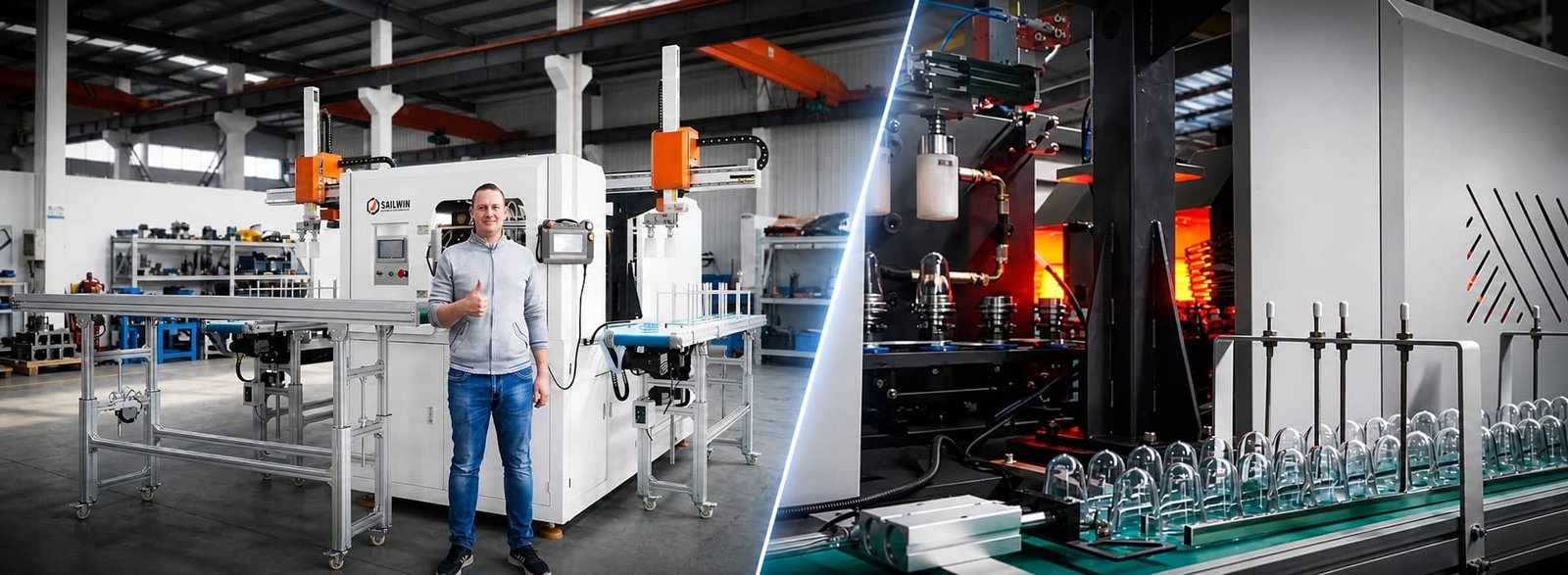
The neck diameter of a PET container is not just a dimensional specification — it determines the entire production architecture. Three fundamental differences separate wide-mouth PET jar production from standard narrow-neck bottle production.
Difference 1: Preform Geometry and Supply Chain
A standard 500ml water bottle uses a PCO 1881 preform with a 28mm neck finish — available from dozens of regional preform suppliers in every major market. A 63mm wide-mouth PET jar requires a preform with a 63mm neck finish — which exists in almost no regional preform supply chain outside of large-scale integrated producers.
This preform supply constraint has a direct consequence: buyers who invest in a 2-stage wide-mouth jar machine discover post-delivery that they cannot source preforms locally and must either import preforms (adding logistics cost and lead time) or invest in a separate preform injection machine. For neck diameters above 45mm, the practical solution in most markets is single-stage ISBM — where the preform is injection-moulded in the same machine immediately before blowing, eliminating the external preform supply chain dependency.
Difference 2: Stretch Ratio and Wall Thickness Distribution
The biaxial stretch ratio in PET blow moulding — the ratio of final container diameter to preform diameter — determines wall thickness uniformity. Standard bottles have a relatively high stretch ratio: a 28mm preform expanding to a 65mm bottle body. Wide-mouth jars have a lower stretch ratio because the neck diameter is already large relative to the jar body.
Lower stretch ratio means less molecular orientation — which reduces the clarity and strength advantages that PET offers compared to other materials. For wide-mouth PET jars to achieve commercial clarity and drop performance, the preform wall thickness, heating profile, and blow timing must be precisely calibrated for each jar geometry. A standard bottle machine running wide-mouth tooling without recalibration produces jars with poor wall distribution and inadequate clarity.
Difference 3: Mold Core and Neck Ring Tooling
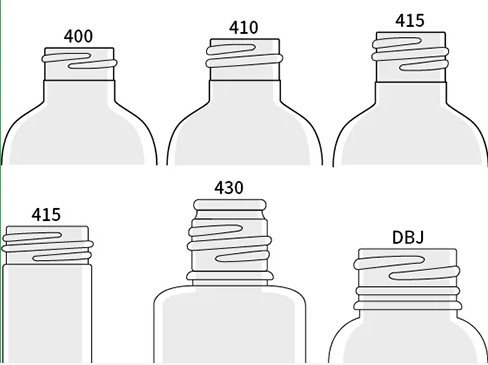
Wide-mouth jars require larger neck ring tooling and a wider blow core than standard bottle machines are designed to accommodate. Some standard 2-stage machines can be configured with wide-neck blow stations up to 38mm; above 38mm, dedicated wide-neck machine architecture is required. Attempting to fit 63mm or 89mm tooling into a machine designed for 28–38mm neck finishes produces dimensional inconsistency at the neck — the most critical sealing surface for food and cosmetic applications.
Need to confirm your jar’s neck diameter against machine capability? Send Sailwin your jar drawing — we’ll confirm which machine type and preform strategy is correct for your specification.
Neck Diameter Guide: Which Machine for Which Application
| Neck Diameter | Typical Application | Recommended Machine Type | Preform Source |
| 28 – 38mm | Dressing, sauce, small condiment bottles | Standard 2-stage or wide-neck 2-stage | External supply available |
| 38 – 48mm | Yogurt jars (small), jam, honey | Wide-neck 2-stage or 1-stage ISBM | Limited external supply; 1-stage preferred |
| 48 – 70mm | Yogurt jars (large), cosmetic cream, nut butter | 1-stage ISBM or dedicated wide-neck | External supply unavailable; in-house required |
| 70 – 89mm | Cosmetic cream jars, spice jars, premium food | 1-stage ISBM (dedicated) | In-house injection only |
| 89mm+ | Wide-mouth storage containers, institutional food | 1-stage ISBM (specialised) | In-house injection only |
Key decision point: If your jar’s neck diameter is above 45mm, plan for in-house preform production from the start. Budgeting for a 2-stage machine and assuming preform supply will be available locally is the most common and most expensive planning error in wide-mouth PET jar projects.
Application Guide: Machine Specification by End Market
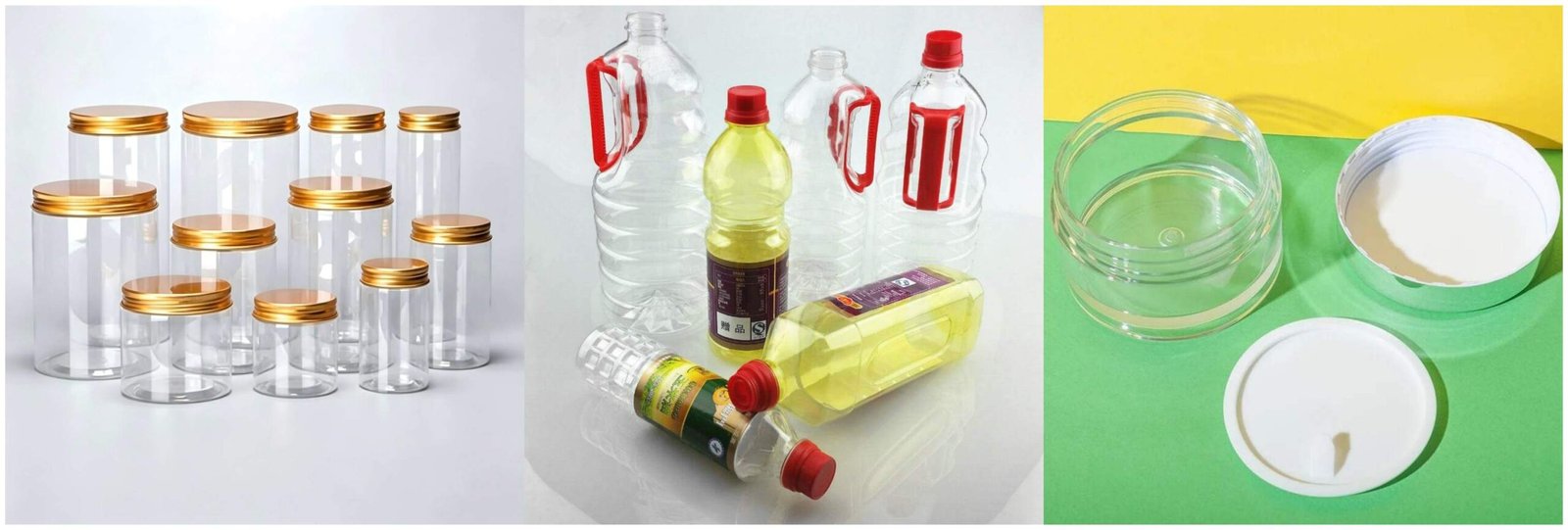
Yogurt and Dairy Jars
Yogurt jars are the highest-volume wide-mouth PET jar application globally. Standard configurations:
- Volume range: 100ml – 1,000ml
- Neck diameter: typically 63mm – 75mm for spoonable yogurt; 38mm–48mm for drinkable formats
- Fill temperature: cold-fill (standard PET) or mild warm-fill (below 60°C — standard PET can accommodate)
- Labelling: sleeve label or IML (in-mould label) — confirm mould compatibility with your labelling method
- Regulatory: food contact compliance required — confirm resin grade (food-grade PET, IV 0.72–0.82 dL/g)
Machine requirement: for 63mm+ yogurt jars, 1-stage ISBM with in-house preform injection is the standard production model. Sailwin’s wide-neck PET blow molding machine covers this application range.
Cosmetic and Personal Care Jars
PET is increasingly replacing glass and PP in cosmetic cream jars for premium positioning — crystal clarity, lower weight, and shatter resistance. Key specifications:
- Neck diameter: 58mm – 89mm for cream jars; 28mm – 38mm for serum and lotion dispensers
- Wall thickness: higher average wall (1.2mm – 2.0mm) for premium tactile feel and structural rigidity
- Surface finish: optically clear, no weld lines or flow marks — requires precise heating zone calibration
- Decoration: UV coating, metallisation, or sleeve label — confirm compatibility with mould release and surface treatment post-blowing
For cosmetic jar production, 1-stage ISBM offers an advantage beyond preform supply: the residual heat from injection produces a more homogeneous crystalline structure, which reduces the visible haze that can appear at high stretch ratios in 2-stage-blown cosmetic jars.
Honey, Nut Butter, and Viscous Food Jars
Viscous food products (honey, nut butter, tahini, jam) require wide-mouth access (typically 58mm – 89mm) and a flat, stackable base. Additional specification considerations:
- Base geometry: flat base required for stacking stability under load; avoid domed base designs
- Wall rigidity: higher wall thickness than beverage bottles to resist squeeze deformation at fill temperatures
- Cap compatibility: confirm lug cap or continuous thread specification against neck ring tooling before mould design
Spice and Dry Food Jars
Spice jars typically use 38mm – 53mm neck finishes — within the range where external preform supply may be available in some markets, making 2-stage production viable if preform sourcing is confirmed before machine purchase.
- Neck finish: 38mm or 43mm continuous thread for standard spice dispensing lids
- Transparency: high clarity required for product visibility — confirm heating profile and stretch ratio for the specific jar geometry
- Static control: dry product (spice) generates static — consider anti-static treatment or filling line compatibility
Your application not listed above? PET jar applications extend into pharmaceutical, pet food, protein powder, and industrial sectors — each with different neck, wall, and clarity requirements. Describe your product to Sailwin’s engineers.
Single-Stage vs 2-Stage for Wide-Mouth Jars: The Correct Choice for Each Scenario
| Factor | Single-Stage ISBM | 2-Stage RSBM (wide-neck) |
| Neck diameter above 45mm | ✓ Correct choice | ✗ Preform unavailable externally |
| Neck diameter 38 – 45mm | ✓ Valid option | ✓ Viable if preform confirmed |
| Multiple jar formats / frequent changeover | ✓ More flexible (injection mold change) | Limited (blow mold + preform change) |
| High-volume single format above 1M jars/month | Lower BPH ceiling | ✓ Higher output if preform sourced |
| Hot-fill above 75°C | ✓ Better (residual heat crystallinity) | Requires heat-set mold system |
| Startup / uncertain volume | ✓ Lower preform supply risk | Preform inventory risk if volume varies |
5 Specifications to Verify Before Purchasing a PET Jar Blow Molding Machine
1. Maximum neck diameter supported
Confirm the machine’s maximum blow core diameter and neck ring tooling range in writing. “Wide-neck capable” without a specific millimetre range is not a specification — it is a marketing claim. Get the exact upper limit and confirm it covers your jar’s neck finish.
2. Preform injection unit specification (single-stage machines)
For ISBM machines, the injection unit screw diameter and L/D ratio determine how consistently it can process wide-mouth preform geometries. A screw designed for narrow preforms produces inconsistent melt delivery on thick-wall wide-mouth preforms. Confirm the screw specification matches your preform weight and geometry.
3. Independent IR heating zone count
Wide-mouth preforms have a different axial heat distribution requirement than narrow-neck preforms — more material at the base (which stretches the most), calibrated heating at the neck area (which must not over-stretch). More independent IR zones give finer control. Minimum 6 zones for wide-mouth applications; 8–12 zones for precision cosmetic jar production.
4. Mould cooling system and cycle time
Wide-mouth jars have more material volume per unit than narrow-neck bottles — cooling time is longer. Confirm the mould cooling water flow rate specification and ask for the actual cycle time (in seconds) for a jar of your specific volume and wall thickness — not the rated BPH for a standard bottle.
5. Food contact certification for resin and mould materials
For food and cosmetic applications, confirm that the machine can process food-grade PET resin and that the mould cavity material (typically P20 or hardened steel) is compatible with food contact requirements in your target market. Request documentation, not verbal confirmation.
Case Study: Yogurt Producer Avoids $35,000 Preform Supply Error
The Situation
A dairy producer in East Africa planned to launch a 200g yogurt jar in a 63mm wide-mouth PET format. Initial machine quotation: a 2-stage wide-neck machine from a supplier who confirmed the machine could handle 63mm neck tooling.
The Problem Identified at Engineering Review
Sailwin’s pre-sale engineering review flagged one question the buyer had not asked: where will you source the 63mm preforms? The customer had assumed preform supply would be available from regional PET bottle preform suppliers — the same suppliers providing their 28mm beverage preforms.
Investigation confirmed: no regional supplier stocked or could supply 63mm wide-mouth preforms in the required weight (approximately 24g). Import from overseas added 8–12 weeks lead time and minimum order quantities of 500,000 preforms — tying up $18,000–$25,000 in preform inventory before a single jar was produced.
The Correct Solution
Single-stage ISBM machine — preform injection integrated with blowing. Preform supply chain reduced to PET resin pellets, available from multiple regional sources with 1–2 week lead time and no minimum order constraint. The ISBM machine was 12% higher in price than the 2-stage alternative — but eliminated $20,000+ in preform inventory risk and an 8-week lead time dependency from the production model.
Frequently Asked Questions
What is a PET jar blow molding machine?
A PET jar blow molding machine is a stretch blow molding machine configured to produce wide-mouth PET containers — jars with neck diameters typically ranging from 38mm to 120mm+, used for yogurt, cosmetic cream, honey, nut butter, spice, and similar applications. It differs from standard PET bottle machines primarily in its neck ring tooling capacity, blow core diameter, and (for single-stage models) preform injection unit configuration for wide-mouth preform geometries.
What is the difference between a PET jar machine and a PET bottle machine?
The primary difference is neck diameter and preform architecture. PET bottle machines are optimised for 28–38mm narrow-neck finishes with standard external preforms. PET jar machines handle 38–120mm+ wide-mouth finishes, which require either specialised external preforms (for 38–45mm, where some exist) or in-house preform injection (for 45mm+, where external supply is typically unavailable). The blow station tooling, heating zone configuration, and stretch parameters all differ.
Can a standard PET blow molding machine make wide-mouth jars?
Only up to approximately 38mm neck diameter with appropriate tooling modification. Above 38mm, standard machines cannot accommodate the required neck ring and blow core dimensions. Above 45mm, the external preform supply chain constraint makes 2-stage production impractical in most markets regardless of machine capability.
What neck diameters can a PET jar blow molding machine handle?
Sailwin’s wide-neck PET blow molding machine covers neck diameters from 38mm to 120mm+. The specific upper limit depends on machine model and mould tooling configuration. Always confirm the exact neck diameter range for your specific jar with the supplier engineering team before placing an order.
Do I need a single-stage or 2-stage machine for yogurt jars?
For yogurt jars with 63mm+ neck diameter (the most common format for spoonable yogurt), single-stage ISBM is the recommended choice in most markets because 63mm+ wide-mouth preforms are not available from regional external suppliers. For drinkable yogurt in 38–45mm neck formats where external preforms can be confirmed, 2-stage is viable and offers higher output per hour.
What PET resin grade should I use for food-grade jars?
Food-contact PET resin with IV 0.72–0.82 dL/g, compliant with FDA 21 CFR 177.1630 (USA), EU Regulation 10/2011 (Europe), or applicable local food contact regulations in your market. Always request the resin supplier’s food contact compliance certificate and confirm it covers your specific product content (dairy, honey, cosmetic, etc.).
What is the output (BPH) of a PET jar blow molding machine?
Wide-mouth jar production runs at lower BPH than standard bottle production due to larger preform volume, longer heating time, and longer cooling time per cycle. For a 200g yogurt jar (63mm neck, ~24g PET): typical output on a single-stage machine is 800–1,500 BPH per cavity. For narrower wide-mouth formats (38–45mm), 2-stage output is 1,500–3,000 BPH per cavity. Always request cycle time for your specific jar geometry — not rated BPH for a standard bottle.
Can PET jars be used for hot-fill products?
Standard PET jars can withstand fill temperatures up to approximately 60°C without deformation. For hot-fill products above 75°C (hot-fill juice, jam, sauces), specialised heat-set PET is required — either through a heat-set mould system on a 2-stage machine, or through the natural higher crystallinity achieved in single-stage ISBM processing. Confirm your fill temperature with the machine supplier before finalising machine and mould specification.
Summary
PET jar blow molding is technically distinct from standard PET bottle production in three ways: neck diameter drives a different tooling architecture; wide-mouth preforms above 45mm are not available from standard external suppliers in most markets; and wall thickness distribution requires recalibration for each jar geometry. Selecting a standard bottle machine and applying wide-mouth tooling produces predictable quality failures.
For yogurt, cosmetic, honey, and food jar applications above 45mm neck diameter, single-stage ISBM is the correct production model in most markets — eliminating the external preform supply chain dependency and delivering better crystallinity for applications requiring elevated fill temperature resistance.
Sailwin’s wide-neck PET blow molding machine range covers 38mm to 120mm+ neck diameters, with engineering review of preform strategy, mould specification, and resin grade included before any purchase commitment. For a complete view of the PET machine range, see the fully automatic PET blow molding machine overview and the Sailwin blow molding machine range.
Submit Your Jar Drawing — Get a Free Engineering Review →