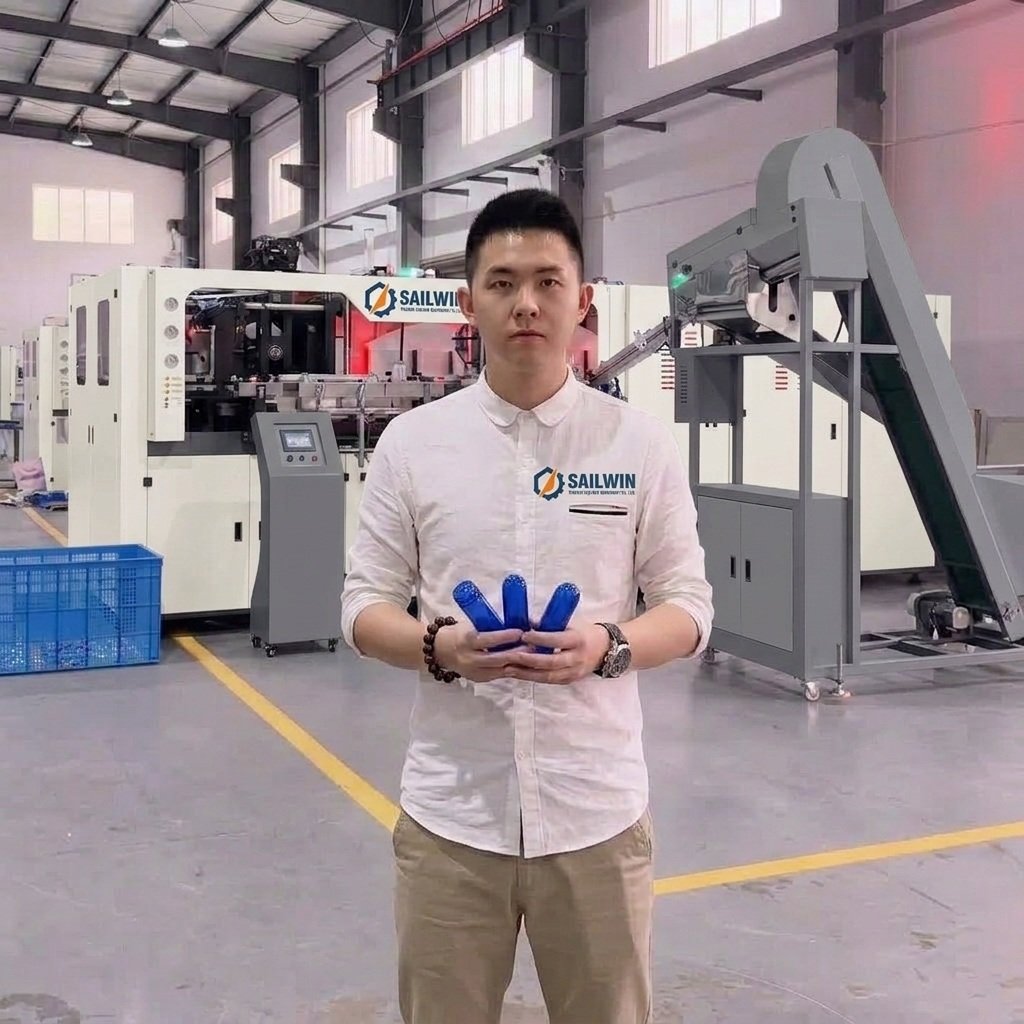
Starting a PET bottle manufacturing business is one of the most reliable entry points into industrial packaging, driven by non-cyclical demand across packaged drinking water, edible oil, carbonated beverages, food jars, and home care chemicals. However, over 40% of first-time bottle factory investors struggle within their first 18 months — not because of market demand, but due to preventable capital misallocations: purchasing mismatched equipment configurations, underestimating compressed air and electrical infrastructure costs, or miscalculating raw material scrap rates during ramp-up.
This comprehensive guide delivers a practical, engineering-validated blueprint for establishing a profitable PET bottle blowing facility. Drawing from hundreds of production line deployments across 60+ countries, we break down initial capital expenditure, machinery selection, plant infrastructure, raw material procurement, staffing requirements, and break-even financial modeling.
| Investment Category | Entry-Level Setup (Semi-Auto) | Commercial Scale (Fully Auto Linear) | Budget Share (%) |
| Target Output (500ml) | 1,000 – 2,000 BPH | 4,000 – 8,000+ BPH | Capacity Benchmark |
| Core Machinery & Tooling | $15,000 – $28,000 | $45,000 – $110,000+ | 35% – 45% |
| Auxiliary Systems (Air/Chiller) | $8,000 – $15,000 | $22,000 – $48,000 | 18% – 22% |
| Plant Prep & Electrical (kVA) | $5,000 – $12,000 | $15,000 – $35,000 | 10% – 15% |
| Initial Raw Materials (Preforms) | $8,000 – $18,000 | $25,000 – $60,000 | 15% – 20% |
| Working Capital (3 Months) | $10,000 – $20,000 | $30,000 – $60,000 | 10% – 15% |
| Estimated Total Capital | $46,000 – $93,000 | $137,000 – $313,000 | 100% |
Market Opportunity: Why Starting a PET Bottle Manufacturing Business Is Highly Profitable
The global polyethylene terephthalate (PET) packaging market continues to expand steadily, exceeding 25 million metric tons annually. This sustained momentum is supported by three fundamental structural drivers:
- Shift from Glass and Rigid PVC to Recyclable PET: Beverage and food packagers are aggressively transitioning to food-grade PET due to shatterproof consumer safety, significantly reduced freight emissions (lightweighting), and widespread 100% rPET circular economy mandates.
- Decentralization of Beverage and Water Bottling: High shipping costs for hollow empty bottles make transporting blown bottles beyond a 150-kilometer radius economically unviable. Local, regional blow molding operations serve regional water bottling brands, edible oil packers, and cosmetic manufacturers with decisive speed and freight advantages.
- High Value-Added Custom Formats: Beyond standard round commodity water bottles, market niches like wide-mouth food jars, square beverage containers, and custom personal care packaging command healthy operating gross margins between 25% and 42%.
For entrepreneurs evaluating how to start a PET bottle manufacturing business, understanding customer categories upfront dictates equipment specification and commercial strategy:
| Target Sector | Typical Bottle Formats | Order Dynamics & Volatility | Recommended Configuration |
| Packaged Water & Beverages | 250ml, 500ml, 1.5L (28mm / 30mm neck) | Ultra-high volume, razor-thin margin, steady year-round | High-speed fully automatic PET blow molding machine (4 to 6 cavity) |
| Edible Oil & Condiments | 500ml, 1L, 2L, 5L handled containers | Medium-to-high volume, requires robust bottom and neck strength | Linear automatic or heavy-duty semi-automatic |
| Cosmetics & Personal Care | 50ml – 500ml custom bottles, lotion dispensers | Low-to-medium runs, frequent SKU changeover, high margin | Flexible 2-cavity machine or single-stage ISBM |
| Food Jars & Confectionery | 38mm – 89mm+ wide mouth jars (honey, yogurt, peanut butter) | Medium batch size, premium surface clarity, distinct mold tooling | Dedicated wide neck PET jar machine |
Step 1 — Define Your Product Formats & Target Volume
The single greatest operational trap for new investors is attempting to build a factory that manufactures “all bottle types.” PET blow molding is fundamentally governed by neck finish, container volume, and clamping tonnage limits. Defining your production scope prior to machine purchase prevents capital redundancy.
The Three-Part Technical Alignment:
- Neck Standard Selection: Standard beverage preforms use PCO 1881 or 3025 neck standards (28–30mm). Wide-mouth jars require 38mm to 89mm+ finishes. A machine configured with standard heating mandrels cannot heat wide-mouth preforms without changing the entire oven conveyor chain assembly.
- Container Height and Maximum Diameter: If your future product roadmap includes 5-liter bottles or 5-gallon water cooler jugs, standard linear machines lack the mold-opening stroke and clamping distance. You will require dedicated large-format architecture such as an 5-gallon PET blow molding machine.
- Hourly Production Sizing: Calculate your plant capacity not on annual projections, but on daily shift execution at 80% to 85% Overall Equipment Effectiveness (OEE). If your initial local market demand is 25,000 bottles daily over two 8-hour shifts (16 hours total), your required net output is 1,563 BPH. Accounting for standard 85% operating efficiency, you need a machine rated at a minimum of 1,840 BPH. A 2-cavity automatic machine (rated at 2,000–2,400 BPH) matches this profile perfectly with room for expansion.
Not sure which machine specification aligns with your bottle samples? Send your container drawings or bottle volume parameters to Sailwin’s application engineers for a custom feasibility and machinery selection plan.
Request a Free Factory Equipment Layout →
Step 2 — Equipment Selection & Capital Budget Planning
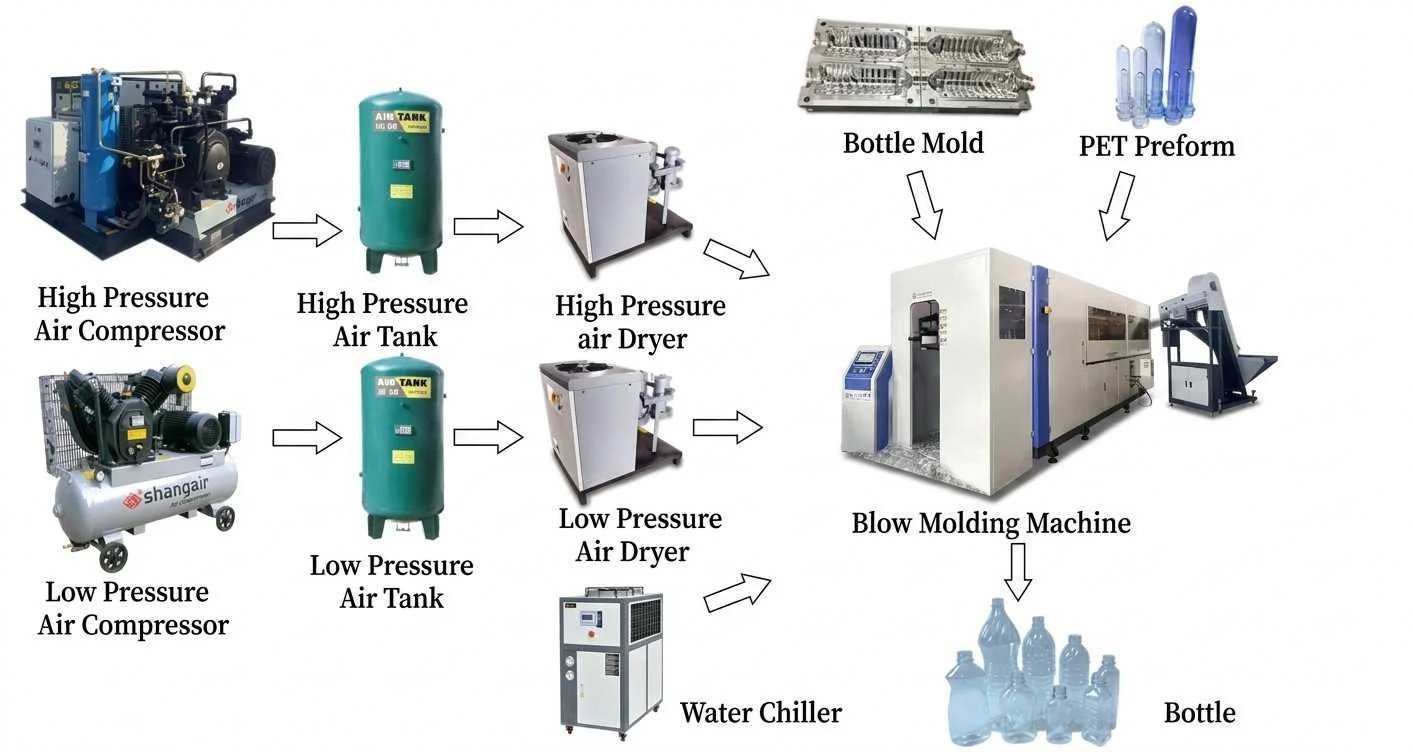
A functional bottle manufacturing line is not an isolated machine — it is an interconnected production system where pressure, temperature, and cooling must remain in precise equilibrium. Bottlenecking any single auxiliary unit degrades overall factory output.
Complete Factory Equipment Checklist & Budget Allocation:
| Machine / System Unit | Functional Role | Key Technical Requirement | Budget Range (USD) |
| PET Blow Molding Host | Preform heating, stretching, and mold clamping | Servo-driven stretch rod, infrared (IR) oven, PLC control | $15,000 – $95,000 |
| High-Pressure Air Compressor | Supplies 28–35 bar air for bottle cavity expansion | Booster or 3-stage piston/screw, oil-free with filtration | $8,000 – $32,000 |
| Low-Pressure Air Compressor | Supplies 8–10 bar air for pneumatic valves and cylinders | Screw compressor, continuous duty | $3,500 – $9,000 |
| Refrigerated Air Dryer & Air Tanks | Eliminates moisture and oil mist from high-pressure lines | Pressure dew point ≤ 3°C, multi-stage micro-filters | $2,500 – $7,500 |
| Industrial Water Chiller | Cools blow molds and preform neck shields | Maintains 8°C – 12°C constant mold temperature | $3,000 – $8,500 |
| Precision Blow Molds (Per Set) | Shapes final container exterior profile | Aircraft-grade 7075 aluminum or stainless steel | $1,800 – $6,500 / set |
| Cooling Tower & Water Pump System | Dissipates heat from air compressors and chillers | Closed or open loop, calibrated to regional ambient heat | $1,500 – $4,500 |
When selecting your blow molding machinery, compare your production strategy across semi-automatic vs fully automatic PET machines. While semi-automatic units minimize initial capital cost, their labor dependency and output ceiling make scaling difficult. For commercial viability, a 4-cavity automatic machine represents the industry benchmark for commercial bottling return on investment.
Step 3 — Factory Space & Utility Infrastructure Requirements
Inadequate power capacity and poor plant layout are among the most expensive post-delivery surprises. Below is an engineering footprint benchmark for establishing a clean, modular PET bottle production facility:
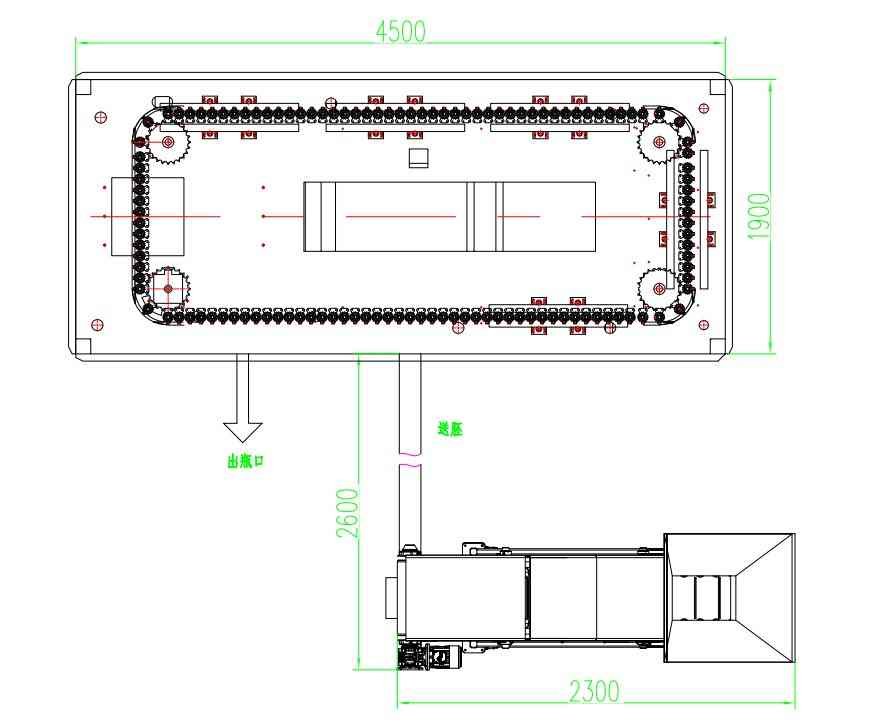
Facility Requirements by Production Scale:
| Infrastructure Metric | Small Operation (1 Line, 2-Cavity) | Medium Operation (1-2 Lines, 4-Cavity) | Commercial Plant (Multi-Line, 6-Cavity+) |
| Production Floor Space | 80 – 120 m² | 180 – 300 m² | 500 – 1,000+ m² |
| Preform & Raw Material Storage | 40 – 60 m² (dry, temperature controlled) | 80 – 150 m² | 200 – 400 m² |
| Finished Bottle Warehouse | 80 – 150 m² (empty bottles occupy massive volume) | 250 – 500 m² | 800 – 2,000 m² |
| Total Recommended Building Area | 200 – 350 m² | 550 – 950 m² | 1,500 – 3,500 m² |
| Electrical Transformer Capacity | 45 – 65 kVA | 100 – 160 kVA | 250 – 450+ kVA |
| Operating Voltage & Stability | 3-Phase 380V/415V/220V ±5% (Voltage stabilizer strongly recommended) | 3-Phase dedicated line | Industrial substation integration |
| Cooling Water Flow Rate | 3 – 5 m³/hr | 8 – 15 m³/hr | 25 – 45 m³/hr |
Critical Warning on Finished Bottle Warehousing: Hollow PET bottles consume enormous physical volume with very low weight. An operation producing 50,000 bottles per day creates approximately 40 to 60 cubic meters of packaged inventory every 24 hours. Without automated bagging or rapid dispatch logistics, warehouse congestion will shut down your blowing line faster than mechanical breakdown.
Step 4 — Raw Material Sourcing: PET Resin vs. Ready Preforms
One of the earliest strategic decisions for a new PET container plant is deciding whether to buy ready-made preforms from commercial converters or invest in preform injection molding machines in-house.
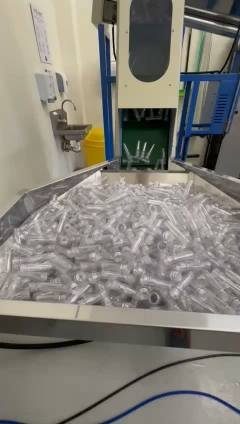
Two Production Pathways Compared:
Pathway A: Buy Finished Preforms (Recommended for Startups & Phase 1)
- Capital Efficiency: Eliminates the need for costly PET injection molding machines, dehumidifying resin dryers, and expensive multi-cavity injection molds (which easily cost $60,000 to $150,000+ per mold).
- Operational Simplicity: Bottle blowing is purely aerodynamic and thermo-mechanical; injection molding introduces complex plasticizing melt chemistry, moisture crystallization, and screw barrel wear.
- Inventory Agility: Switch bottle neck finishes or gram weights simply by ordering different preform batches without retooling an entire injection plant.
Pathway B: In-House Preform Injection (Phase 2 Integration)
- Makes financial sense once monthly consumption consistently exceeds 1.5 to 2 million bottles of a single neck and gram weight.
- Saves between $0.003 and $0.007 per unit by capturing the converter’s conversion margin.
- Requires stringent resin quality control: Virgin PET resin pellets must have an Intrinsic Viscosity (IV) between 0.78 and 0.84 dL/g for bottle blowing and moisture content dried below 0.005% (50 ppm) before injection.
If you are also evaluating HDPE containers (such as milk bottles, jerrycans, or engine oil cans with integrated hollow handles), remember that HDPE uses a completely different thermal extrusion process. Consult our technical comparison on Extrusion Blow Molding vs Stretch Blow Molding to determine the correct equipment pathway.
Step 5 — Staffing, Operating Shifts & Technical Skills
Modern fully automatic PET blow molding machines drastically reduce direct labor requirements. A production facility with two 4-cavity automatic lines running two 8-hour shifts requires a lean operating crew:
| Position Role | Headcount (Per Shift) | Primary Responsibilities | Skill Level |
| Line Operator / Feeder | 1 Person per Line | Loads preform hoppers, inspects bottle clarity, monitors alarms | Semi-skilled (3-5 days training) |
| Packaging / Bagging Crew | 1 – 2 Persons | Transfers bottles into polybags, boxes, or palletizing lines | Entry level |
| Lead Blow Molding Technician | 1 Person (Plant-wide) | Mold changeovers, IR temperature zone tuning, air valve maintenance | Skilled mechanical/pneumatic technician |
| QC Inspector & Warehouse | 1 Person | Top-load burst testing, wall thickness gauge verification, shipping | Trained QC standard |
Sailwin provides on-site machine commissioning, complete operator training manuals, and remote video diagnostic support across all equipment installations, certified under international ISO 9001 quality management standards.
Planning your factory workforce? Sailwin provides turnkey support including plant layout CAD designs, installation schematics, and hands-on technician training.
Contact Sailwin for Turnkey Plant Engineering →
Break-Even Analysis & Financial Projections
Understanding unit economics is the difference between an idle factory and an aggressive, profitable manufacturing venture. Below is a realistic financial model based on a 4-Cavity Automatic Line producing standard 500ml water bottles (18g preform weight):
Operating Assumptions (Monthly Basis):
- Equipment Configuration: 4-Cavity Fully Automatic PET Blow Molding Machine
- Rated Output: 4,000 BPH | Real Production Output (85% OEE): 3,400 BPH
- Working Schedule: 2 shifts / day × 8 hours = 16 operational hours/day × 25 operating days = 400 hours/month
- Total Monthly Production: 3,400 BPH × 400 hours = 1,360,000 bottles/month
- Raw Material Cost (18g Preform): $0.024 per preform delivered
- Utility & Electricity Cost (Power + Air): $0.0035 per blown bottle
- Labor & Packaging Cost: $0.0025 per blown bottle
- Fixed Factory Overheads (Rent, Insurance, Admin): $3,200 per month
- Total Manufacturing Cost per Bottle: $0.024 + $0.0035 + $0.0025 = $0.0300 per bottle
- Wholesale Selling Price to Bottlers: $0.0390 per bottle
- Gross Margin per Bottle: $0.0390 – $0.0300 = $0.0090 per bottle (~23% margin)
Profitability Summary:
- Monthly Gross Revenue: 1,360,000 × $0.0390 = $53,040
- Total Variable Costs: 1,360,000 × $0.0300 = $40,800
- Gross Operating Profit: $53,040 – $40,800 = $12,240
- Net Monthly Operating Profit (After Fixed Overhead $3,200): $9,040
- Annualized Net Operating Profit: $108,480 / year
- Estimated Equipment Investment: ~$65,000 (Machine, Air System, Chiller, 1 Mold Set)
- Simple Payback Period: 7.2 Months of Full-Capacity Operation
Case Study: How an African Beverage Startup Achieved Break-Even in 11 Months
The Challenge
A regional beverage entrepreneur in Nigeria was importing empty 500ml and 330ml PET bottles from commercial converters 180 km away. Shipping empty bottles caused constant transit scuffing, 4% container denting, and severe freight price premiums. Production lines frequently stalled waiting for late bottle deliveries.
The Sailwin Turnkey Solution
- Installed one Sailwin 4-Cavity Fully Automatic Stretch Blow Molding Line with quick-change mold tooling for 330ml and 500ml bottles.
- Provided a skid-mounted 30-bar high-pressure screw compressor and air drying purification train.
- Integrated automated preform conveyor elevator to reduce operator intervention to a single line supervisor.
- Supplied matching 7075 aluminum mold sets with customized ergonomic grip ribs and embossed brand logos.
The Commercial Result
- Container unit packaging cost dropped from $0.048 to $0.031 per bottle, capturing an immediate 35.4% saving.
- Factory bottle transit breakage and scuffing dropped from 4.2% to virtually zero.
- The client began supplying surplus blow-molded bottles to two neighboring juice co-packers, generating $6,500 monthly ancillary net profit.
- The complete capital investment achieved 100% financial payback in 11 months.
Frequently Asked Questions (FAQ)
How much does it cost to start a PET bottle manufacturing business?
A small-scale entry-level bottle manufacturing line using a semi-automatic machine and basic compressor setup requires between $45,000 and $70,000 total investment (including auxiliary machines, electrical installation, initial preforms, and working capital). A commercial-grade, fully automatic 4-cavity linear plant typically requires between $120,000 and $220,000 depending on plant size, building preparation, and automated packaging equipment.
What is the minimum land or factory space needed for bottle manufacturing?
A small single-line operation requires at least 200 to 300 square meters. While the blow molding machine itself occupies only 15–25 m², finished empty bottles consume massive physical volume. Adequate warehouse space for preforms, packaging bags, compressors, and dispatch staging is mandatory to prevent operational bottlenecks.
Is it better to buy preforms or inject them yourself in a new factory?
For 90% of startups, buying preforms from established regional injection converters is the smart financial choice. It reduces initial capital expenditure by over 60%, eliminates the technical complexity of operating plastic injection molding machines, and lets you focus on bottle quality, sales, and logistics. In-house preform injection is only recommended once your monthly consumption exceeds 1.5–2 million bottles.
What electrical power is required to run a PET blow molding line?
A 4-cavity automatic blow molding line with its high-pressure air compressor and water chiller requires an electrical transformer capacity of at least 100 to 150 kVA (3-Phase 380V/415V). The high-pressure compressor is the single largest power consumer, accounting for approximately 55% to 65% of the line’s total electricity draw.
How many bottles can one machine produce in a single day?
On a 2-shift operating schedule (16 hours total) at 85% real production efficiency:
- A 2-cavity automatic machine produces approximately 25,000 to 32,000 bottles daily.
- A 4-cavity automatic machine produces approximately 50,000 to 65,000 bottles daily.
- A 6-cavity high-speed machine produces approximately 85,000 to 110,000+ bottles daily.
Can one PET blow molding machine make different bottle sizes and shapes?
Yes. By replacing the blow mold cavity sets, a single machine can blow multiple bottle designs (e.g., 330ml, 500ml, 1L, and 1.5L) provided they share compatible neck standards and fall within the machine’s maximum clamping length and diameter parameters. Mold changeover on a modern Sailwin automatic linear machine takes between 45 and 90 minutes.
What certifications should I look for when purchasing equipment from China?
Ensure your equipment manufacturer holds accredited CE certification for mechanical and electrical safety, complies with ISO 9001 quality management systems, uses internationally serviceable brand components (such as Siemens PLC, Festo or SMC pneumatics, Schneider electrics), and provides written warranties covering pressure vessel safety.
How does Sailwin support overseas factory startups?
Sailwin provides complete turnkey factory support including 2D/3D plant layout engineering, transformer power matching, custom bottle CAD mold design, on-site engineer installation and commissioning, comprehensive operator maintenance training, and guaranteed lifetime spare parts delivery.
Summary & Next Steps
Launching a PET bottle manufacturing plant offers exceptional return on capital when technical parameters are properly aligned from Day 1. Success depends on matching your machinery to real market neck standards, securing reliable high-pressure compressed air systems, and starting with ready-made preforms to preserve operational agility.
Explore the complete Sailwin equipment ecosystem across our PET blow molding machine collection, examine specific machine specifications across our 2-cavity and 4-cavity equipment, or browse the complete Sailwin blow molding machine catalog.
Get a Customized Turnkey Factory Proposal & Quotation →
Related Articles
- How to Choose a PET Blow Molding Machine: 2026 Complete Buyer’s Guide
- Fully Automatic vs Semi-Automatic PET Blow Molding Machine: Which Is Right for You?
- 4 Cavity vs 6 Cavity PET Blow Molding Machine: Cost, Output & ROI Comparison
- Extrusion Blow Molding vs Stretch Blow Molding: Which Machine Do You Need?