Updated: 2026 Engineering Standard · By Sailwin Technical Team
Single vs. Double Station Extrusion Blow Molding: Cycle Time and Output Calculation
When investing in a commercial continuous extrusion blow molding line for detergent bottles, motor oil containers, or cosmetic jars, equipment buyers face a fundamental production architecture question: should you select a single-station shuttle machine or a high-capacity double-station shuttle press?
While a single-station machine offers lower initial equipment capital and simpler mold setups, the extruder must pause or throttle down while the mold cools, idling 50% of the extruder’s plasticizing potential. Conversely, double-station shuttle machines alternate molds continuously, doubling container throughput on identical factory footprints.
This engineering guide details mechanical shuttle kinematics, hourly output formulas, tooling multi-cavity trade-offs, and investment payback on Sailwin continuous extrusion blow molding systems.
Key Engineering Takeaways
- Output Doubling Synergy: While Station A is cooling and blowing, Station B is capturing the newly extruded parison—utilizing 100% of extruder screw output to deliver 75% to 90% higher hourly bottle production.
- Tooling Capital Consideration: Double-station machines require two identical sets of molds (or a mirrored pair), increasing initial tooling investment by approximately 75%–85%.
- Footprint & Labor Efficiency: A double-station machine produces the output of two separate single-station machines while requiring only one operator, one material feeder, and 35% less floor space.
Need Output Calculations for Your Bottle Line?
Submit your bottle drawing (volume & gram weight) for customized single vs. double station output and ROI comparison.
1. Technical & Output Comparison: Single vs. Double Station EBM
Machine Sizing Law: If annual demand exceeds 1.5 million containers, double-station shuttle architecture is always the lower cost-per-part solution despite higher initial tooling cost.
Review the operational output comparison across standard commercial bottle sizes:
| Bottle Volume & Format | Cavities (Per Platen) | Single Station Output (BPH) | Double Station Output (BPH) | Output Gain (%) |
|---|---|---|---|---|
| 500ml Shampoo / Detergent | Triple Cavity (3-Cavity) | 650 – 800 BPH | 1,200 – 1,500 BPH | + 87.5% Production Boost |
| 1L Motor Oil Bottle | Double Cavity (2-Cavity) | 420 – 520 BPH | 780 – 980 BPH | + 88.4% Production Boost |
| 5L Lubricant / Chemical Jerrycan | Single Cavity (1-Cavity) | 140 – 180 BPH | 260 – 320 BPH | + 82.3% Production Boost |
| 20L Stackable Jerrycan | Single Cavity (1-Cavity) | 55 – 70 BPH | 100 – 130 BPH | + 85.7% Production Boost |
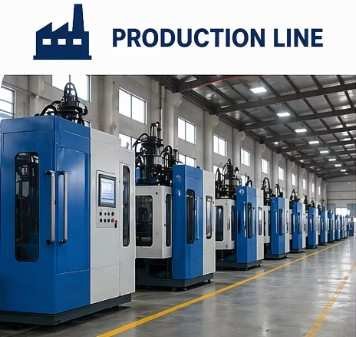
Sailwin Customer Case Study: Detergent Packager Swaps 3 Single Machines for 2 Sailwin Double-Station Lines
How a contract packaging converter in Poland optimized floor space and labor costs by adopting Sailwin double-station technology.
- Factory operating floor was completely congested with 3 older single-station machines.
- Required 3 full-time operators per shift plus high electrical utility overhead.
- Frequent conveyor bottlenecks from manual flash trimming.
- Replaced 3 older presses with 2× Sailwin SC-2S5L double-station continuous EBM machines.
- Integrated automated in-mold deflashing and pneumatic bottle take-out robots.
- Configured scrap regrind conveyors returning flash directly into extruder hoppers.
- Total monthly container output increased by 28.5%.
- Factory floor labor reduced from 3 operators to 1 supervisor per shift.
- Floor space utilization improved by 45%, freeing room for secondary labeling lines.
Data source: Sailwin Plant Modernization Audit & Client Production Record #SW-PL-2026, 2026.
Frequently Asked Questions
SAILWIN MACHINERY · FACTORY-DIRECT PACKAGING SYSTEMS
Maximize Extrusion Blow Molding Throughput with Sailwin
Sailwin manufactures high-speed linear guide shuttle EBM systems up to 16 cavities. Request technical layout and quote today.
Explore Integrated Packaging Machinery on Sailwin:
• PET Preform Injection Molding Machine – High-speed 140T to 550T systems for multi-cavity bottle preform lines.
• PET Water Bottle Blowing Machine – Linear automatic servo stretch blow molding equipment.
• Liquid Filling Machine & Bottling Line – 3-in-1 rotary monoblocs for drinking water and beverage factories.
• HDPE Extrusion Blow Molding Machine – Industrial continuous blow molding systems for jerrycans and drums.
• Need technical plant advice? Contact our engineering team for free turnkey consultation.