In commercial water bottling operations, the global shift from traditional polycarbonate (PC) carboys to BPA-free polyethylene terephthalate (PET) is accelerating rapidly. For bottled water brand owners and contract packaging plants, operating a dedicated 5 gallon PET blow molding machine is no longer just a regulatory upgrade — it is an urgent economic imperative. A standard 20-liter PC jug costs $4.50 to $6.00 to procure from external container molders, while blow molding your own 5-gallon PET jugs in-house from preforms cuts container manufacturing costs to $1.60 – $2.10 per bottle.
However, producing large 5-gallon (18.9L) and 20-liter containers presents severe engineering challenges that standard 500ml bottle blow molders cannot handle. Blowing a container with a wall volume of nearly 20 liters requires heating massive 650g to 750g thick-walled preforms (up to 9mm wall thickness), applying up to 35-bar blow pressures across large-format platen clamps, and engineering bottom structural ribbing capable of surviving 1.5-meter drop tests and multi-tier warehouse palletizing. This comprehensive technical guide covers equipment sizing, PC versus PET material comparisons, preform heating physics, neck standard tolerances, and production capacity planning for modern water bottling plants.
| Container Specification | 3-Gallon PET Bottle (11.3L) | 5-Gallon Standard PET Jug (18.9L) | 20-Liter Industrial Water Carboy |
| Target Preform Weight | 450g – 550g | 650g – 720g (Standard) / 750g (Heavy-Duty) | 700g – 780g |
| Neck Finish Diameter | 55mm Non-Spill Snap-on | 55mm Standard (Crown / Screw optional) | 55mm Standard Non-Spill |
| Typical Machine Output | 120 – 160 BPH (Single Cavity) | 80 – 120 BPH (1-Cavity) / 200 – 240 BPH (2-Cavity) | 80 – 110 BPH (Single Cavity) |
| High Blow Pressure Required | 28 – 32 bar | 30 – 35 bar | 32 – 35 bar |
| Drop Test Resistance | 1.8 meters filled water | 1.5 meters filled water (3 impacts) | 1.5 meters filled water |
| Container Material Advantage | 100% BPA-Free, High Clarity | BPA-Free, 100% Recyclable, High Transparency | FDA & EU Food Contact Approved |
PC vs PET for 5-Gallon Jugs: The Global BPA-Free Transition
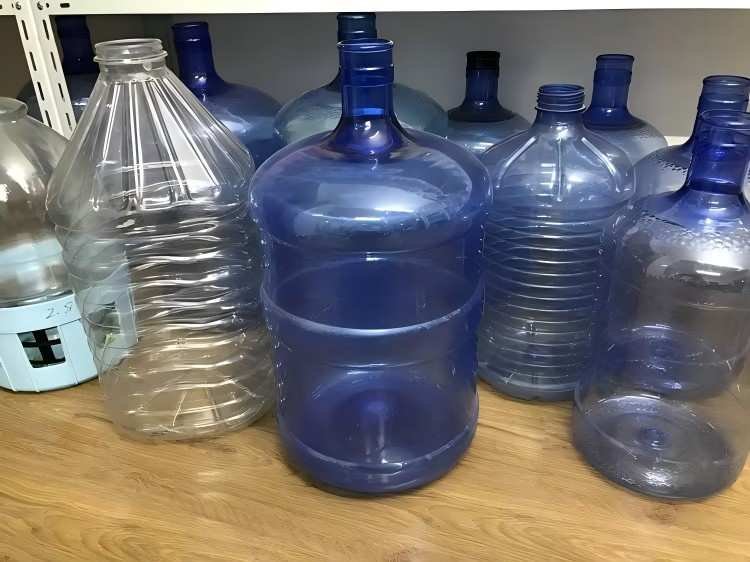
For over three decades, extruded polycarbonate (PC) dominated the water cooler jug market due to its high impact toughness and compatibility with high-temperature (65°C – 70°C) caustic wash cycles. However, shifting health regulations and retail consumer awareness have triggered a massive worldwide migration toward BPA-free PET for large water carboys.
Polycarbonate resin synthesis relies on Bisphenol A (BPA). Scientific studies confirmed that trace amounts of BPA can leach into drinking water over extended storage times or when exposed to UV light and alkaline detergents. Major beverage regulatory bodies across North America, the European Union, and emerging markets have enacted strict restrictions on BPA-containing containers in contact with consumable liquids. Beyond food safety, the economic and operational comparison clearly demonstrates why packaging producers are standardizing on our 5 gallon PET blow molding machine systems:
| Comparison Metric | Polycarbonate (PC) Carboy | PET Water Jug (Sailwin SBM) | Operational Significance |
| Chemical Safety & BPA | Contains Bisphenol A (Leaching risk) | 100% BPA-Free (Zero phthalates) | Full compliance with FDA, EU & NSF standards |
| Raw Material Cost (Resin) | $2.80 – $3.50 / kg | $0.95 – $1.25 / kg | 60% lower raw resin cost per container |
| Optical Clarity & Gloss | Yellows after multiple wash cycles | Exceptional glass-like transparency | Superior shelf appeal and water purity perception |
| Manufacturing Equipment Cost | High-investment EBM / ISBM ($120k+) | Cost-effective 2-Stage SBM ($25k – $65k) | Significantly lower capital entry barrier |
| Container Weight (5 Gallon) | 750g – 850g | 650g – 720g | 15% container weight reduction |
| Recyclability Code | RIC #7 (Other — Difficult to recycle) | RIC #1 (PET — Globally recyclable) | Fully supports circular economy programs |
Planning to Upgrade Your 5-Gallon Line from PC to BPA-Free PET?
Our container packaging engineers assess your current plant throughput, neck closure requirements, and washing line compatibility to configure the optimum 5-gallon blow molding solution.
Technical Requirements for 5-Gallon Large Jug Production
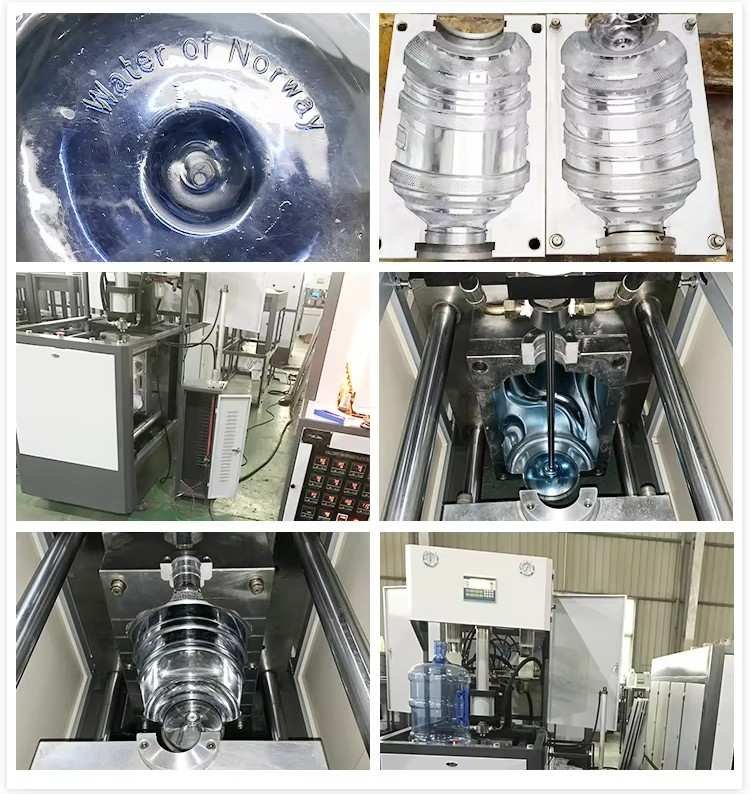
Blowing a 500ml water bottle requires approximately 20 to 25 grams of preform material stretched across an 8-inch stroke. In stark contrast, 5 gallon water bottle blow molding involves stretching a 700g mass of PET plastic across an axial stroke exceeding 480mm and expanding it to a diameter of 270mm. Achieving structural uniformity across this massive expansion ratio requires specialized engineering across four mechanical systems:
1. High-Penetration Deep Infrared Heating Tunnel
The single greatest operational failure in 5-gallon PET molding is inadequate preform core heating. A 700-gram preform has an average wall thickness of 7.0mm to 9.2mm. Standard quartz lamps will overheat and burn the exterior preform skin while the interior remains cold and unyielding, resulting in severe wall thickness imbalance or bottle explosion during high-pressure blowing.
Our dedicated 5-gallon heating systems utilize high-penetration carbon-fiber infrared lamps combined with independent multi-stage temperature control across 16 vertical lamp channels. Preforms rotate continuously on precision mandrels while high-volume internal cooling blowers circulate ambient air, maintaining the outer preform skin below 115°C while driving radiant heat completely through the core resin to achieve a uniform 105°C – 110°C stretching window.
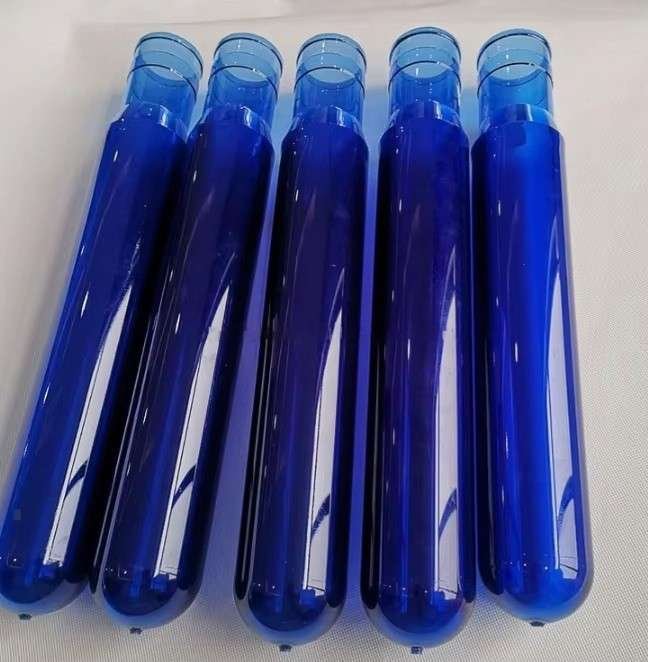
2. Preform Quality Benchmarks: Weight, Gate & IV
To produce consistent, commercially viable 5-gallon containers, preform supply must satisfy stringent quality thresholds:
- Resin Intrinsic Viscosity (IV): Preforms must be molded from virgin bottle-grade resin with an IV rating of 0.84 to 0.86 dL/g. Lower IV resin (e.g., 0.78 dL/g used for small water bottles) lacks the molecular chain length necessary to support bi-axial stretching without stress-cracking under hydrostatic loads.
- Injection Gate Concentricity: Because the stretch rod travels nearly 500mm, any gate off-center eccentricity exceeding 0.15mm will cause the stretch rod to slip, forcing uneven wall thickness distribution where one sidewall is 0.8mm thick while the opposite side is only 0.2mm.
- Preform Weight Selection: For standard one-way export jugs, 650g to 680g is standard. For multi-trip returnable water delivery fleets, 720g to 750g provides the extra sidewall thickness required to withstand 30+ refill and transport cycles.
3. Mold Clamping Rigidity & Bottom Mold Synchronization
When high blowing pressure (32 to 35 bar) hits a 20-liter cavity, the projected surface area creates over 350 kN (35 tons) of outward opening force. A lightweight toggle mechanism will flex under this massive force, creating thick parting line flash that cuts delivery drivers’ hands and prevents smooth stacking. Sailwin 5-gallon machines incorporate reinforced nodular iron platen structures backed by hydraulic or heavy-duty pneumatic toggle locking systems. The bottom base mold features synchronized mechanical lifting to ensure sharp definition of bottom anti-vacuum structural ribs.
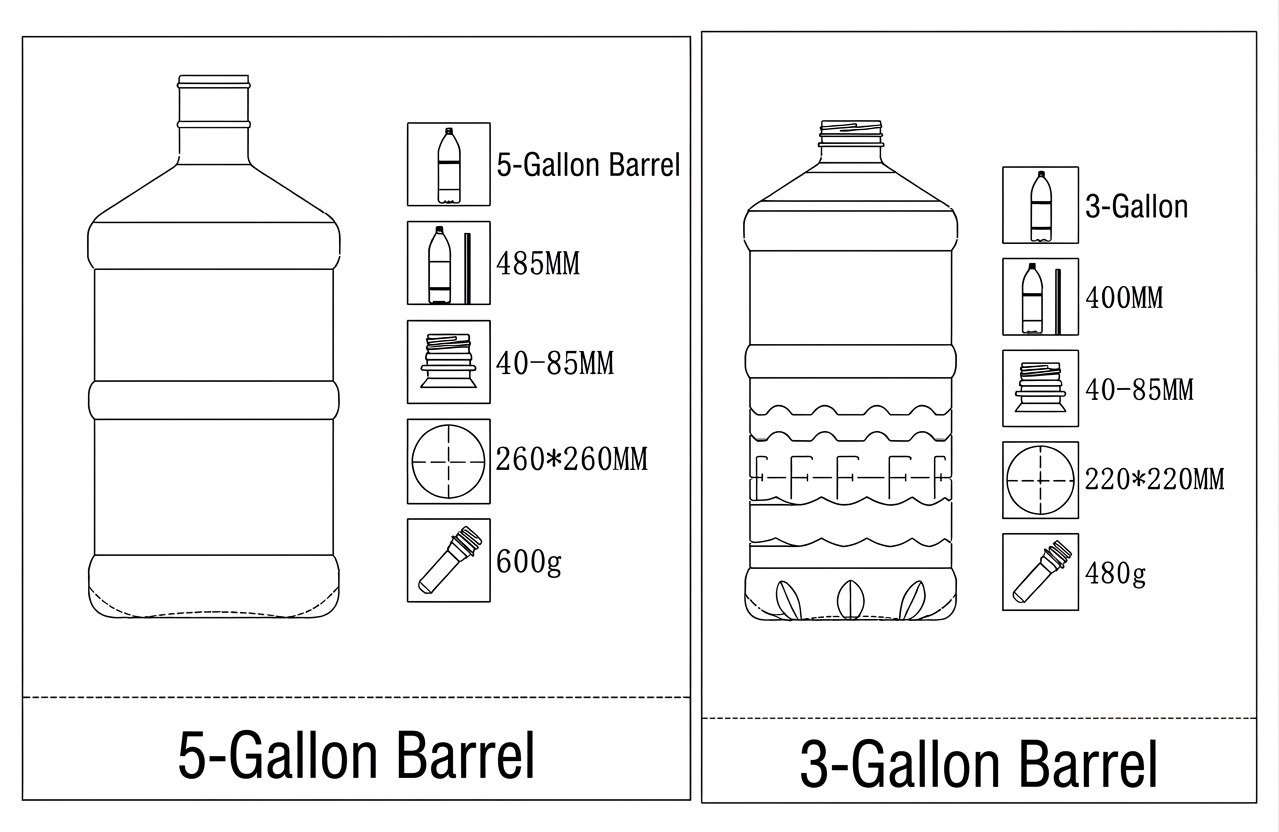
Container Geometry & Mold Design: 3-Gallon vs 5-Gallon Standards
Designing a large-format water bottle requires balancing ergonomic handling, pallet logistics, and vacuum resistance. When 18.9 liters of water are dispensed from an office water cooler, significant internal vacuum pressure develops inside the jug. Without engineered structural corrugations, the sidewall collapses inward.
Our CAD mold engineering incorporates continuous circumferential reinforcing ribs along the center body panel. These horizontal ribs act as structural arches, preventing container buckling under top-load weights exceeding 120 kg (essential for stacking water bottles 3-high on warehouse delivery racks). For plants serving both residential water dispensers (3-gallon) and commercial offices (5-gallon), our mold platens support rapid mold insert changeover in less than 45 minutes.
Neck Finish Standards and Non-Spill Cap Compatibility
A 5-gallon water jug is only as good as its neck closure seal. The universal standard for commercial 5-gallon water cooler dispensers is the 55mm Snap-On Neck Finish, engineered to accept standard food-grade polyethylene non-spill valve caps.
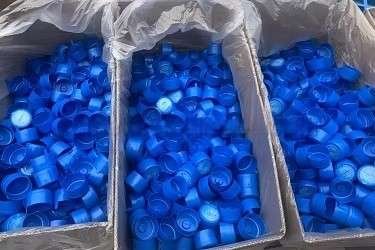
During the stretch blow molding process, the preform neck finish remains unheated inside dedicated water-cooled neck protection shields. This preserves strict neck ovality tolerances within ±0.10mm. If the neck finish is distorted during heating, the 55mm non-spill cap will leak during inverted delivery on cooler puncture probes, causing customer property damage and brand reputation loss.
Machine Configurations: Sizing the Right Line for Your Plant
Selecting the proper equipment configuration depends on your target daily distribution volume, floor space, and available power infrastructure. Sailwin provides two primary platform classes for 5-gallon container manufacturing:
| Machine Model / Series | SW-5G-1 (Single Cavity Semi-Auto) | SW-5G-2 (Dual Cavity Semi-Auto) | SW-5G-A (Full Automatic Linear) |
| Output Capacity (5-Gallon) | 80 – 120 BPH | 200 – 240 BPH | 350 – 500 BPH |
| Daily Output (16-Hour Run) | 1,280 – 1,920 Jugs / Day | 3,200 – 3,840 Jugs / Day | 5,600 – 8,000 Jugs / Day |
| Preform Loading Operation | Manual into rotary heater | Manual into rotary heater | Automatic elevator & unscrambler |
| Installed Power (Heating + Drive) | 22 kW | 38 kW | 55 kW |
| High-Pressure Air Demand | 1.0 m³/min @ 30 bar | 1.8 m³/min @ 32 bar | 3.2 m³/min @ 32 bar |
| Target User Profile | Regional bottler starting in-house blowing | Established bottler replacing PC carboys | Large industrial beverage manufacturing plant |
For startup bottling plants and regional distributors, the semi-automatic 1-cavity and 2-cavity models deliver unmatched flexibility: an operator transfers pre-heated preforms from the adjacent infrared oven into the clamping station. This minimizes capital investment while providing immediate in-house supply security. For operations requiring fully automated end-to-end lines from small containers to large jugs, review our comprehensive automatic PET blow molding machine catalog.
Need an Equipment & Compressor Sizing Quotation for 5-Gallon Bottles?
Tell us your daily water bottling target and available power supply. Our engineering group will furnish a complete equipment package quotation including mold, preform heater, and high-pressure compressor.
Output Capacity & Financial Payback Calculation for Water Bottling Plants
To quantify the financial return of bringing 5-gallon bottle production in-house, consider a commercial water bottling plant distributing 3,000 five-gallon bottles per day across an urban market:
- Current External Sourcing Cost (PC Carboys): Purchasing pre-molded bottles from commercial blow molders at $4.80 each, with a 3% annual attrition/damage rate = $43,200 annual container replacement budget.
- In-House Production Cost (PET Preforms):
• 700g Virgin PET Preform: $1.15
• Electrical & Compressor Power (0.35 kWh @ $0.12): $0.042
• Direct Labor & Packaging: $0.08
• Total In-House Cost per 5-Gallon Bottle: $1.272
- Direct Net Savings: $4.80 − $1.272 = $3.528 saved per new bottle produced.
For a plant manufacturing 50,000 new bottles during an initial fleet rollover or market expansion, net direct savings total $176,400. Against an initial turnkey machinery investment of $35,000 to $48,000 (including high-pressure compressor and 5-gallon mold), full capital payback is achieved in less than 4.5 months.
Engineering Case Study: Bottled Water Producer in Nigeria Replaces PC Carboys
Customer Background: A leading packaged drinking water producer in Lagos, Nigeria operated two 300-BPH 5-gallon washing and filling lines. The factory relied exclusively on imported 5-gallon PC bottles from Asian suppliers. Escalating sea freight rates and foreign exchange volatility caused bottle landed costs to surge above $5.80 each, resulting in frequent container stockouts and idle filling lines.
Sailwin Turnkey Engineering Solution:
- Supplied a Sailwin SW-5G-2 dual-cavity 5-gallon PET blow molding machine rated at 220 BPH.
- Supplied custom aviation-grade aluminum molds engineered with heavy-duty base anti-vacuum arches and standard 55mm snap-cap neck tooling.
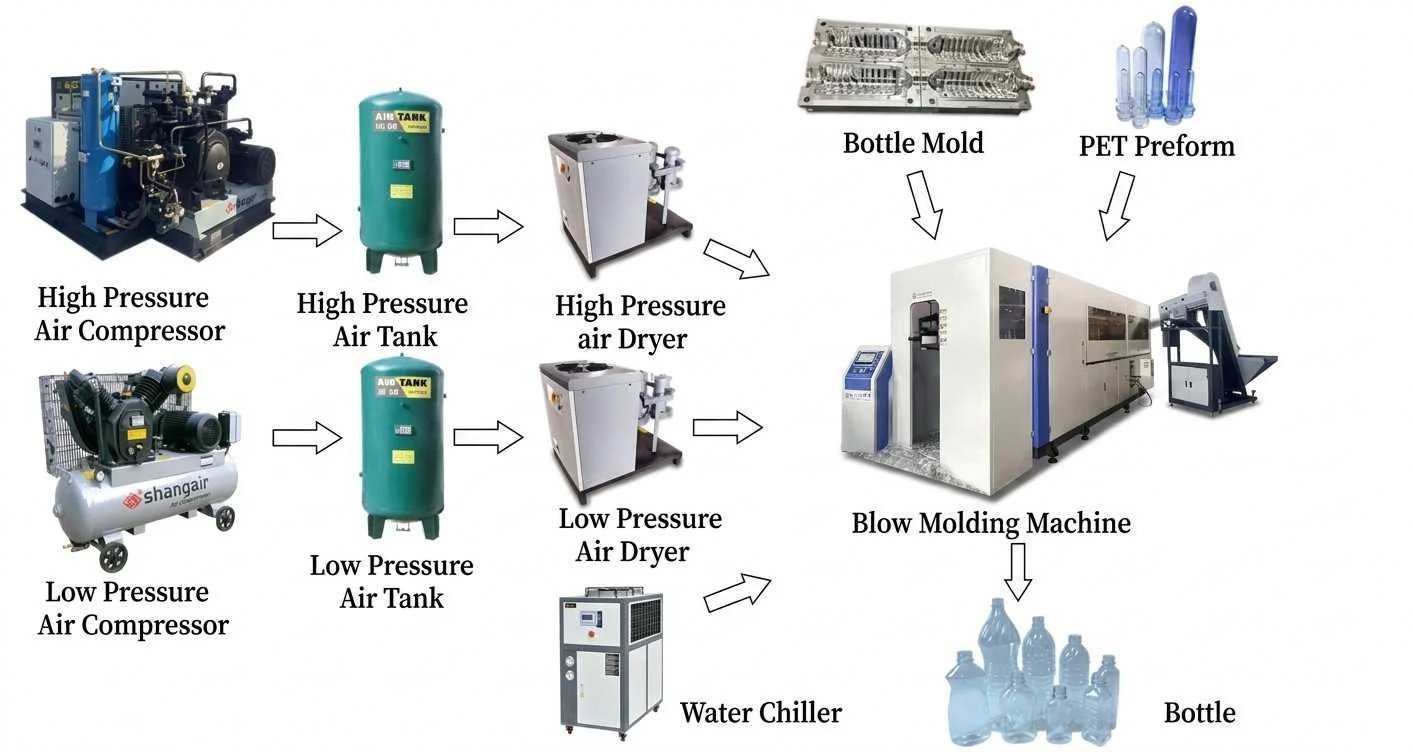
- Integrated an energy-efficient rotary infrared preform heating tunnel with localized neck water-cooling chillers.
- Furnished a complete auxiliary air skid including a 30-bar screw compressor, refrigerated air dryer, and air filtration battery.
Factory Performance Results:
| Operational Parameter | Imported PC Carboys (Previous) | Sailwin In-House PET (Post-Upgrade) | Operational Benefit |
| Landed Cost per Bottle | $5.80 (CIF Lagos + Duty) | $1.85 (Preform + Power + Labor) | 68.1% container cost reduction |
| Inventory Lead Time | 60 – 90 Days (Sea shipment) | On-Demand (Same-day blowing) | Zero production stops from stockouts |
| Warehouse Storage Footprint | 450 m² (Bulky empty jugs) | 40 m² (Compact nested preforms) | 90% warehouse floor space reclaimed |
| Full Equipment Payback | — | 3.8 Months | Immediate monthly operational cash flow positive |
Ready to Eliminate Expensive External 5-Gallon Bottle Purchases?
Contact Sailwin machinery today. Our sales engineers deliver factory-direct pricing, custom mold design proposals, and complete packaging plant layout support.
Frequently Asked Questions: 5-Gallon PET Blow Molding
Can 5-gallon PET water bottles be washed and refilled like PC bottles?
Yes. Commercial 5-gallon PET jugs blown from heavy-weight preforms (700g – 750g) are rated for 25 to 40 refill cycles in professional bottled water delivery routes. However, washing temperatures must be regulated between 55°C and 60°C using mild food-grade detergents; exposing PET bottles to caustic washes exceeding 65°C will cause thermal shrinkage and deformation.
What high-pressure air compressor is required for a 5-gallon PET blow molding machine?
A 5-gallon machine requires a dedicated high-pressure booster or screw compressor delivering 30 to 35 bar (435 to 500 psi) with an air flow rating of 1.0 to 1.8 m³/min depending on cavity count. High blow pressure is mandatory to force the thick 700g plastic completely into the bottom mold ribbing and produce a flat, stable standing base.
Can one 5-gallon machine also blow 3-gallon water bottles?
Yes. By replacing the mold cavity inserts and adjusting the stretch rod mechanical stroke, the machine can blow 3-gallon (11.3L), 15-liter, and standard 5-gallon (18.9L) bottles. Mold changeover typically takes 40 to 60 minutes.
What preform neck standard is used for 5-gallon water bottles?
The global packaging standard is the 55mm Snap-On Neck Finish, which fits universal non-spill hygiene caps used on office water dispensers. Some regional markets also utilize 55mm screw finishes or crown caps, both of which can be accommodated with customized neck clamping plates.
How does PET bottle clarity compare to PC carboys?
PET features superior optical light transmission (over 90%) and a brilliant glass-like surface gloss. Unlike polycarbonate, which tends to acquire a hazy yellowish tint after multiple cleaning cycles, PET maintains pristine optical clarity, significantly enhancing consumer perception of water purity.
Does Sailwin verify 5-gallon mold performance prior to international export?
Yes. Every Sailwin 5-gallon blow molding machine undergoes rigorous 48-hour continuous testing with actual client preforms. Bottles are subjected to full dimensional inspection, top-load crush testing (>120 kg), and 1.5-meter drop tests in strict adherence to ISO 9001 certified quality standards before dispatch.
Summary & Related Machinery Guides
Investing in a dedicated 5 gallon PET blow molding machine is the single most effective capital upgrade a commercial water packaging plant can make to eliminate external container procurement markups, reclaim valuable warehouse floor space, and comply with global BPA-free food contact regulations. By combining high-penetration infrared preform heating with rigid high-pressure mold clamping, Sailwin systems deliver reliable, continuous production with fast commercial payback.
To further explore blow molding equipment across different capacities and packaging formats, review our specialized guides:
- High Speed PET Blow Molding Machine: How to Maximize Output at Minimum Cost — Engineering high-volume beverage packaging lines.
- PET Jar Blow Molding Machine: Buying Guide for Food & Cosmetic Packaging — Sizing machinery for wide-mouth containers.
- How to Start a PET Bottle Manufacturing Business: Equipment & Cost Guide — Complete turnkey factory planning and financial modeling.
- PET Blow Molding Machine Series Catalog — Browse full automatic and semi-automatic linear machines.
Ready to Establish Your Own 5-Gallon Water Bottle Production Line?
Speak with Sailwin’s engineering specialists today for turnkey machinery quotations, mold technical drawings, preform supplier connections, and factory layout designs.