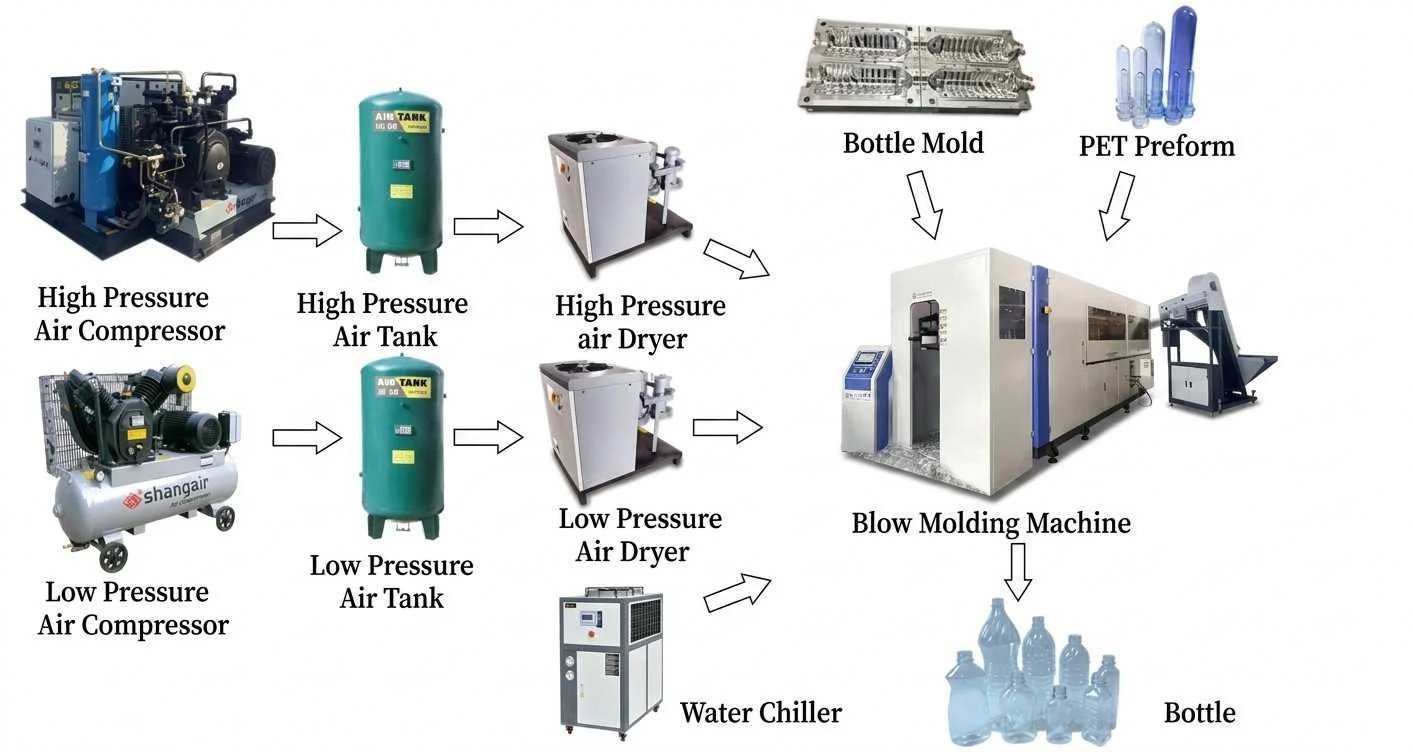
The decision between a 4-cavity and 6-cavity PET blow molding machine is not about which machine produces more bottles — both can be scaled to meet most production targets. It is about which configuration delivers the lowest total cost of ownership at your specific volume, and whether the incremental output of 6 cavities justifies the higher capital cost, longer changeover time, and increased operational complexity. This guide gives you the BPH comparison, ROI calculation framework, and decision criteria to make the right call before you sign a purchase order.
| Specification | 4-Cavity | 6-Cavity |
| BPH (500ml, rated) | 6,000 – 10,000 | 10,000 – 15,000+ |
| Monthly Output (2 shifts, 85%) | ~2,400,000 – 4,000,000 | ~4,000,000 – 6,000,000 |
| Mold Cost (per set) | Lower | Higher (~50% more) |
| Changeover Time | Shorter | Longer |
| Format Flexibility | Better (multi-format operations) | Lower (optimized for single format) |
| Best For | Growth phase, multi-SKU producers | High-volume, stable single-format lines |
BPH Output Comparison: The Numbers Behind the Decision
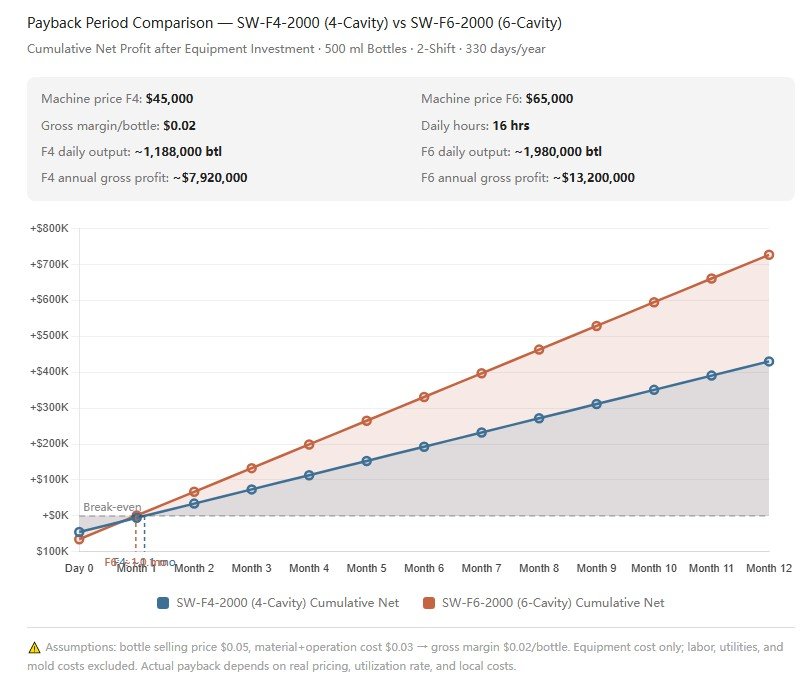
Output per hour is the headline specification buyers compare first — but raw BPH figures without context mislead more often than they inform. Two corrections are necessary before using BPH to make a purchase decision.
Correction 1: Use 85% Efficiency, Not Rated BPH
Manufacturer BPH ratings are tested under optimal conditions: standard preform, single bottle format, no changeover downtime, ambient temperature within specification. Real production environments run at 80–90% of rated output due to preform feeding variation, minor jams, heating zone adjustments, and planned micro-stops. Use 85% of rated BPH as your planning figure.
Correction 2: Monthly Output Determines Machine Selection, Not BPH Alone
The correct calculation:
- Monthly bottle target ÷ 25 production days = daily target
- Daily target ÷ operating hours per day = required BPH
- Required BPH ÷ 0.85 = rated BPH needed
- Select the machine whose rated BPH at 85% efficiency meets or exceeds this figure
Example — 3,500,000 bottles/month (500ml), 2 shifts (16 hours/day):
3,500,000 ÷ 25 ÷ 16 = 8,750 BPH required → ÷ 0.85 = 10,294 rated BPH needed
At this output requirement, a 4-cavity machine at its upper rated range (10,000 BPH) is at its ceiling — leaving no growth headroom. A 6-cavity machine at 10,000–15,000 BPH covers this requirement comfortably and provides capacity for volume growth. This is the crossover zone where 6-cavity becomes the correct specification.
| Monthly Target (500ml, 2 shifts) | Required Rated BPH | Recommended Configuration |
| Under 2,000,000 | Under 5,900 | 2-cavity (do not over-specify) |
| 2,000,000 – 3,500,000 | 5,900 – 8,200 | 4-cavity — optimal zone |
| 3,500,000 – 4,500,000 | 8,200 – 10,600 | 4-cavity (ceiling) or 6-cavity (growth buffer) |
| Above 4,500,000 | Above 10,600 | 6-cavity — required |
Want this calculation run against your exact production plan? Share your monthly target, bottle format (volume and weight), and shift pattern — Sailwin will confirm the correct cavity count.
Calculate My Required Cavity Count →
4-Cavity vs 6-Cavity: Full Specification Comparison
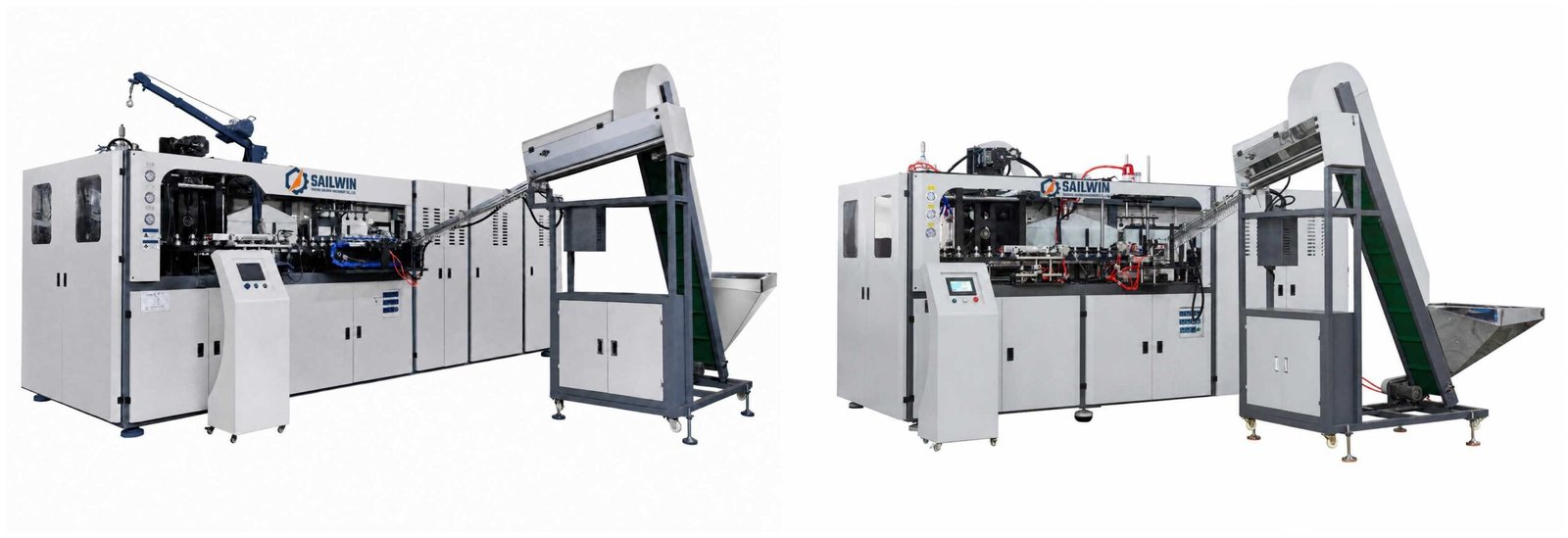
| Factor | 4-Cavity | 6-Cavity | Advantage |
| Rated BPH (500ml) | 6,000 – 10,000 | 10,000 – 15,000+ | 6-cavity |
| Mold Set Cost | Lower baseline | ~50% higher per set | 4-cavity |
| Mold Changeover Time | Shorter (4 mold units) | Longer (6 mold units) | 4-cavity |
| IR Oven Heating Zones | Standard range | More zones (longer oven) | 6-cavity (finer control) |
| Machine Footprint | Smaller | Larger | 4-cavity |
| Format Flexibility | Better (lower changeover cost) | Lower (optimized for single format) | 4-cavity |
| Per-Bottle Energy Cost | Slightly higher | Lower (more bottles per kWh) | 6-cavity |
| Preform Distribution Complexity | Standard | Higher (6-channel balance required) | 4-cavity |
ROI and Payback Period: The Financial Framework
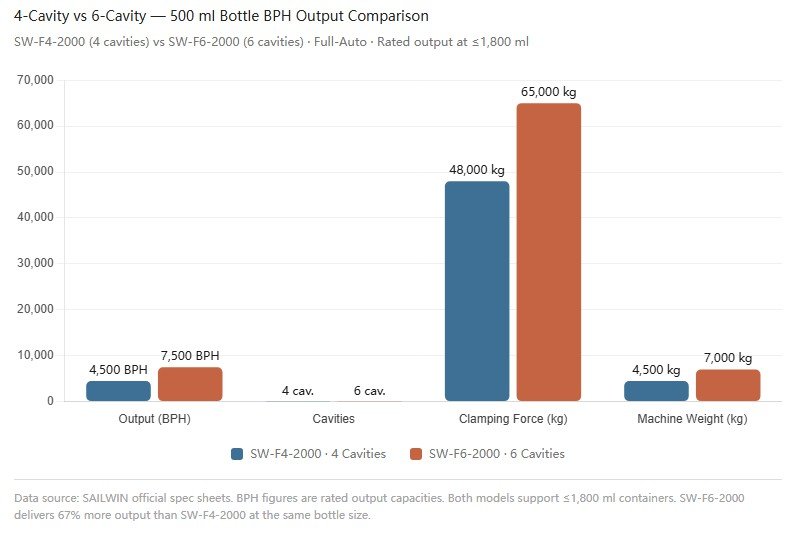
The financial case for 6-cavity vs 4-cavity rests on one question: does the incremental output of 6 cavities generate enough additional revenue to recover the higher capital cost within an acceptable payback period?
ROI Framework: 3 Variables That Determine the Answer
Variable 1 — Incremental output value
6-cavity produces approximately 50% more bottles than 4-cavity at the same operating hours. The revenue value of that incremental output depends on your selling price per bottle and your actual utilization rate (are you running at capacity, or could you run more if you had more machines?).
Variable 2 — Price premium of 6-cavity machine
The 6-cavity machine carries a higher purchase price than 4-cavity. It also carries higher mold costs (50% more mold cavities) and longer changeover downtime if you run multiple formats.
Variable 3 — Operating cost delta
6-cavity has a lower per-bottle energy cost and the same operator requirement as 4-cavity (1 operator per machine). The energy saving per bottle is a real but typically minor factor compared to the output and capital cost differential.
When 6-Cavity Has a Faster Payback Than 4-Cavity
- You are already running a 4-cavity machine at or near 100% utilization and need incremental output
- Your production is single-format with minimal changeover (the changeover cost disadvantage is minimized)
- Your bottle selling price is high enough that the incremental output revenue materially exceeds the capital cost premium within 24 months
When 4-Cavity Has Better ROI Despite Lower Output
- You run 3+ bottle formats with regular changeovers — the 6-cavity changeover time penalty compounds over a year
- You are not running at full utilization — buying more output capacity you cannot sell does not generate ROI
- Your growth trajectory is uncertain — 4-cavity protects capital while leaving room for a second machine later
- Mold investment for multiple formats: 6 mold cavities × multiple formats = significantly higher mold inventory cost
Want a custom ROI model for your production scenario? Share your monthly volume, bottle formats, shift pattern, and local energy cost — Sailwin will build a payback period comparison for both configurations.
The Hidden Cost Buyers Consistently Underestimate: Mold Changeover
The BPH and capital cost comparison is straightforward — most buyers do these calculations. The factor that consistently surprises buyers post-installation is mold changeover cost, particularly when running multiple bottle formats.
Why Changeover Cost Matters More on 6-Cavity
Mold changeover on a 6-cavity machine requires changing 6 mold units vs. 4 on a 4-cavity machine. The time difference per changeover is typically 45–90 minutes — which appears manageable in isolation. Annualized across a high-changeover operation, it becomes significant:
Example — 3 format changes per week, 50 weeks/year:
– 4-cavity changeover: 60 minutes per changeover × 150 changeovers = 150 hours/year of downtime
– 6-cavity changeover: 90 minutes per changeover × 150 changeovers = 225 hours/year of downtime
– Difference: 75 additional hours of production downtime per year
At 10,000 BPH rated output on 6-cavity: 75 hours × 10,000 × 0.85 = 637,500 bottles of lost production annually — purely from the additional changeover time. Whether this loss exceeds the output advantage of 6 cavities depends entirely on your changeover frequency and bottle selling price.
The rule: If you change formats more than twice per week, the 4-cavity changeover advantage is a real operational factor — not a theoretical one.
Mold Cost: The Specification Most Buyers Request Too Late
Mold cost is frequently treated as an afterthought in the machine purchase decision — quoted separately, after the machine price has already been committed to. This creates a distorted total cost picture.
For a PET blow molding machine producing multiple bottle formats:
- 4-cavity machine, 3 bottle formats: 3 mold sets × 4 cavities = 12 mold cavities total
- 6-cavity machine, 3 bottle formats: 3 mold sets × 6 cavities = 18 mold cavities total
The 6-cavity machine requires 50% more mold cavities for the same number of formats. If each cavity costs $X to manufacture, the 6-cavity machine’s mold investment across a 3-format operation is 50% higher than 4-cavity — a material cost that should be included in the total investment comparison, not discovered after delivery.
The correct approach: Request a combined quote for machine + mold tooling for all your bottle formats before comparing 4-cavity vs 6-cavity total investment.
Sailwin’s mold tooling is dimensionally cross-compatible across 2-cavity, 4-cavity, and 6-cavity machines — so if you start on 4-cavity and scale to 6-cavity, your mold investment from the first machine is not wasted. For all configurations, see the fully automatic PET blow molding machine range and the Sailwin blow molding machine overview.
Request a combined machine + mold quotation for your bottle formats. Sailwin provides all-in pricing for machine, mold tooling, and auxiliary equipment — so your total investment is clear before any commitment.
Request a Full Investment Quote →
Frequently Asked Questions
What is the difference between a 4-cavity and 6-cavity PET blow molding machine?
Cavity count equals the number of bottles produced per machine cycle. A 4-cavity machine produces 4 bottles per cycle; a 6-cavity machine produces 6 bottles per cycle. At the same cycle time, a 6-cavity machine produces approximately 50% more bottles per hour. The trade-offs are higher machine cost, higher mold cost per format, and longer changeover time on the 6-cavity configuration.
How many bottles per hour does a 4-cavity PET blow molding machine produce?
For standard 500ml round bottles: approximately 6,000–10,000 BPH rated output. At 85% real production efficiency, plan for 5,100–8,500 BPH sustained output. Actual output varies by bottle weight, preform quality, and ambient conditions. Always use 85% of the manufacturer’s rated BPH for capacity planning.
How many bottles per hour does a 6-cavity PET blow molding machine produce?
For standard 500ml round bottles: approximately 10,000–15,000+ BPH rated output. At 85% real production efficiency, plan for 8,500–12,750 BPH sustained output. The upper end requires optimal preform consistency, controlled ambient temperature, and minimal changeover interruption.
Is a 6-cavity machine always better than 4-cavity?
No. 6-cavity is better only when your monthly volume consistently exceeds what a 4-cavity machine can deliver, you run a stable single-format or low-changeover operation, and the incremental output revenue exceeds the additional capital and mold cost within your target payback period. For multi-format operations with frequent changeovers, 4-cavity typically delivers better total ROI — the output advantage of 6 cavities is partially offset by the changeover time penalty.
What is the monthly output of a 4-cavity vs 6-cavity machine?
Based on 2-shift operation (16 hours/day), 25 production days/month, at 85% efficiency:
4-cavity (8,000 BPH rated): approximately 2,720,000 bottles/month.
6-cavity (12,000 BPH rated): approximately 4,080,000 bottles/month.
These figures assume single-format production with standard preforms. Multi-format operations with changeover will reduce effective monthly output.
Can I upgrade molds from a 4-cavity to 6-cavity machine later?
With Sailwin machines, yes — mold tooling is cross-compatible across 2, 4, and 6-cavity machines. Your Phase 1 mold investment on a 4-cavity machine transfers to a 6-cavity machine without retooling. Always confirm this cross-compatibility in writing before purchasing from any supplier.
How long does it take to change molds on a 4-cavity vs 6-cavity machine?
Changeover time depends on operator experience, mold weight, and machine design. As a general reference: 4-cavity changeover typically takes 45–75 minutes with a trained operator; 6-cavity changeover typically takes 75–120 minutes. For operations with more than 2 format changes per week, the annual production time difference is material and should be included in the ROI calculation.
What is the PET blow molding machine price difference between 4-cavity and 6-cavity?
The 6-cavity machine carries a higher purchase price than the equivalent 4-cavity model. The exact premium depends on machine specification, component brands, and mold tooling requirements. For a direct price comparison on your specific bottle format and output requirement, request a factory-direct quotation from Sailwin — comparing prices without a specification produces numbers that cannot be verified against production requirements.
Summary: The Decision in Three Questions
Q1: Does your monthly volume exceed 3,500,000 bottles on 2 shifts?
Yes → 6-cavity is worth evaluating seriously.
No → 4-cavity is likely the correct specification.
Q2: Do you run more than 2 format changeovers per week?
Yes → Factor the changeover time penalty into your ROI model — it may reverse the 6-cavity output advantage.
No → The changeover disadvantage is minimal; output and capital cost dominate the decision.
Q3: Have you requested a combined machine + mold quote for all your formats?
No → Do this before committing. The mold cost difference between 4 and 6-cavity across multiple formats is material and changes the total investment comparison.
Sailwin manufactures 4-cavity and 6-cavity PET blow molding machines with cross-compatible mold tooling, Siemens PLC control, and CE / ISO 9001 certification. Combined machine + mold + auxiliary equipment quotations are provided as standard — so your total investment is clear before any purchase decision.
Get a 4-Cavity vs 6-Cavity Quotation for My Bottle Format →