PET blow molding machine warranty terms are the part of a quotation buyers read least and rely on most. Two suppliers can both offer “a two-year warranty” and mean completely different things, because the words that decide the cost are not the duration — they are what is covered, who pays for travel, how quickly a fault gets a response, and whether the spare part exists when you need it.
The exposure is easy to underestimate. A machine that stops is not a repair bill; it is a filling line standing idle, a customer order delayed, resin going through a dryer for nothing, and staff paid to watch a screen. The financial difference between a warranty that returns the line to production in a day and one that returns it in three weeks is usually far larger than the price difference between the two machines.
Sailwin has delivered PET stretch blow molding machines into 500+ installations across 60+ countries over 15+ years, manufacturing under ISO 9001:2015 with CE marking. Machines are FAT tested at full load before shipment, installation and commissioning on site takes 3–7 days, common wear parts ship within 48 hours, remote support is available 7×24, and the machine warranty runs for 2 years. This guide sets out what to compare line by line, which clauses decide your real cost, and how to turn after-sales terms into a selection criterion rather than a footnote.
Key Takeaways
- Duration is the least informative number in the document. Scope, labour, travel, response time and spare-part commitments decide what a fault actually costs you, and they are all negotiable at quotation stage.
- Ask for the response definitions in writing. “24-hour response” can mean a reply, a diagnosis, an engineer dispatched or an engineer on site — and only the last two stop your line losing money.
- Spare parts availability is the clause that protects production. A commitment to ship common wear parts within 48 hours, and a defined critical spares list held locally, is worth more than an extra year of coverage.
Comparing Quotations and Need the Terms in Plain Language?
Send the two offers and your production profile — Sailwin engineers return a like-for-like comparison of scope, response and spares support within 24 hours.
1. What a Warranty Covers, and What It Never Does
Most machine warranties are defect warranties, not performance guarantees. They commit to repairing or replacing a component that fails because of a manufacturing defect within a defined period. They do not commit to a cycle time, an output figure or a bottle quality level once the machine is running on your site with your tool and your material.
That distinction matters because the faults that hurt most are often not defects. A heating zone that drifts is a process issue; a bottle that fails a drop test may be a tool or resin issue; a PLC alarm that nobody on site can interpret is a training issue. A well-written agreement covers the grey area explicitly — remote diagnostic support, engineer attendance for commissioning, operator training and a defined response path — instead of leaving it to goodwill.
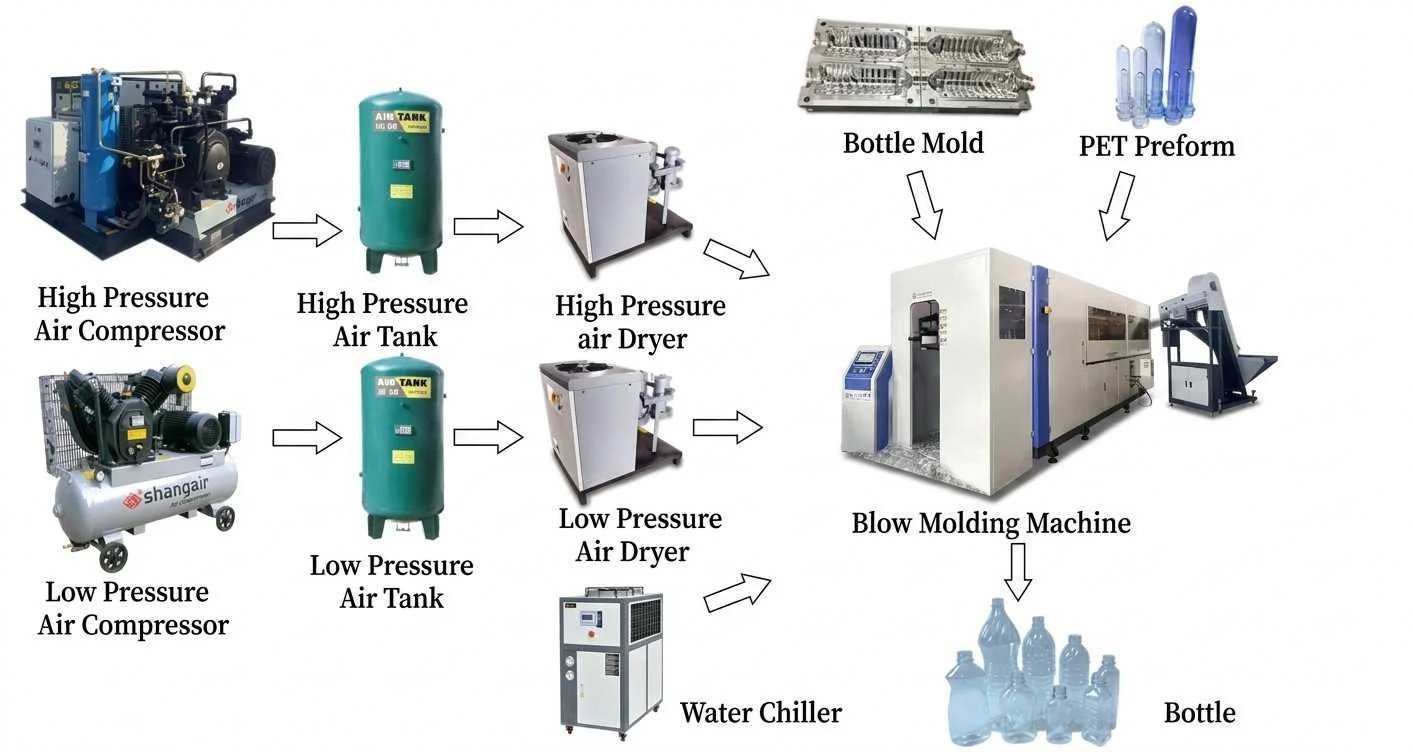
Four typical exclusions appear in almost every document, and each one is worth reading twice. Wear parts are excluded by definition, so ask for the list rather than assuming it. Damage caused by incorrect utilities — unstable voltage, wet or dirty compressed air, untreated cooling water — is excluded, which is why the utilities requirement belongs in the same file as the warranty. Unapproved spare parts and unapproved modifications void coverage. And missed maintenance usually voids coverage too, so the warranty and the maintenance schedule have to be read together.
2. Comparing Two Offers Side by Side
Put both quotations into one table and answer the same questions for each. The exercise usually changes the ranking.
| What to compare | Question to ask | Why it decides your cost |
|---|---|---|
| Period and start date | When does the clock start — shipment, arrival, or the end of commissioning? | Six weeks of shipping at the beginning of the period is coverage you paid for and never used |
| Parts, labour and travel | Are all three included, or only the part? | A free part with a chargeable engineer and flight is not a warranty, it is a discount on a component |
| Wear parts list | Which parts are excluded, and what do they cost per year? | Exclusions decide the true annual ownership cost more than the headline period does |
| Response definitions | Response means what, measured from when? | An acknowledgement is not a repair; the gap between them is your downtime |
| Spare parts commitment | Lead time for common wear parts, and for the parts that stop the line? | Availability is what converts a fault into a short stoppage instead of a long one |
| Remote diagnostics | Can the supplier read the machine’s parameters without travelling? | Most faults are diagnosed from data; travel should confirm a fix, not start an investigation |
| Training and documentation | Who trains the operators, and in what language are the manuals and the HMI? | Operators who understand the parameter screen prevent more downtime than any service contract |
One more question deserves its own line in the table even though it is not strictly a warranty term: what happens to the machine at the end of the period? A supplier who supports the machine for its working life — with documented spare parts, revision-controlled software and an upgrade path — is offering something a two-year period cannot express.
3. Response Time Is the Clause That Costs the Most
In service terms, the number that matters is mean time to repair — the total elapsed time from fault to running production. It is made of several segments, and a warranty only protects you if it addresses the slow ones.
- Detection. How quickly does your team recognise that something is wrong? Machines that log 40+ parameters in real time shorten this segment, because a trend is visible before bottles are rejected.
- Diagnosis. This is where 7×24 remote support earns its place. With access to the parameter record, a controls or process fault can often be identified the same day without anyone boarding a flight.
- Part availability. If the diagnosis ends in a part, the clock keeps running until the part arrives. A commitment to ship common wear parts within 48 hours, and a critical spares list held at the plant, are what keep this segment short.
- Attendance. Where a site visit is required, ask what the dispatch commitment is and whether travel is covered. Response clauses exclude travel far more often than buyers expect.
- Restart and verification. After the fix, parameters must be re-established and output verified. A commissioning standard of 3–7 days on site during installation sets the pattern for how quickly the machine can be returned to a validated state later.
Want the After-Sales Terms Before You Compare Price?
Send your requirement list \u2014 Sailwin engineers return coverage, response path, spare parts commitment and a factory-direct quotation within 24 hours.
4. Case Study: Two Quotations, Two Different Risks
A beverage producer compared two PET line quotations with a similar machine specification and a clear price difference, and asked the supplier of the more expensive offer to justify it in writing.
- Both quotations described a two-year warranty, but neither defined what response time meant
- No wear parts list was attached, so the annual cost of exclusions could not be estimated
- Spare parts lead times were described only as “available on request”
- Rebuild both offers into a single comparison table covering scope, labour, travel, response and spares
- Define response in stages, from acknowledgement through remote diagnosis to engineer on site
- Attach the wear parts list and price it against expected annual usage instead of treating it as an exclusion
- Ask both suppliers to state spare parts lead times for the components that stop the line
- Price the risk in downtime hours rather than in machine price alone
- The offers became comparable, because both were described in the same vocabulary of scope, response and spares
- The exclusions were priced, so the annual ownership cost replaced the headline price as the deciding number
- Negotiation moved to the clauses that matter, with the buyer asking for spare parts commitments instead of more discount
- The decision was documented, which made it defensible to management on grounds other than the purchase price
Composite scenario from machine procurement support work, with no customer-identifying detail. Commercial terms are confirmed in each written quotation.
5. Turning Warranty Terms Into a Selection Criterion
Once the terms are in a table, the machine evaluation changes. These are the points worth scoring, and the standard Sailwin supports on PET blow molding machines.
- Coverage period. A 2-year machine warranty, with the start point stated in the contract rather than assumed.
- Proof before shipment. Machines are FAT tested at full load before they leave the factory, so performance is demonstrated while access to the supplier’s engineers is easy.
- Commissioning standard. On-site installation and commissioning take 3–7 days, which sets a documented baseline for machine condition and for operator training.
- Spare parts availability. Common wear parts ship within 48 hours, and a recommended spares kit can be defined before shipment so the parts most likely to be needed are already on your shelf.
- Support channel. 7×24 remote support with access to the machine’s parameter record, so diagnosis does not depend on describing a fault over the phone.
- Component provenance. Siemens or Mitsubishi PLC, FESTO blow valves, SMC cylinders, Schneider electrical and ABB components — named parts are easier to source locally, which shortens every future repair.
- Certification and documentation. CE marking and ISO 9001:2015 manufacturing, with manuals, drawings and the parameters record handed over so the plant can operate independently.
- Delivery schedule. 30–45 days on a standard configuration and 45–60 days for a custom build, stated as a commitment rather than an intention.
Frequently Asked Questions
Get the After-Sales Terms Before You Compare Machine Prices
Send your bottle drawing, container sample or target output. Our engineering team replies with a machine recommendation, mould assessment and factory-direct quotation within 24 hours.
Related Reading:
• PET Blow Molding Machines — 2-cavity to 8-cavity models
• PET Blow Molding Machine Spare Parts List
• Shipping, Installation and Commissioning
• Operator Training for PET Lines
• PET Blow Molding Machine Buying Guide
• How Much Does a PET Blow Molding Machine Cost?