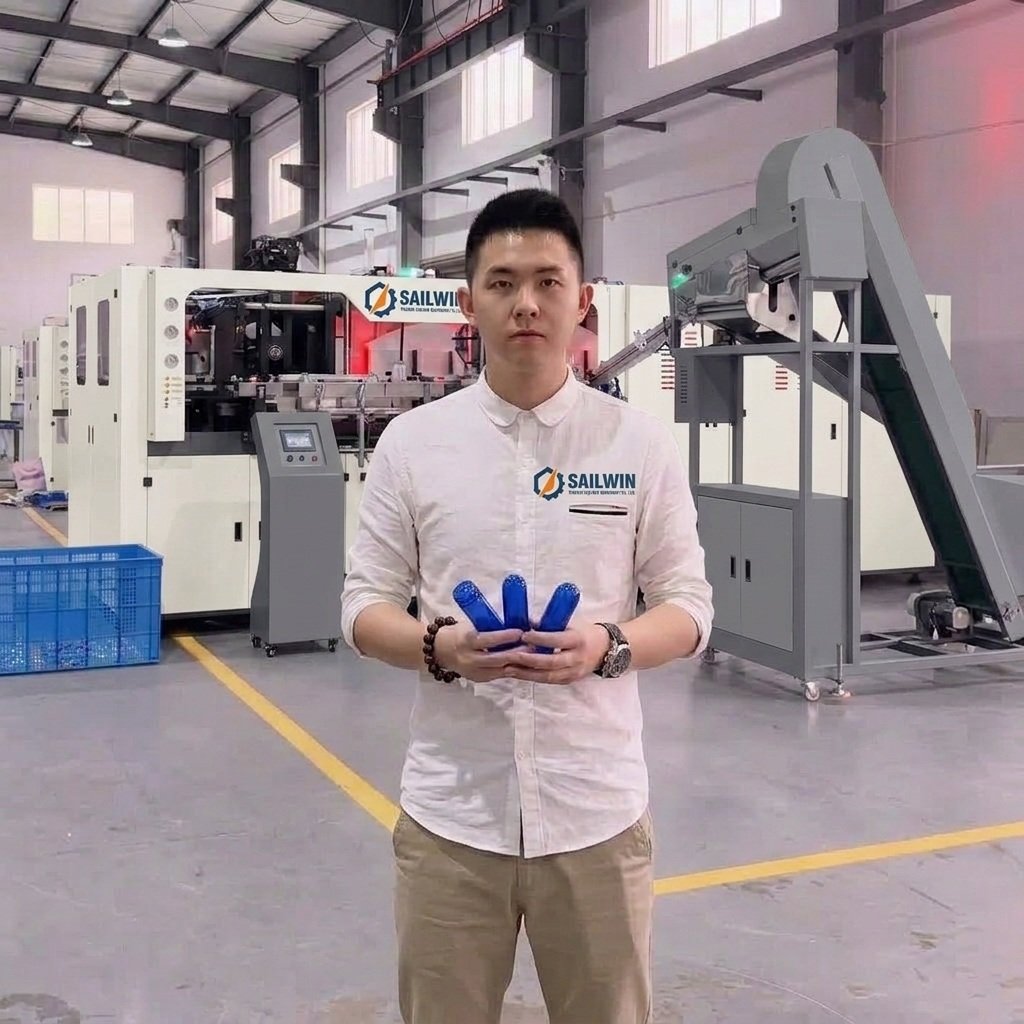
A PET blow molding machine supplier audit exists to answer one question that quotations cannot: is this company actually building the machine it is selling you? The market contains genuine manufacturers, trading companies that assemble from purchased sub-assemblies, and resellers who pass orders to a third factory. All three can produce a professional quotation with the same photographs, and the difference only becomes visible when you walk the shop floor.
The reason it matters is not snobbery about factory size. It matters because everything you will need after delivery — spare parts, technical answers, modification support, a second machine matched to the first — depends on whether the supplier controls the design and the assembly. A company that builds its own machines can tell you why a particular valve was specified. A reseller generally cannot, and when a part fails two years from now, the answer will come from a factory you have never visited.
Sailwin has delivered PET blow moulding machines into 500+ installations across 60+ countries over 15+ years, manufacturing under ISO 9001:2015 with CE marking, with named control components, full-load FAT testing before shipment, 30–45 day standard delivery (45–60 days custom), 3–7 day on-site installation and commissioning, 48-hour shipment on common wear parts, 7×24 remote support and a 2-year machine warranty. This checklist sets out the 30 points to verify on a factory visit, grouped so that a half-day audit covers them in a logical order.
Key Takeaways
- Ask to see the machine under test, not the machine on display. A completed machine running a real mould with recorded parameters is stronger evidence than any showroom unit.
- Component provenance is checkable. Named PLC, valve, cylinder and electrical brands can be verified against the bill of materials and by looking at the machines on the floor.
- The after-sales package is audited on paper, before the order. Spare parts lists with prices, warranty scope, response definitions and training scope should all exist as documents, not as verbal assurances.
Comparing Two Suppliers and Want an Independent View?
Send the quotations and the machine specifications — Sailwin engineers return a like-for-like technical comparison within 24 hours.
1. Manufacturing or Reselling: The Question the Audit Answers
Three business models appear in PET blow moulding machinery, and they are easy to confuse because all three present well. A manufacturer designs, machines, assembles and tests under one roof. An assembler buys major sub-assemblies and integrates them, which can still produce a good machine if the integration is engineered rather than merely bolted together. A reseller takes the order and places it elsewhere.
Each model has different consequences for the buyer. With a manufacturer, technical questions reach the people who designed the machine, modifications are engineering decisions, and spare parts come from a known bill of materials. With a reseller, every technical question is a round trip, and the machine you receive may differ in detail from the one you were shown. The audit below is designed to place a supplier in one of these categories within a few hours, using what you can see rather than what you are told.
2. Group A — Company Identity and Capability (Points 1–6)
Start with the legal and commercial picture, because it frames everything you will see on the floor.
- Legal entity and site ownership. Confirm the company name on the contract matches the building you are standing in. Ask whether the site is owned or leased, and whether any part of production is subcontracted.
- Years in operation, evidenced. Ask for the business licence and cross-check the registration date against the company’s claimed history. Sailwin, for reference, has 15+ years in the industry — a figure that should be verifiable, not just quotable.
- Export track record. Ask how many countries the machines have been delivered to, and request the shipping documentation pattern rather than a market list. Sailwin’s machines are installed in 60+ countries.
- Installed base. A claimed cumulative delivery figure such as 500+ machines should be supported by serial number ranges or an order book extract.
- Machine range and model list. Ask for the full model table with cavity counts and outputs. A manufacturer can produce this instantly with specifications; a reseller usually produces a partial list. Sailwin’s PET range, for example, runs from the SW-F2-650 (2-cavity, 2,800 BPH, containers up to 650 ml) to the SW-F8H-800 (8-cavity, 16,000 BPH, up to 800 ml).
- Production capacity and lead time consistency. Compare the number of machines under construction with the quoted lead time. If the shop floor holds two machines and the quote promises six units in four weeks, the arithmetic needs explaining. Sailwin quotes 30–45 days on standard configurations and 45–60 days on custom builds.
3. Group B — Machining and Fabrication (Points 7–12)
Machining capability is the single clearest dividing line between a manufacturer and everyone else. Blow moulding machines contain large, heavy, precision components, and the ability to produce them in-house changes both cost and quality control.
- CNC machining centres, running. Count them, and note whether they are producing parts or standing idle. Ask what proportion of the machine’s components originate on site.
- Large-part machining capability. Platens, mould bases and clamping frames are heavy. The equipment needed to machine them accurately is a strong indicator of genuine manufacturing depth.
- Inspection equipment and records. A coordinate measuring machine is only useful if it is used. Ask to see dimensional inspection records for a recent batch, not just the instrument.
- Frame fabrication and welding. Check weld quality on machine frames, look for jigs used to control distortion, and ask how frames are stress-relieved before machining.
- Surface treatment and painting. Look at the preparation and finishing line. Consistent finish on machines about to ship indicates a stable process rather than an ad hoc one.
- Incoming material inspection. Ask how raw castings, steel plate and purchased components are checked on arrival, and who signs them off. Traceability starts here, not at final assembly.
4. Group C — Assembly and Component Standards (Points 13–18)
Assembly is where quality becomes visible. The following checks are quick and objective, and they distinguish a disciplined builder from one that assembles to whatever the drawing loosely implies.
- Named component provenance, verified on the floor. Check what is actually fitted to machines in assembly, not to the showroom unit. Sailwin machines use Siemens or Mitsubishi PLC, FESTO blow valves, SMC cylinders, Schneider electrical components and ABB parts — these should be readable on the machine itself.
- Torque control and records. Ask whether critical fasteners are tightened to specified torque with calibrated tools, and whether records exist. Uncontrolled tightening is a leading cause of early structural problems.
- Hydraulic and pneumatic cleanliness. Look at how pipework is prepared before assembly. Flushing and cleanliness control on day one determine how many valve and cylinder problems appear in year two.
- Electrical wiring discipline. Check conductor routing, ferruling, terminal numbering and whether the wiring matches the drawings. Neat, labelled wiring is the visible signature of a controlled process.
- Safety guarding and interlocks. Confirm guards, interlocked doors and emergency stop circuits are fitted as standard and functional, and ask how the safety functions are validated before shipment.
- Alignment and geometry records. Ask for the alignment procedure for heating, blowing and clamping assemblies, and for evidence it was carried out. Alignment errors appear later as uneven heating or inconsistent bottles.
5. Group D — Testing and Validation (Points 19–24)
Testing is where a factory visit earns its cost, because a specification sheet cannot show whether a machine actually runs properly. The most important single question on any audit is simple: will you run the machine at full load with a real mould while I am here?
- Full-load FAT before shipment. Sailwin machines are FAT tested at full load before they leave the factory. Insist that your machine is tested the same way, and that you receive the record.
- A real mould, and real output. Ask to see bottles or preforms produced on the machine during the test, with the cavity count stated. Witnessing a production run and counting output is more informative than reading a rated capacity.
- Recorded process parameters. Request the parameter record from the test — heating profile, blowing pressure, cycle time and monitored values. The PLC on a Sailwin machine monitors 40+ parameters in real time, and PID control holds ±1 °C on heating zones, which makes the test record comparable with what you will run in production.
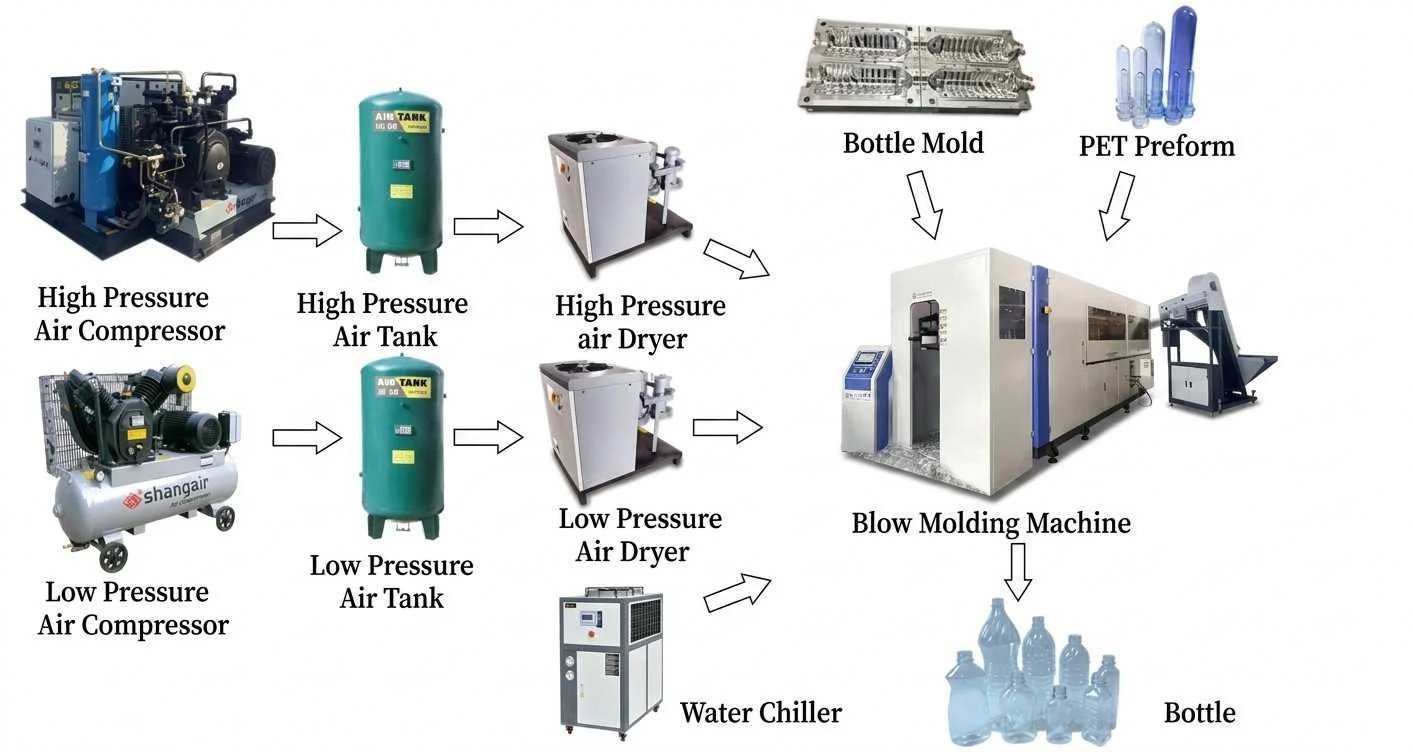
- Utility simulation. Confirm the test used representative conditions: blowing pressure in the 25–40 bar range, heating between 90–115 °C, chilled water at the temperature your plant will supply, and compressed air at the required pressure. A test run on ideal utilities hides the problems you will meet.
- Test duration. A short demonstration proves the machine starts. Ask for the duration of the run, whether it included a mould change — Sailwin machines complete a mould change in under 30 minutes — and whether alarms and interlocks were exercised.
- Defect handling during the test. Ask what was done with the parts that failed acceptance during testing. A factory that records, categorises and investigates those defects is managing quality; one that quietly discards them is not.
Ask one question twice and compare the answers. Ask how a specific sub-assembly is machined, then ask a different engineer the same question later in the visit. At a manufacturer the two answers will agree and add detail. At a reseller they will diverge, because neither person owns the design.
Want a Second Opinion on a Factory Audit Report?
Send your audit notes and the supplier’s technical offer — Sailwin engineers review the specification and identify gaps within 24 hours.
6. Group E — Documentation, Compliance and After-Sales (Points 25–30)
The final group determines what happens after the machine arrives. Every point here should be answered with a document you can keep, not with an assurance you have to remember.
- Certification. Request the CE documentation and the ISO 9001:2015 certificate, and check the certificate’s scope and validity date cover the machine you are buying. Sailwin manufactures under ISO 9001:2015 with CE marking.
- Manuals, drawings and parameter records. Ask for the operation and maintenance manual, electrical and pneumatic drawings, and the parameter record in your language. Documentation determines whether your team can operate the machine independently.
- Spare parts list with prices. Request the recommended spare parts list as a document with prices, split into commissioning spares, wear parts and critical spares. This is the single most useful document for budgeting maintenance.
- Spare parts lead time commitment. Ask for a stated lead time on common wear parts. Sailwin’s commitment is shipment within 48 hours, and asking the same question of every supplier makes the answers comparable.
- Warranty scope in writing. Confirm the period, what is covered, whether labour and travel are included, and what voids the warranty. A 2-year machine warranty is meaningful only when it is defined; the same words can mean very different obligations.
- Installation, training and support. Establish the commissioning scope, how many days are included, who trains the operators, and how support is delivered. Sailwin’s commissioning takes 3–7 days on site, with 7×24 remote support available afterwards.
Finish the visit by asking for two reference installations you can contact directly, ideally on the same machine model and producing a comparable container. A manufacturer with a substantial installed base will normally arrange this. A reseller often cannot, and that answer is itself useful information.
7. The 30-Point Audit at a Glance
| Group | Points | Evidence that satisfies the check | Red flag |
|---|---|---|---|
| A. Identity & capability | 1–6 | Registered licence matching the site; full model table with outputs; capacity that matches the quoted lead time | Vague answers on site ownership or where the machine is built |
| B. Machining & fabrication | 7–12 | CNC machines in production; dimensional inspection records; weld quality and stress-relief practice | A workshop with no large-part machining capability |
| C. Assembly standards | 13–18 | Named components visible on machines in assembly; torque records; ferruled, documented wiring | Branded parts on the showroom unit but not on machines being built |
| D. Testing & validation | 19–24 | Full-load FAT on a real mould; output counted; parameter record handed over | Unwillingness to run the machine, or a test on ideal utilities only |
| E. Documentation & after-sales | 25–30 | CE and ISO 9001:2015 certificates; priced spare parts list; defined warranty scope; contactable references | Verbal assurances with no documents, and no reference visits offered |
8. Case Study: An Audit That Changed the Decision
A bottler preparing to install a second PET line had two quotations within 8% of each other on price, both offering 4-cavity machines with comparable rated output. The supplier of the cheaper offer had a well-presented showroom and a large catalogue covering several machinery categories.
- Two quotations within 8% on price, with specifications that read almost identically
- Neither supplier had provided a spare parts list with prices or a written warranty scope
- The second line had to match the first in output and bottle format, so a specification surprise was costly
- Visit both sites with the same 30-point checklist and score each answer against evidence rather than assertion
- Ask to see a machine under FAT rather than a showroom unit, and to count output during the run
- Read component brands off machines in assembly and compare them with the quotation’s bill of materials
- Request a priced spare parts list and written warranty scope from both suppliers on the same day
- Ask the same technical question of two engineers at each supplier and compare the consistency of the answers
- One supplier could not present a machine running under test, which resolved a close price comparison in a single visit
- The component comparison produced a documented difference, rather than a discussion about brand reputation
- The spare parts list became a maintenance budget, replacing an estimate with priced line items
- The decision became defensible in writing, based on recorded observations rather than impressions
Composite scenario from machinery sourcing support work, with no customer-identifying detail. Audit findings, component specifications and commercial terms are confirmed against each supplier’s written documentation.
9. Frequently Asked Questions About Supplier Audits
Audit With a Checklist, Decide With Evidence
Send your bottle drawing, container sample or target output. Our engineering team replies with a machine recommendation, mould assessment and factory-direct quotation within 24 hours.
Related Reading:
• PET Blow Molding Machines — 2-cavity to 8-cavity models
• PET Blow Molding Machine Buying Guide
• PET Blow Molding Machine Spare Parts List
• Blow Molding Machine Warranty: What to Compare
• Shipping, Installation and Commissioning
• Operator Training for PET Lines