Most small bottling projects are quoted for the machine and financed for the plant. The filling machine is the visible purchase, and the items that actually decide whether the business works — water treatment, air, drainage, storage, the quality lab, working capital for bottles and closures, and the regulatory registration that has to be completed before the first bottle can be sold — are discovered afterwards, in sequence, at full retail price.
The consequence is a start-up that reaches the point of running bottles while it is already out of budget for the equipment needed to sell them. The line produces, but there is no working capital to hold inventory, no warehouse space to store it, and no validated water quality to defend the product. Projects that fail at this stage rarely fail on the filling machine; they fail on scope.
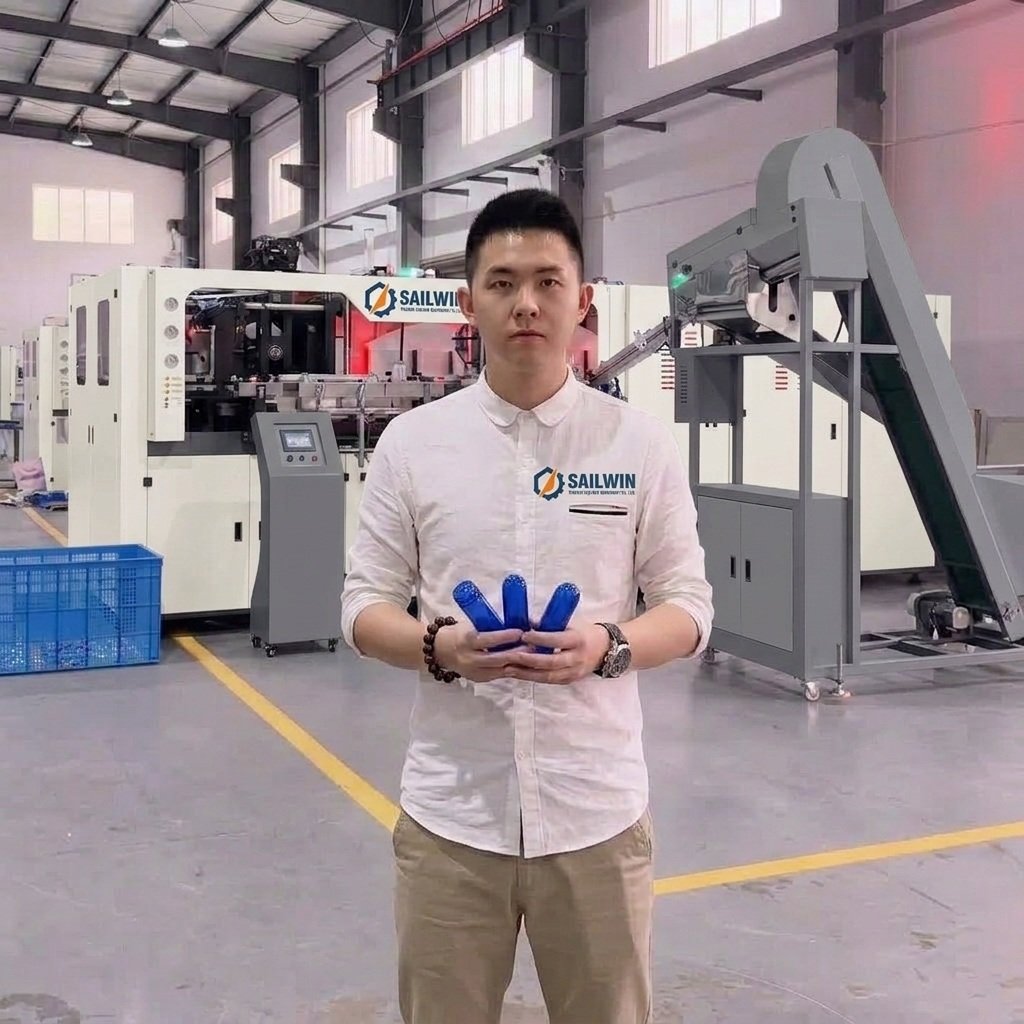
Sailwin has built filling and plastic machinery for 15+ years, with 500+ machines delivered into 60+ countries, CE marking, ISO 9001:2015 manufacturing and a 2-year whole-machine warranty. Standard lead time is 30–45 days, extending to 45–60 days for custom configurations; machines are tested at full load before shipment, installed and commissioned in 3–7 days on site, and supported with common wear parts shipped within 48 hours and remote engineering support at 7×24. This article sets out what a small bottling line actually contains, what can safely be deferred, how to choose a throughput, and how the cost structure should be read when quotes arrive.
Key Takeaways
- Budget the scope, not the machine. Water treatment, utilities, civil works, storage and working capital typically decide whether a start-up can actually sell what it produces.
- Decide whether you buy or make the container. Buying preforms or bottles lowers capital and complexity now, and leaves the option to integrate upstream later.
- Choose throughput from demand, not from aspiration. A line running far below its rated speed costs the same to own as one running at capacity, and earns less.
Plan Your Small Line Scope With Sailwin
Share your product, target market and volume expectation — Sailwin engineers return a minimum viable scope, a throughput recommendation and the sequence to expand it.
1. What a Small Bottling Line Actually Contains
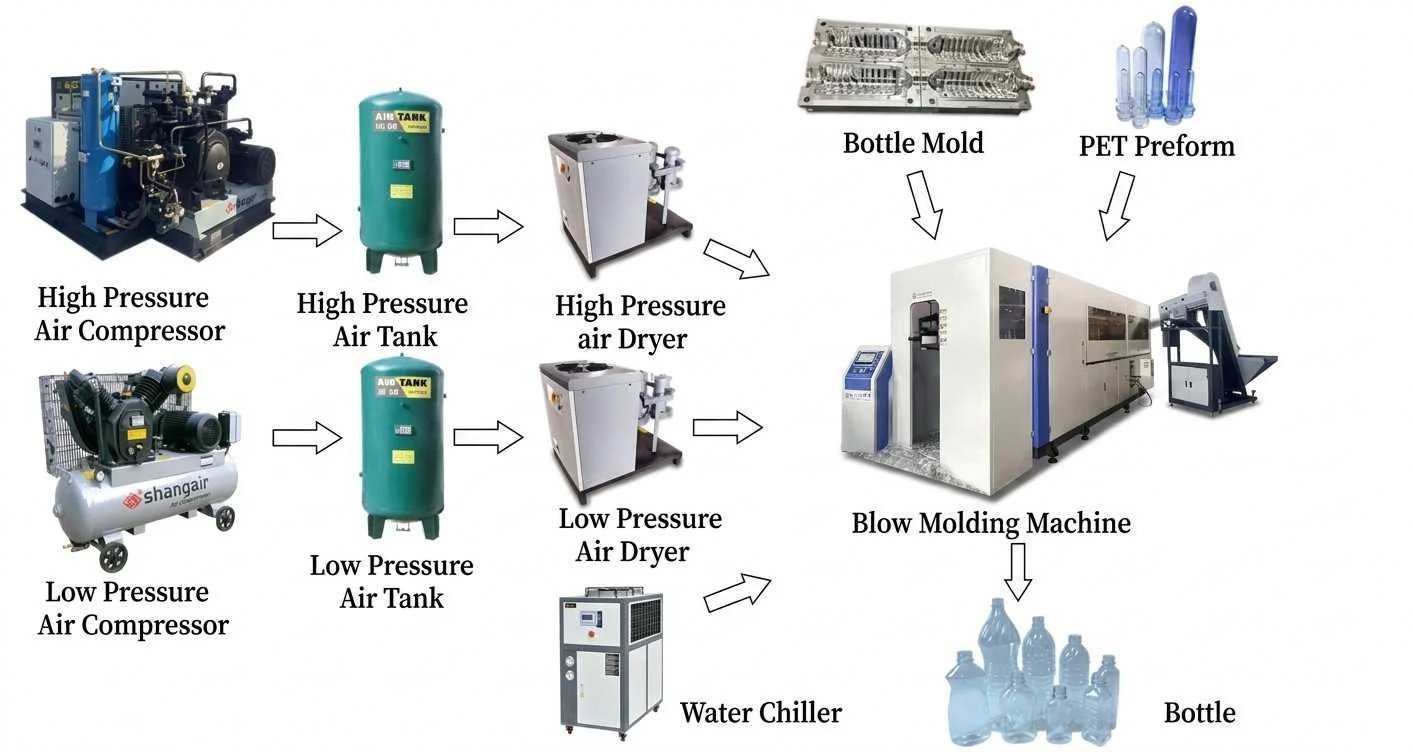
The filling machine sits in the middle of a scope that extends on both sides. Upstream there is water treatment, container supply, and the utilities that feed the process. Downstream there is capping, labelling or decoration, date coding, packing and palletising. Around all of it sit the things that are usually missing from an equipment quotation: drainage, floor loading, power capacity, compressed air, storage space and quality control.
A 3-in-1 rinse-fill-cap monobloc reduces part of this scope because rinsing, filling and capping happen inside one machine, which removes transfer conveyors and one source of contamination between stages. That is a genuine simplification for a start-up, and it is worth understanding when comparing quotes: two separate machines may look cheaper on paper and cost more once the conveyor, the transfer design and the additional hygiene controls are included.
The container side of the scope is the biggest strategic choice. Buying preforms or finished bottles means you buy a commodity and concentrate your capital on filling and selling; blow moulding your own containers means capital, floor space, energy and technical capability, in exchange for control of unit cost and design. Both are legitimate, and the right answer depends on volume, on whether your bottle is a differentiator, and on how quickly you expect to grow.
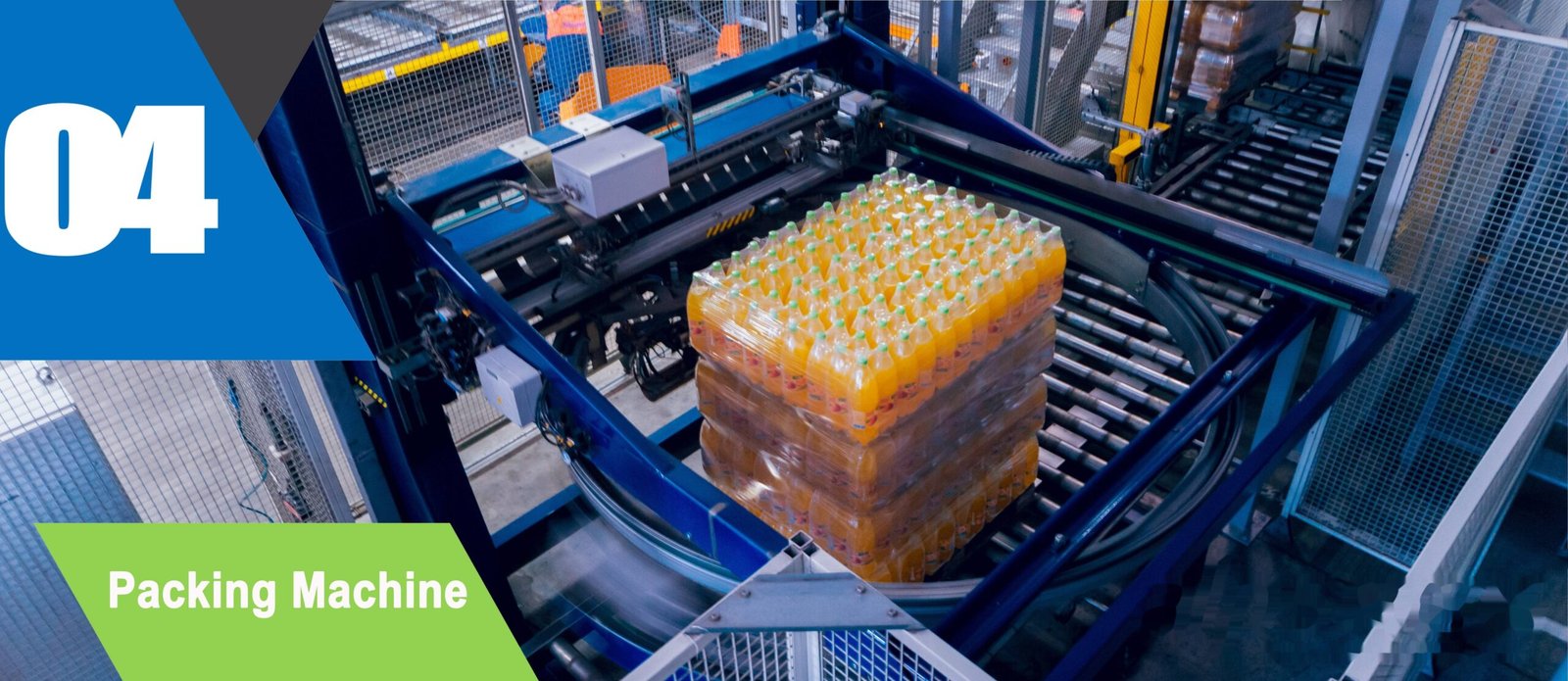
Precision Engineering & Core Components: turnkey bottling line step 04 shrink wrapping packing machine
2. Minimum Viable Scope: What You Can Defer
Deferring the wrong item is what turns a workable start-up into an unfinished project. The test is simple: can the business sell product and satisfy its regulator without this item? Anything that fails that test belongs in phase one, whatever it costs.
| Scope item | Phase | Why |
|---|---|---|
| Water treatment and quality testing | Phase one | Water is the product or touches it; without control there is no defensible quality claim or batch record |
| Filling, capping and container hygiene | Phase one | This is the core process; 3-in-1 monoblocs also consolidate the transfer and hygiene steps |
| Utilities to specification | Phase one | Power, air, water pressure and drainage; a line without stable utilities cannot hold its rated output |
| Coding, labelling and packing | Phase one, at minimum viable level | Product cannot legally or practically reach a shelf without coding and a pack |
| Working capital for containers and closures | Phase one | Minimum order quantities for bottles, preforms, caps and labels are a cash commitment, not an afterthought |
| Automatic palletising and high-speed labelling | Deferrable | Manual or semi-automatic handling is viable at low volume and can be mechanised once volume justifies it |
| In-house blow moulding | Deferrable, with a decision point | Adds capital, space and technical capability; revisit when container volume and unit-cost pressure justify it |
| Full laboratory and R&D equipment | Partly deferrable | Routine quality control is phase one; development capability can follow if external testing covers the gap |
One deferral deserves a warning. Buying containers rather than making them is genuinely sensible at the start, but it introduces dependence on minimum order quantities and lead times, and the unit cost of a purchased bottle is usually the single largest variable cost in a small plant. Review that decision on schedule rather than waiting for margin pressure to force it.
3. Choosing Throughput: Automatic, Semi-Automatic or 5-Gallon
Throughput is the decision that determines the size of everything else: the water treatment capacity, the electrical supply, the floor area, the number of people on the line and the working capital needed to keep containers and closures in stock. Choosing it from an aspiration rather than from a demand forecast is the most expensive error available to a start-up.
The practical choice is usually between a semi-automatic configuration, which suits modest volumes and keeps capital low, and a fully automatic configuration, which adds capital but reduces labour per bottle and improves consistency. Sailwin’s range covers both ends of that spectrum, from semi-automatic PET blowing at around 1,000–2,000 bottles per hour to fully automatic 8-cavity machines rated at 16,000 bottles per hour, with a dedicated 5-gallon configuration for large-format water.
| Target format and volume | Reference configuration | What it implies for scope |
|---|---|---|
| Small bottles up to 2 L, low volume | Semi-automatic PET blowing, SW-2000-2 at 1,000 BPH (up to 2 L) or SW-1500-4 at 2,000 BPH (up to 1.5 L) | Lowest capital; more manual handling; utility demand modest and easier to add incrementally |
| Small bottles, growing volume | Automatic 2- or 4-cavity, SW-F2-650 at 2,800 BPH (up to 650 ml) or SW-F4-2000 at 4,500 BPH (up to 1,800 ml) | Higher capital and a real utility specification; labour per bottle falls sharply |
| 6–10 L containers | Semi-automatic SW-880-6L at 1,000 BPH (up to 6 L) or SW-10L-2 at 1,200 BPH (up to 10 L) | Container handling becomes the constraint; plan for filling accuracy across a heavier range |
| 5-gallon water, up to 25 L | SW-5G at 100–200 BPH (up to 25 L), with a matching 5-gallon filling line | Container washing and returnable-container logistics dominate; a different business model from single-use bottles |
| Large containers and industrial packaging | Extrusion blow moulding from 0.5 L to 1000 L, for example SW-S30L at 600/h (up to 30 L) or SW-S60L at 450/h | Different technology and different skill set; container design becomes a competitive asset |
Use the table as a starting point for a conversation with the demand forecast, not as a specification. The useful question is not which machine is best but how many hours per day the plant intends to run and how much of that output it can already sell. A machine running two shifts at half its rated speed is a different business from one running one shift at full speed, and the difference is rarely in the equipment.
4. The Cost Structure: Four Blocks to Read in Every Quote
Quotations for bottling equipment are difficult to compare because they rarely cover the same scope. The way to read them is to break every figure into four blocks and ask which items sit inside each. Prices vary by configuration, capacity, materials and market, so the useful exercise is not a target number but a complete structure that nothing important is missing from.
| Block | What drives it | Common omission in a first budget |
|---|---|---|
| Capital scope | Filling and capping, container forming if in scope, water treatment, coding, labelling, packing, conveyor | Water treatment, coding and packing; installation and commissioning days |
| Site and infrastructure | Floor loading and drainage, electrical capacity and panel, compressed air, steam, chiller, warehouse space | Utility upgrades and drainage; the cost of connecting a machine is rarely in the machine price |
| Working capital | Containers or preforms, closures, labels, finished goods inventory, receivables terms | Minimum order quantities and the cash tied up in stock while customers pay on terms |
| Operating cost | Resin or purchased containers, energy and utilities, labour, maintenance and spares, quality testing | Maintenance and spares budget, and the cost of quality testing once volume starts |
A start-up runs out of money on scope, not on equipment. The filling machine is the item that gets priced; the items that get forgotten are the ones that decide whether the first bottle can be sold.
5. Case Study: A First Line Budgeted From the Machine Price
A new water bottling business built its investment plan around filling equipment and discovered that water treatment, utilities and container minimum order quantities consumed the remainder of its budget before production stabilised.
- Budget built from filling equipment plus building works, with treatment and utilities assumed to be minor
- Container and closure minimum order quantities not included in the cash plan
- No allowance for routine quality testing, which became mandatory before the first commercial batch
- Full scope map built around four cost blocks — capital, site and infrastructure, working capital, operating
- Scope split into a minimum viable phase one and an explicitly deferred phase two
- Throughput chosen from a demand forecast rather than from the largest machine the budget appeared to allow
- Phase one became sellable rather than merely operational, with treatment and testing inside it
- Working capital planned alongside capital expenditure instead of being discovered at start-up
- Expansion path defined in advance, so phase two equipment could be added without reworking utilities
Scenario based on a Sailwin customer project; site-specific figures available on request during engineering review.
6. Planning the Investment Sequence
A start-up line is easier to build when the sequence is decided before the first order. Sailwin quotations typically carry a standard lead time of 30–45 days, extending to 45–60 days for custom configurations, with full-load testing before shipment and installation and commissioning completed in 3–7 days on site. Knowing that cadence matters, because it determines how much site work has to be finished before the machine arrives.
- Start from the regulatory and market requirements. What the product must be tested for and how it must be labelled determines the minimum scope, and it is easier to design around than to retrofit.
- Decide buy or make for the container. This single decision changes capital, floor space, labour and utility demand, and it should be revisited on a schedule rather than under margin pressure.
- Set throughput from sellable volume. Choose the smallest configuration that covers the demand forecast with realistic shift patterns, then plan the upgrade path.
- Size utilities for the whole scope, including phase two. Electrical capacity, drainage and compressed air are far cheaper to install once than twice.
- Model working capital separately from capital expenditure. Containers, closures, labels and finished goods are cash, and customers pay on terms.
- Plan spares and support before start-up. Common wear parts ship within 48 hours and remote engineering support runs 7×24, but the first order of wear parts should be placed with the machine, not after the first failure.
- Use the acceptance test as a training exercise. Commissioning lasts 3–7 days, and the operators who will run the line should be present for it.
Sailwin supports first-time buyers with equipment from semi-automatic PET blowing at the lower end through to fully automatic high-cavity machines, filling lines including 3-in-1 monoblocs, hot fill, isobaric and 5-gallon configurations, and extrusion blow moulding from 0.5 L to 1000 L. Equipment carries CE marking, ISO 9001:2015 manufacturing and a 2-year whole-machine warranty. The useful first step is a scope discussion before a machine discussion, because the machine is the easiest part of the project to get right.
Start With a Scope Review, Not a Machine Quote
Send your product, target market, expected volume and available site data — Sailwin engineers return a minimum viable scope, throughput recommendation and expansion path.
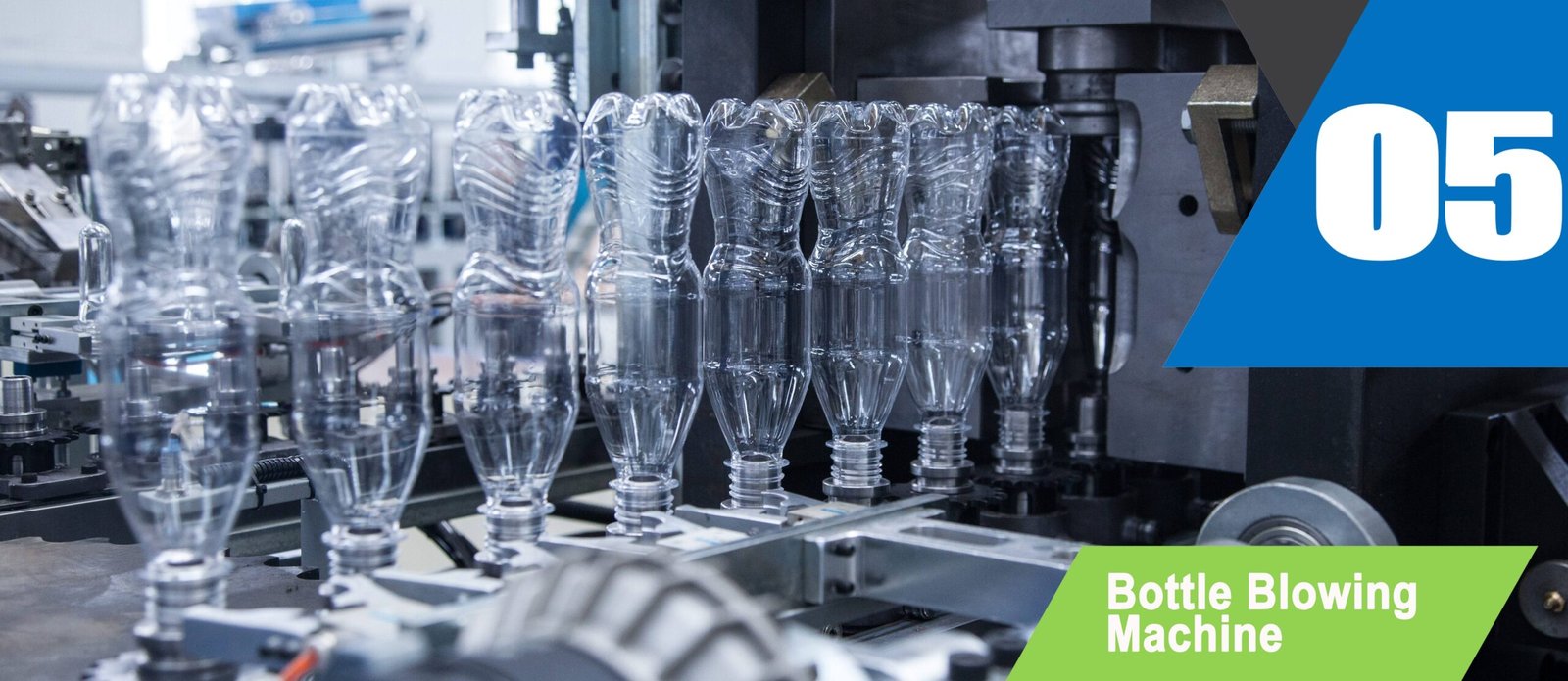
Industrial Machinery Assembly & Workshop: turnkey bottling line step 05 automatic bottle blowing machine
7. Frequently Asked Questions
Budget the Scope, Not Just the Machine
Send your bottle drawing, container sample or target output. Our engineering team replies with a machine recommendation, mould assessment and factory-direct quotation within 24 hours.
Related Reading:
• Filling Machines: Monobloc, Isobaric, Hot Fill and 5-Gallon Lines
• Liquid Filling Machine Cost Guide
• Gravity vs Piston vs Flowmeter Filling
• Filling Line Layout Design
• 5-Gallon Water Filling Lines
• Utilities for a Bottling Line: Steam, Air, Water and Power